



Market Overview
Digital assets experienced another challenging week but also achieved key institutional milestones including tokenised fund approval, institutional ETF holdings and tokenisation initiatives.
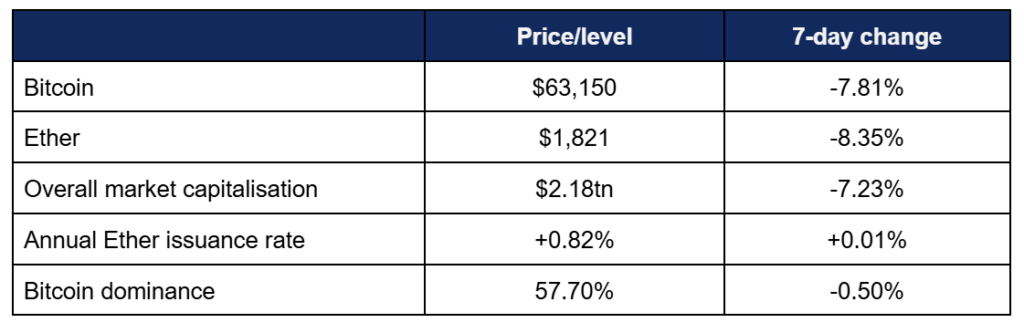
- Bitcoin declined as the current crypto winter grew colder, leaving it on trend for its worst month since the 2022 bear market
- Bitcoin actually performed relatively steadily throughout the majority of the week, trading between $66,500 and $68,000 between Tuesday and Sunday, before large-scale macro-led liquidations dropped it below $65,000 in early Monday trading
- Bitcoin peaked over the weekend, hitting $68,630 on Saturday, before hitting lows of $62,800 in early Tuesday trading, its lowest levels since the first week of February
- Bloomberg noted that many crypto hedge funds have switched holdings into cash as they hedge and look for signs of broader market recovery
- Ether peaked much earlier in the week, hitting $2,027 on Wednesday, before declining alongside Bitcoin to a low of $1,815 earlier today
- Investor sentiment on the Fear & Greed index remains rooted at historic lows of “extreme fear”, currently registering 11/100
- Overall market capitalisation reached an intraweek high of $2.35tn on Saturday, before pulling back to current levels
- According to industry monitoring site DeFi Llama, total value locked in DeFi dropped around $6bn, to $90.5bn
Digital assets saw a series of institutional milestones this week despite the week’s market volatility, including sovereign wealth fund and bank Bitcoin ETF holdings disclosures, WisdomTree’s tokenised fund approval, Dubai real-estate tokenisation plans and a reported bitcoin-backed sale.
ETF News
What Happened?
- Digital asset investment products recorded their fifth consecutive week of outflows, bringing year-to-date figures to around $4bn
- According to Coinshares data published on Monday, the trading week ending Friday the 20th experienced $288m total outflows, up around $100m from the week before
- In a continuation of recent trends, the US market was responsible for the vast majority of outflows, whilst Canadian and European products (particularly in Germany and Switzerland) registered inflows
- Similarly, several altcoin ETFs (including Chainlink, Solana, and XRP) registered (modest) inflows despite the recent downward trend for Bitcoin and Ether funds
- Coinshares Head of Research James Butterfill notes the recent rangebound trading of major assets has had an effect, as “growing investor apathy” led to the lowest trading volumes since July
- Spot Bitcoin ETFs underscored these lowered trading volumes, as three days of low nine-figure ($105m-$166m) outflows were followed by one day of high eight-figure inflows
- The $88m inflows on Friday included $65m from BlackRock’s IBIT, by far the week’s most positive performance by an ETF
- Although they posted lower overall inflows, Grayscale’s 0.15% fee mini-ETF and Fidelity’s FBTC exhibited more consistent positivity, as they both posted multiple days of inflows compared to IBIT’s one
- IBIT led the way for outflows, surrendering $164m on Thursday, and accounting for an absolute majority of all the daily outflows
- Bloomberg’s chief ETF analyst Eric Balchunas once again considered the wider context of Bitcoin ETFs when commenting on recent performance, tweeting that “Bitcoin ETFs’ cumulative net inflows (the most important number) peaked at +$63bn in October. Today it’s +$53bn. That’s NET NET +$53bn in only two years. Our (more bullish than most of our peers) prediction was $5-15b in first year. This is important context to consider when looking/writing about the $8bn in outflows since 45% decline and/or the relationship between Bitcoin and Wall Street, which has been overwhelmingly positive”
- Spot Ether ETFs posted smaller overall outflows, beginning the week with $49m inflows before two days of outflows (topping out at $130m) and a rarely-spotted day of net zero overall flows
- BlackRock’s ETHA, Fidelity’s FETH, and Grayscale’s produced the week’s best daily performances, each adding between $11m and $23m on Monday
- ETHA suffered by far the largest outflows, as it shed $96m on Thursday
- In other category news, staking ETFs for the altcoin SUI went live, reflecting the further diversification of the crypto ETF complex
- WisdomTree secured regulatory approval for intraday trading in its tokenised Treasury Money Market Digital Fund.
- Recent SEC 13F filings also gave fresh insight into holders of crypto ETFs, with some interesting reports emerging
- Abu Dhabi’s Mubadala sovereign wealth fund added significantly to its Bitcoin ETF holdings during the market downturn
- Mubadala increased its holdings by 46% in Q4 2025, bringing total IBIT holdings above $1bn
- Abu Dhabi Investment Council also increased its exposure, commenting that it sees Bitcoin “as a store of value similar to gold”
- Italy’s largest bank, Intesa Sanpaolo, confirmed $96m of Bitcoin holdings across five separate ETFs, led by ARK Invest’s ARKBI
- In Hong Kong, a new shell company called Laurore Ltd filed an IBIT position of $436m
- According to industry publication Coindesk, a spokesperson said “Our principal prefers to keep a low profile, and this position [in IBIT] is simply a reflection of their personal investment conviction”
- Registry filings indicate the owner to be a Mainland China passport owner, using Hong Kong as a means for crypto exposure during the mainland’s continued trading ban
- CME Group moved to increase trading hours for crypto options to (near) 24/7, echoing the market structure of the underlying assets
- According to a group statement, “The contracts will trade continuously on CME’s Globex platform as of May 29, with at least a two-hour weekly maintenance window over the weekend, subject to regulatory review”
Crypto Treasury news
What Happened?
- Leading treasury firm Strategy added to its holdings yet further this week, buying around $40m worth at an average price just above $67,200
- The bulk of this was financed once again by the sale of common stock, although Strategy is currently pitching preferred shares
- Chairman and founder Michael Saylor spoke to FOX Business this week, and acknowledged challenging current conditions but maintained long-term conviction
- “We are in a crypto winter… a much milder winter [than previous bear markets]… [which] will be shorter than previous winters”
- He maintained this bullish outlook on X (formerly Twitter), where he added “spring is coming”
- Leading Ether treasury firm BitMine also increased its reserves, adding over 51,000 Ether to take its share of total circulating supply to 3.66%
- In a weekly statement, chairman Thomas Lee echoed Saylor’s statements and claimed the market is experiencing “a mini crypto winter”
- However, he added that “Bitmine has been steadily buying Ethereum, as we view this pullback as attractive, given the strengthening fundamentals. In our view, the price of Ether is not reflective of the high utility of Ether and its role as the future of finance”
What happened: Trump-led “Board of Peace” considers stablecoin for Gaza
How is this significant?
- A Financial Times article this week claimed that president Trump “is exploring the creation of a dollar-pegged stablecoin for Gaza”
- The initiative would be overseen by his recently-created international “Board of Peace”, according to five sources consulted by the FT
- Access to physical cash has become limited in Gaza due to destruction and tight border controls by Israel; conditions which can be addressed by the borderless and digital nature of blockchain
- The talks currently remain in the “preliminary stages” according to reports, and “will not be a ‘Gaza Coin’ or a new Palestinian currency, but a means to allow Gazans to transact digitally”
- Such a coin would also go some way towards reinforcing US Dollar hegemony as an international unit of exchange; a cited benefit of stablecoin adoption amongst several in the current American administration
- However, technology site Gizmodo notes that digital transactions come with their own challenges in Gaza, where residents are currently limited to unreliable 2G mobile internet connections, several steps below the current 5G standard
- Israeli tech entrepreneur Liran Tancman is believed to be heading the initiative, and pledges improved internet infrastructure to support it, stating “The NCAG (National Committee for the Administration of Gaza) is building a secure digital backbone, an open platform, enabling e-payments, financial services, e-learning, and healthcare with user control over data”
- In other stablecoin news, Standard Chartered predicted that stablecoins could reach a $2tn market capitalisation by 2028; up from around $300bn now
- The bank believes this could generate up to $1tn in new T-bill demand, as stablecoin firms seek highly-liquid assets to back their issuances
- Research chief Geoff Kendrick believes “Stablecoin issuers are becoming the biggest buyers of US T-bills”, and that they could foster $0.9tn of excess demand versus current issuance trendlines
What happened: Digital asset firm sells nearly $200m of Bitcoin-backed bonds
How is this significant?
- After last week’s news about HSBC issuing digital government gilts, the trend of blockchain bonds continued this week as crypto firm Ledn sold “$188m of securitised bonds backed by Bitcoin” this week
- Bloomberg noted that TradFi firm Jefferies acted as structuring agent and bookrunner on the deal, and that it represents a first in the asset-backed debt market
- Sources said that “The deal comprises two bonds, including an investment-grade portion that priced at a spread of 335 basis points over the benchmark rate”
- The bonds are secured by thousands of Ledn customers using their Bitcoin as collateral on loans
- S&P noted that “the lender [Ledn] uses algorithmic liquidation to sell its Bitcoin collateral when a loan default is triggered”, thus helping insulate ABS investors from the asset’s (relative) volatility
- In other news around bonds and tokenisation, Japanese financial giant SBI Holdings “is launching its first blockchain-based bond aimed at individual investors, a 10bn Yen (~$64.5m) issuance that combines traditional fixed-income features with blockchain settlement and crypto perks”
- The three-year bonds will pay interest semi-annually, and can also receive rewards in the form of XRP tokens
- Bonds will trade on the Osaka stock exchange’s START system, and reflects a long-standing collaboration with (and partial ownership of) Ripple, the developers of the XRP token and its XRP Ledger blockchain
- Figure Technology Solutions is debuting a new class of tokenised stocks in the firm; the FGRD token issued on the firm’s own OPEN (Onchain Public Equity Network) blockchain
- Company chairman (and former SoFi CEO) Mike Cagney told Coindesk “Public equity still runs on decades-old market plumbing, and it simply doesn’t make sense anymore. By issuing FGRD natively onchain, we’re re-architecting the core infrastructure of capital markets to be real-time, transparent, and programmable, while removing layers of intermediaries that add cost, risk, and friction”
What happened: Digital asset firms approved for federal bank charters
How is this significant?
- Whilst the US Congress attempts to push ahead with the CLARITY market structure bill, several firms in the digital asset sector gained greater regulatory approval this week
- Exchange Crypto.com announced it had won conditional approval from the Office of the Comptroller of the Currency for a national trust bank charter
- The company said it will use this charter to “offer services like staking and trade settlement”
- Company CEO Kris Marszalek commented “This conditional approval is the latest testament to both our commitment to compliance and to providing customers trusted and secure services they expect from Crypto.com”
- Bridge, the stablecoin arm of payments processor Stripe, similarly received conditional approval for a national trust bank charter
- This builds on last year’s passage of the GENIUS stablecoin act, and in a press release the company claimed its charter “will enable Bridge to operate stablecoin products and services under direct federal oversight, a critical step in enabling businesses everywhere to build safely on top of these exciting new rails”
- This makes the two just the latest among a crypto cohort to receive (conditional) charters; in December five firms were granted similar approval
- These included XRP developers Ripple, stablecoin issuers Circle and Paxos, and the digital asset arm of TradFi giant Fidelity
- At the time Comptroller of the Currency Jonathan Gould stated “New entrants into the federal banking sector are good for consumers, the banking industry and the economy. They provide access to new products, services and sources of credit, and ensure a dynamic, competitive and diverse banking system”
What happened: Goldman Sachs CEO discloses crypto holdings
How is this significant?
- Goldman Sachs CEO David Solomon became the latest former sceptic to make a public about-turn on digital assets this week, revealing that his personal portfolio now includes crypto
- Speaking at the World Liberty Financial Forum (a crypto summit organised by the Trump-linked DeFi firm of the same name), Solomon said he was “not a great Bitcoin prognosticator”, but does hold a “limited amount” of the asset, describing himself mostly as an “observer”
- He also used the Mar-a-Lago setting of the summit to stress the importance of “codifying a rule-based system… for how crypto and related financial instruments will operate in the US”
- Solomon stated “As an American, I think it is very important that as we put legislation in place, we get it right for the long term… Our banking system is unique, and our banking system needs to coexist with this technological innovation”
- He added that Goldman is currently “super-interested” in crypto business, though he described it as still just a small part of the bank’s overall offering
- “We obviously are doing a bunch of things around digitisation and tokenisation. We touch all that stuff… We have clients, our clients have needs, we’re here to serve our clients”
- Other attendees at the summit included Binance founder Changpeng Zhao (making his first US appearance since being pardoned by President Trump), representatives from FIFA, and Franklin Templeton CEO Jenny Johnson
What happened: Dubai advances real estate tokenisation project
How is this significant?
- The UAE continued its push to become a digital asset hub this week, as the Dubai Land Authority and tokenisation firm Ctrl Alt announced a secondary market for real-estate backed tokens
- The market will launch with a relatively modest $5m worth of tokenised property, but represents the latest step in a grand vision to tokenised $16bn of property by 2033
- This would represent 7% of the overall Dubai real estate market
- The new property tokens are only available for trading within a controlled market environment, and are recorded on XRP’s Ledger blockchain, secured by Ripple Custody
- Speaking at the World Liberty Financial Forum, real estate billionaire Barry Sternlicht said his company (owning $125bn of properties) was ready to do the same in the US – as soon as regulation allows
- Sternlicht said “We want to do it right now and we’re ready. It’s ridiculous that our clients can’t do it in token”
- He added that the broader public has yet to grasp the benefits of tokenisation in the same way as other technological advances like A.I. “This is even earlier in the physical world than AI is…. It’s exciting as can be. It’s a fantastic thing for the world, the world just has to catch up with it”
- In other real-world asset (RWA) news, South Korean financial giant Hanwha Securities made a significant investment in digital asset wallet infrastructure firm Kresus
- This includes further development of Kresus’ institutional tokenisation framework, and representatives said Hanwha “plans to use Kresus’ technology to enhance its client-facing digital asset services and to develop tokenised versions of traditional financial products”
- Hanwha had a busy week in digital assets, also entering into a strategic partnership with JitoSOL “to develop infrastructure for liquidity staking exchange-traded products (ETPs) in the country”
- This partnership is based on JitoSOL’s liquid staking tokens within the Solana blockchain, providing a dual-yield opportunity to investors
- Hanwha VP Choi Young-jin claimed “JitoSOL is an innovative asset that simultaneously provides high returns and liquidity. It will become an attractive alternative asset for retirement pension investors seeking to diversify their portfolios”
What happened: France sells national data centre to Bitcoin mining firm
How is this significant?
- The French government this week signed off on a deal to sell a massive state-owned EDF (Electricite de France) data centre to Bitcoin mining firm MARA Holdings – with a few specific conditions attached
- Under the terms of the deal, MARA Holdings will acquire a 64% stake in Exaion for $168m, but EDF will retain a minority share and client status, and French firm NJJ Capital will secure a 10% stake in order to protect national interests
- Exaion’s board of directors will also include representatives from the above three firms
- The deal was first announced in August, but underwent a thorough government-led due diligence process, as Exaion’s high-performance digital computing infrastructure was deemed potentially sensitive for foreign control
- French finance minister Roland Lescure stated “In this operation, the State is advancing on two fronts: we are confirming France’s attractiveness for international investment, while ensuring uncompromising protection of our strategic interests and our technological sovereignty”
- MARA Holdings is currently the largest public Bitcoin miner in the world, and this new acquisition looks set to increase their production capacity yet further
This weekly financial roundup is for informational purposes only and is not financial, investment, or legal advice. Information is based on public sources as of publication and may change. Consult a professional before acting.