



Market Overview
Digital assets encountered significant volatility during weekend trading, as the 24/7/365 nature of crypto markets left them exposed to escalating geopolitical tensions.
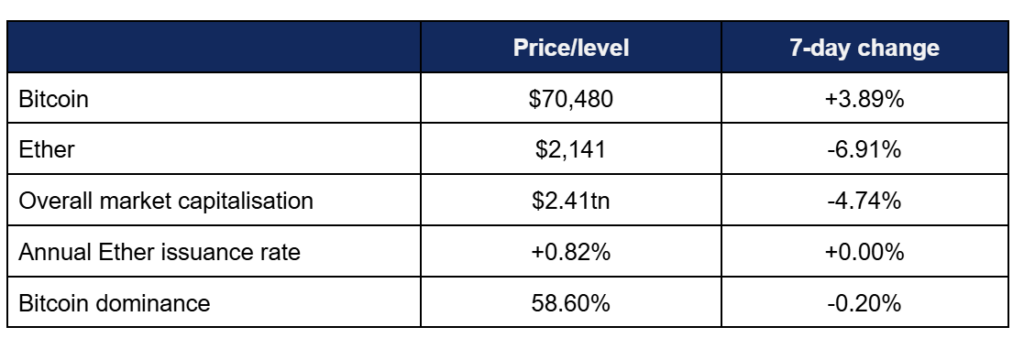
- Digital assets pulled back from last week’s strong growth after tension escalated dramatically between USA and Iran
- The crypto market proved particularly prone to the fallout from these rising tensions, as the rhetoric came over the weekend, as traditional markets are closed, but digital assets trade 24/7/365
- This was compounded by expectations of continued inflation and a more hawkish Fed, following the latest FOMC meeting
- Digital assets did recover somewhat on Monday as President Trump came out with new statements suggesting possible negotiations and compromises, returning Bitcoin from below $68,000 to current levels back above $70,000
- Bitcoin peaked at $74,890 on Wednesday, steadily declining throughout the rest of the week before a steep drop-off to a Sunday low of $67,410 as geopolitical tensions increased
- Ether broadly matched Bitcoin’s movements, with a Tuesday high of $2,353 and a Sunday low of $2,028
- Overall market capitalisation rallied from weekly lows of $2.33tn to current levels
- According to industry monitoring site DeFi Llama, total value locked in DeFi dropped by $5bn, to $95.4bn
Digital assets saw sharp swings as 24/7 trading captured market shifts whilst traditional markets were closed. Blackrock’s CEO Larry Fink highlighted digital assets’ promise and the potential of tokenisation. EY’s 2026 survey shows institutional appetite is continuing to grow cautiously regardless of price spikes.
ETF News
What Happened?
- Digital asset investment products logged a fourth week of inflows, albeit at more modest levels than the last month
- According to Coinshares data published on Monday, the trading week ending Friday the 20th registered an overall $230m inflows
- This included a significant reversal in momentum with $405m in post-FOMC outflows due to renewed inflation concerns from the Fed
- Coinshares Head of Research James Butterfill wrote “the more likely cause is the market’s ‘hawkish pause’ interpretation of the US Federal Reserve’s Wednesday meeting. The intra-week data supports this; inflows were strong in the first two days, totalling US$635m, before reversing sharply in the wake of the FOMC meeting, with US$405m in outflows—moderated noticeably by Friday”
- Spot Bitcoin ETFs opened the week with two days of identical nine-figure inflows ($199.4m exactly), followed by three days of outflows declining from $164m to $52m
- As has often proved the case, BlackRock’s IBIT led the way, with inflows of $139m and $169m
- Fidelity’s FBIT posted the next-best performance, adding $65m on Monday
- These two leading funds were also responsible for the largest daily outflows, led by FBIT on Wednesday at $104m
- Spot Ether ETFs displayed the same pattern, opening with two days of inflows followed by three reversals
- BlackRock also dominated here, as BlackRock’s ETHA posted the largest inflows ($82m) and outflows ($102m), whilst its new ETHB staked Ether ETF was the only fund to return inflows every single day
- In other ETF news, Morgan Stanley filed an S-1 registration form for its proposed Bitcoin Trust ETF, under the MSBT ticker, building on its initial application from January
- Elsewhere, CoinShares filed for a new Bitcoin volatility ETF, seeking to capitalise on the potential swings available from the world’s largest digital asset
Crypto Treasury news
What Happened?
- Leading treasury firm Strategy bought more Bitcoin, albeit at lower levels than in the last weeks
- It purchased 1,031 Bitcoin for $77m, bringing its total holdings to 762,099 Bitcoin
- Although its buys were relatively modest, there was significant news which could inform its future purchase policy; Strategy unveiled a new $42bn plan for Bitcoin acquisition
- According to an SEC filing, it is split between $21bn of Class A common stock and $21bn of perpetual stretch preferred stock
- Leading Ether treasury firm BitMine added 65,341 Ether in the last week, as chairman Thomas Lee commented “As many have noticed, crypto and particularly ETH have outperformed the broader market since the Iran war commenced, with ETH rising 18% and outperforming equities by 2,450bp. Crypto is demonstrating itself to be a good ‘war time’ store of value. Bitmine has maintained the increased pace of Ether buys in each of the past three weeks, as our base case is that it is in the final stages of the mini-crypto winter”
- Finally, Trump-linked mining firm American Bitcoin increased its holdings to 6,899 Bitcoin, making it the 16th-largest holder of the asset
- Industry publication Coindesk noted that, unlike several other miners who are pivoting their computational power towards A.I., American Bitcoin is increasing its efforts in the space, purchasing over 11,000 ASIC miners in March
What happened: BlackRock CEO promotes digital assets in annual investor letter
How is this significant?
- Blackrock’s CEO, Larry Fink, once again used his annual letter to BlackRock investors in order to promote a wide range of strategic visions and priorities, including digital assets and tokenisation
- He wrote “half the world’s population carries a digital wallet on their phone. Imagine if that same digital wallet could also let you invest in a broad mix of companies for the long term – as easily as sending a payment”
- In particular, he rallied behind the concept of tokenisation, saying “tokenisation could help accelerate that future by updating the plumbing of the financial system – making investments easier to issue, easier to trade, and easier to access”
- Fink argued that digital assets, blockchain, and tokenisation could be key to democratisation of market access
- He claimed “Expanding access to that [capitalist market] system – through better technology and financial education – could help more people share in economic growth… the same technological advances could also help bring greater transparency and potentially broader access to parts of the private markets – areas like infrastructure and private credit that have traditionally been out of reach for most individual investors”
- Fink also noted that “We’re seeing significant momentum across our premium growth categories, like active ETFs, digital assets, and international markets”
- He also wrote “BlackRock is also actively building in exciting newer technologies in financial markets, including digital assets and tokenised funds. Today, there’s very little access to traditional investment products in digital wallets. We plan to lead the charge in changing that. BlackRock has already established early leadership in bringing institutional-quality products to the digital markets at scale, with nearly $150bn in AUM connected to digital assets”
- This builds on many previous statements in support of tokenisation from Fink, including an op-ed in The Economist last year
- It also followed on just a week after Goldman Sachs acknowledged crypto assets for the first time in its annual investor letter (albeit framed as highly-speculative assets)
- In other tokenisation news, Europe’s largest asset manager, Amundi, debuted its first tokenised on the Ethereum and Stellar blockchains, with $100m in committed assets
- According to a statement, the fund is “structured as a tokenised sub-fund of SPIKO SICAV, a SICAV regulated under French law, and is designed to meet treasury and collateral needs for corporates and financial institutions”
What happened: Mastercard makes $1.8bn acquisition for stablecoin expansion
How is this significant?
- Following last week’s news of its new Crypto Partner Program, global payments giant Mastercard enhanced its crypto credentials yet further this week with a major acquisition
- In a press release, Mastercard confirmed a successful bid for stablecoin infrastructure firm BVNK, in a deal worth up to $1.8bn
- Chief product officer Jorn Lambert praised “the benefits of tokenised money to the real world” and stated “We expect that most financial institutions and fintechs will in time provide digital currency services” Analysts identified the deal as a clear endorsement of blockchain-based money movement as a concept, acknowledging the benefits provided by stablecoins versus legacy financial rails
- Investment bank William Blair commented that “We see Mastercard’s BVNK acquisition as further affirmation of the stablecoin market for cross-border commerce, rather than B2C payments, which are well served by card”
- Mizuho analyst Dan Dolev told industry publication Coindesk “Stablecoins are integral to the future of payments”, and Harvey Li of Tokenisation Insight noted that “Card networks are the most exposed payment rail to stablecoin disruption… It’s about rewiring how money moves across their network”
- In particular, Mastercard aims to use BVNK’s stablecoin capabilities to “connect onchain payments to its global network, enabling use cases such as cross-border transfers, remittances and business-to-business payments”
What happened: Prediction markets continue expansion
How is this significant?
- Blockchain-based and crypto-friendly prediction markets Polymarket and Kalshi continued their recent aggressive expansion plans this week, with major new funding and acquisitions
- The Wall Street Journal broke news on a major new funding round for the market leader, emphasising the current enthusiasm around the peer-to-peer markets (although Nevada recently won a bid to restrain sports betting on them)
- Kalshi raised $1bn at a $22bn valuation, doubling its effective market capitalisation since its previous funding round in December
- According to Bloomberg sources, the round was led by Coatue management, with an annual run rate of $1.5bn at Kalshi
- Meanwhile, Polymarket announced the acquisition of financial infrastructure firm Brahma
- Polymarket CEO Shayne Coplan commented that “Building reliable infrastructure across blockchain networks and traditional financial rails is hard… The Brahma team has shown they can design, operate, and scale complex products for sophisticated users. As Polymarket grows, we’re intentionally adding teams that have already solved difficult problems and can execute at a very high level”
What happened: SEC and CFTC issue joint guidance that most digital assets aren’t securities
How is this significant?
- On Tuesday, the SEC and CFTC issued a joint statement regarding token taxonomy, confirming that most crypto assets are not securities – in direct contradiction to former SEC chair Gary Gensler’s claims under the previous administration
- According to the new guidance (which SEC chair Paul Atkins also elucidated in a CNBC interview), “payment stablecoins, digital collectibles and digital commodities as non-securities”
- Atkins spoke at the Digital Chamber in Washington, commenting on the previous administration’s apparent overreach; “We’re not the securities and everything commission anymore”
- Additionally, the SEC clarified that “a non-security crypto asset may stop being an investment contract under securities laws when an issuer has either fulfilled or failed its representations or promises”
- Atkins added that the agency will soon launch a “safe harbour” program allowing startups to launch crypto programs without pre-registering at the SEC
- He said “Such a safe harbour would provide crypto innovators bespoke pathways to raise capital in the US while providing appropriate investor protections”
- Not everybody at the SEC is necessarily a supporter of this more permissive new attitude; its former enforcement division director Margaret Ryan resigned on Monday after just six months in the job, after clashing on enforcement policy
- In other legislative news, the SEC approved a tokenised equities by Nasdaq, following a filing from the stock exchange
- TradFi publication TheTrade reported that Nasdaq is partnering with Talos on the program, “addressing long-standing friction in connecting digital assets with established collateral and risk management systems”
- The proposed CLARITY crypto market bill appeared to advance somewhat in the halls of the US Senate, as Politico reported a compromise on the issue of stablecoin yield, a major point of friction between the crypto and banking lobbies
- However, some crypto industry commentators appeared unconvinced by the new language of the text
- Under the proposed revision, reward programs will be permitted based on users’ stablecoin activity, but not yield on balances, as that was deemed too similar to interest paid on bank accounts
What happened: New digital asset venture fund raising $125m
How is this significant?
- Bloomberg reported that KKR founder Henry Kravis is backing a new digital asset venture fund from ParaFi, which recently raised $125m to invest across various crypto ventures
- This is in addition to $325m raised across ParaFi’s existing digital asset funds since the beginning of 2025, with the company now holding around $2bn AUM
- Founder Ben Forman told Bloomberg “We are excited to have raised meaningful capital in a difficult market backdrop. To us, that is a sign that sophisticated investors are increasingly distinguishing between short-term token price volatility and the long-term adoption of blockchain-based financial infrastructure”
What happened: North Carolina proposes state Bitcoin reserve
How is this significant?
- North Carolina introduced a bill this week which, if passed, would allow state treasurers to allocate up to 10% of public funds towards Bitcoin as part of long-term financial diversification
- The bill passed its first senate reading, and is now referred to the state’s Rules and Operations Committee
- According to analysts at industry publication Bitcoin Magazine, any “use of the reserve would be restricted to severe financial crises, approved investment strategies, funding for critical infrastructure and economic development projects, and support for Bitcoin-related research, education, and business incentives”
- It also notes that “Texas, New Hampshire, and Arizona have enacted laws allowing portions of state funds to be allocated to Bitcoin, while Maryland, Iowa, Kentucky, North Carolina, Michigan, South Dakota, Illinois, Tennessee and Missouri have introduced legislation proposing similar reserves”
- Liquidation of any custodied Bitcoin would require approval from two-thirds of the legislature
- The bill also proposes the creation of a Bitcoin Economic Advisory Board in order to guide the creation of the policy, including matters such as cold storage of the assets
What happened: New EY survey publishes findings on institutional investor crypto attitudes
How is this significant?
- A new survey from EY Parthenon produced in conjunction with Coinbase revealed new attitudes towards institutional digital asset investing in 2026, shaped by the lessons of the current crypto winter conditions
- EY wrote that “headline from 2026 is not blind optimism, but rather sustained intent that is paired with more disciplined execution. Of the survey respondents, 73% plan to increase allocations in 2026 and 74% expect prices to rise over the next 12 months, but they are approaching growth more deliberately than in prior years”
- Additionally, 66% of respondents get exposure through spot crypto ETFs, and 81% prefer spot exposure through a registered vehicle
- As in many other surveys conducted by a myriad of organisations, regulation emerged as the key theme governing confidence in allocation; “65% said greater regulatory clarity was a key driver, yet 66% also called regulatory uncertainty a primary concern when investing in digital assets”
- 86% of the 371 respondents already use stablecoins, whilst 63% see tokenised assets as a compelling investment opportunity
This weekly financial roundup is for informational purposes only and is not financial, investment, or legal advice. Information is based on public sources as of publication and may change. Consult a professional before acting.