



Market Overview
Digital assets rallied strongly this week, as optimism around a resolution of the US-Iran war increased, leading investors back to perceived risk-on assets.
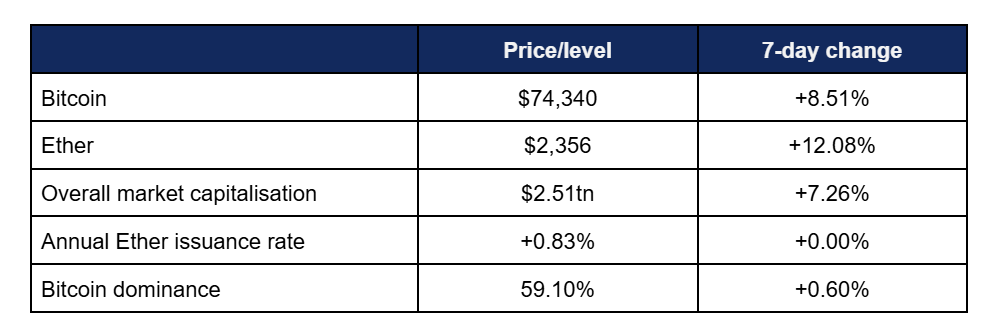
- Digital assets built on (and accelerated) last week’s bullish momentum, posting strong recoveries across the board, bringing the market to its highest point since the 18th of March
- This was aided by ceasefire news in the US-Iran war, alongside better-than-expected CPI figures, leading to greater investor confidence across a broad range of assets
- Bitcoin displayed consistent growth throughout the week, building from a weekly low of $67,860 last Tuesday to a high of $74,760 in the early hours of today, representing its highest value since March 17th
- Ether performed similarly, rising from a weekly low of $2,063 on Tuesday to highs of $2,374 in early trading today
- Overall market capitalisation currently sits just below its weekly high of $2.54tn
- Sentiment was positive across almost the entire market, as over four-fifths of the top 100 projects by market capitalisation posted a weekly gain
- According to industry monitoring site DeFi Llama, total value locked in DeFi grew by over $6bn to $98.2bn
Digital assets posted positive performances across the board, as de-escalation between the US and Iran led to relief amongst investors. ETFs had their best week since January, including the debut of the Morgan Stanley’s crypto ETF, a first by a Wall Street bank and Bitcoin was cited by the FT as a preferred toll payment in the Strait of Hormuz, Hong Kong and Switzerland both advanced stablecoin plans, and much more.
ETF News
What Happened?
- Digital asset investment products logged strong inflows, returning their best results since January
- According to CoinShares data published on Monday, funds across all crypto assets added $1.1bn in fresh capital over the last week
- CoinShares chief of research James Butterfill cited several reasons for this sharp uptick in fortunes, which he believes “reflects a rebound in risk appetite following tentative ceasefire developments in Iran, alongside support from softer-than-expected US spending and CPI data”
- Spot Bitcoin ETFs experienced outflows for two days of the trading week, before strongly recovering the losses (and then some) on Thursday and Friday
- Outflows for the first two days totalled about $253m, less than either Monday ($471m), Thursday ($358m), or Friday’s ($257m) inflows
- BlackRock’s IBIT once again led the way, logging three days of nine-figure inflows between $137m and $182m
- Fidelity’s FBTC and ARK Invest’s ARKB joined BlackRock in the nine-figure inflow club, as they added $147m and $119m respectively on Monday
- This activity moved Bitcoin ETFs back into positive year-to-date territory for flows, following a challenging Q1 for digital assets
- Spot Ether ETFs exhibited the exact same pattern as their Bitcoin counterpart; inflows on Monday, Thursday, and Friday, all in excess of Tuesday’s and Wednesday’s outflows
- The largest outflows came on Tuesday ($64.7m), whilst Monday led for inflows of $120m
- BlackRock’s new ETHB staked Ether ETF continued its positive post-launch run, avoiding any outflows – but it lost out to the firm’s first Ether ETF (ETHA), which took the crown for largest daily inflows ($91m on Thursday)
- According to late-breaking (but incomplete at the time of writing) Monday figures, Ether ETFs continued their positive pattern, whilst Bitcoin funds may be taking a breather, with significant sell-offs in the wake of major weekend price growth
- In other ETF news, a “Bitcoin After Dark” ETF debuted on Wednesday to offer exposure outside of trading hours, and (perhaps more significantly), Morgan Stanley’s first Bitcoin ETF began trading the same day
Crypto Treasury news
What Happened?
- Leading treasury firm Strategy made a major Bitcoin buy this week, acquiring 3,927 Bitcoin for $1bn at an average $71,902 each
- This brings the firm’s total holdings to 780,897 Bitcoin at an average cost of $75,577
- Bloomberg noted “the leverage-to-buy-Bitcoin model pioneered by Michael Saylor’s Strategy Inc. has spawned yet another web of startups tied to its fortunes—all of them exposed if Bitcoin falls”
- The startups in question manage around $100m of stablecoins backed by Strategy’s “Stretch” perpetual preferred shares, which Bloomberg describes as “a hybrid security that pays a junk bond equivalent yield”
- Despite Bitcoin currently sitting below Strategy’s average purchase price and thus possibly threatening future dividends, the company has around $2.25bn in cash reserves, enough to serve distributions and interest for more than two years
- Leading Ether treasury firm BitMine meanwhile purchased over 71,500 Ether, bringing its total holdings to above 4% of total circulating supply
- Its average Ether buy price now sits at $2,202, putting BitMine back in the black at the time of writing
- In his weekly investor letter, BitMine chairman Thomas Lee wrote “The Iran war enters its seventh week and this war remains the most important driver of global markets. Ether is now the best performing asset since the start of the war, with a 17.4% gain and outperforming the S&P 500 by 1,830 basis points”
Stablecoin news
What Happened?
- Stablecoins were once again the subject of a broad range of adoption and reporting as enthusiasm around the technology continues to grow
- HSBC and Standard Chartered were awarded Hong Kong’s first two licences for local stablecoin issuance, emerging victorious from an initial pool of 36 applicants
- Standard Chartered’s licence is for a joint-venture with local digital asset firm Animoca and Hong Kong Telecommunications
- The Hong Kong Monetary Authority commented “Regarding the granting of additional licences and related timing, we adopt an open yet prudent stance, with no definitive inclination at this stage. Should additional licences be granted in future, the overall number will remain very limited”
- In other Standard Chartered news, Bloomberg reported that the bank is considering a full take-over of its Zodia-Custody co-venture with SBI Holdings, potentially merging it into its extant digital asset division
- A report from White House economists posited that offering yield on stablecoins – a key sticking point in current negotiations on the CLARITY crypto market structure bill – will have no material effect on community banks
- According to the Council of Economic Advisers, “Prohibiting such rewards would only boost traditional lending marginally – by 0.02%, or $2.1 billion – most of which would come from large banks rather than community lenders”
- They concluded that “In short, a yield prohibition would do very little to protect bank lending, while forgoing the consumer benefits of competitive returns on stablecoin holdings”
- Meanwhile, a report by S&P Global Market Intelligence indicated that banks are still exercising extreme caution on stablecoins
- In its Q1 2026 U.S. Bank Outlook survey, just 7% of 100 (mostly smaller) institutions are currently developing stablecoin frameworks, with none actively piloting any yet
- S&P’s fintech research director Jordan McKee noted “Most financial institutions remain early and cautious. Our survey of US banks shows that stablecoin strategy is still largely exploratory, with limited internal development and no active pilots among smaller institutions”
- However over in Europe, some banks appear rather more proactive; six major Swiss banks (UBS, PostFinance, Sygnum, Raiffeisen, Zürcher Kantonalbank, and BCV), have set up a pilot with local crypto firm Swiss Stablecoin AG to test out a Swiss Franc stablecoin within a sandbox
- According to reports in industry publication Coindesk, “The group will run the stablecoin trial period through 2026, allowing banks and other institutions to test transactions in a live but controlled setting. The Swiss franc-pegged stablecoin project is designed to allow participants to simulate real payment flows with limits on users and transaction volumes to manage risk”
- According to a new report by blockchain data firm Chainalysis, stablecoin volume is set to continue growing strongly; forecast to reach $719tn in 2035 by organic growth alone
- Factoring in generational wealth transfer and point-of-sale adoption could potentially see this value soar to $1.5 quadrillion within the same time frame
- This would set the category up as a legitimate rival to payment processors like Mastercard and Visa
- Chainalysis wrote “For incumbents, the calculus is becoming straightforward. The blockchain is now the essential plumbing for the next era of global payments. The institutions that build for this reality now will be positioned to define it, while those that wait may find themselves settling transactions on someone else’s rails”
Regulatory news
What Happened?
- Japanese news agency Nikkei reported that the country recently passed a bill to recognise crypto as financial products under the Financial Instruments and Exchange Act
- The bill was passed in a cabinet meeting, meaning that it still needs to go before the Diet before it can officially come into law
- Currently, crypto is mainly regulated under the Payment Services Act
- Analysts from industry publication TheBlock noted that “the shift signals a move toward broader oversight of crypto-related businesses”
- Japanese authorities are also looking to cut the capital gains rate on crypto from a maximum 55% to 20%, bringing it in line with assets like stocks and shares
- In the US, the Financial Crimes Enforcement Network (FinCEN) and the Office of Foreign Assets Control (OFAC) issued a joint rule proposal aimed at ensuring KYC and AML compliance amongst stablecoin issuers
- Treasury Secretary Scott Bessent commented “President Trump is strengthening American leadership in digital financial technology. This proposal will protect the US financial system from national security threats without hindering American companies’ ability to forge ahead in the payment stablecoin ecosystem”
- Additionally, the SEC moved to further clarify digital asset classifications, stating that “certain user interfaces that allow users to transact and use their crypto wallets may not need to register as broker-dealers if certain conditions are met”
- The guidance relates to “covered user interfaces”, i.e. websites, software, or browser wallets designed to make it easier for users to transact on the blockchain with their own custodial wallet
- In particular, the agency “will not object to the Covered User Interface Provider creating, offering, and/or operating a Covered User Interface without registering as a broker-dealer”
- Following Congress’ return from recess, attention once again turned to the CLARITY market structure bill
- Patrick Witt, executive director of the President’s Council of Advisors for Digital Assets, sounded an optimistic voice, saying “[months ago] all felt impractical, unsolvable to camps that had irreconcilable differences… I’m encouraged by the fact that we solved a lot of these that felt unsolvable”
- Whether this optimism manifests into reality remains to be seen, but another area of current regulatory scrutiny is prediction markets, particularly Kalshi, which has grabbed a vast majority (81%) of the US market for itself
What happened: Morgan Stanley becomes first major bank to launch crypto ETF
How is this significant?
- Banking giant Morgan Stanley emerged as perhaps BlackRock’s most significant rival on the digital asset ETF scene this week, as it debuted $MSBT; its first exchange-traded Bitcoin fund
- Head of investment management Ben Huneke stated “We believe this new ETP aligns with long-term trends in financial innovation and serves to strengthen the range of investments we provide investors”
- This makes Morgan Stanley the first Wall Street bank to enter into Bitcoin ETF issuance, which Bloomberg called “a milestone for the digital-asset ecosystem that underscores how deeply the original crypto asset has embedded itself in the financial mainstream”
- It is also the cheapest fund on the scene, with a 14 basis point fee, one point below the long-established industry player Grayscale
- Morgan Stanley’s global head of ETFs Allyson Wallace was confident such a move should pay off in the long term “We really wanted to show our commitment by having that lower fee. The demand, especially from the high-net-worth investors, has been quite high. Viewed at the firm level, this is an asset class that is not going away”
- This demand translated into four consecutive days of inflows post-launch, debuting by taking in $31m on its first day
- The bank appeared very satisfied with this performance, as its digital assets head Amy Oldenburg told Bloomberg TV “It was the best first day of trading for any of our ETFs… We had to start with Bitcoin (ETF), but this is just the first of a long road map of new products both on the asset management side and wealth business”
- She added “Digital assets are increasingly intersecting with traditional markets, and our focus is on helping clients access that evolution through structures they understand and trust. MSBT reflects our firmwide approach to thoughtfully building digital asset capabilities grounded in traditional governance and market infrastructure that seeks to meet long-term client needs”
- Bloomberg’s chief ETF analyst Eric Balchunas noted that after undercutting all the established funds in the space “You’ve got this product that’s cheap enough where [allocations] won’t look like a conflict of interest,” he said. “They’re literally picking the most fiduciary product if you go by fees alone”
What happened: Iran moves to accept digital assets as Strait of Hormuz toll payment
How is this significant?
- After previously writing that “the Iran War Exposed Weakness of the Dollar”, the Financial Times reported this week that “Iran will demand that shipping companies pay tolls in crypto for oil tankers passing through the Strait of Hormuz, as it seeks to retain control over passage through the key waterway during the two-week ceasefire”
- Hamid Hosseini, a spokesperson for Iran’s Oil, Gas and Petrochemical Products Exporters’ Union, told the FT that “the tariff is $1 per barrel of oil… Once the email [to a ship] arrives and Iran completes its assessment, vessels are given a few seconds to pay in Bitcoin, ensuring they can’t be traced or confiscated due to sanctions”
- The Strait of Hormuz remains a major point of tension despite recent de-escalations, and the decision to allow payment via digital assets illustrates on of the major selling points of decentralised blockchains; no central controlling power or geographic limitations
- According to translations from state media, Iran’s parliament passed legislation allowing for such payments in April, in direct response to the escalation of conflict
- Despite its previous illegality, Iran’s crypto market grew to $7.8bn in 2025 according to Chainalysis data, as the regime requires alternative trade options (such as Chinese Yuan adoption) due to widespread sanctions
- However, FalconX senior derivatives trader Bohan Jiang stressed that there’s no hiding any flows; “Whether they do stablecoins or Bitcoin, it is all on public ledgers. Eventually people will be able to see this transfer. Even off-ramping the crypto into fiat currency requires a counterparty willing to accept digital tokens”
What happened: Quantum computing consequences cause crypto industry concerns
How is this significant?
- Following recent breakthroughs in quantum computing development by Google, there have been some concerns on the side of digital asset observers, fearing that the exponential increase in future computational power could undermine the cryptographic security of current blockchains
- Google currently says it’s preparing for a post-quantum future (or “Q-Day” in industry parlance) from 2029 onwards; but analysts from Bernstein believe those timeframes leave developers with little to worry about
- They wrote that “Recent breakthroughs seem to have accelerated the [quantum computing] timeline, as the challenge is no longer ‘a decade away’ as thought earlier. However, the scaling from 10s of logical qubits to 1000s of logical qubits is not trivial and involves multi-dimensional breakthroughs—quantum timelines may still be more optimistic than reality”
- Alongside an adequate timescale, they theorised that the presence of major institutional players in the space, such as BlackRock, and Fidelity, means likely greater resources towards a “constructive role” in strengthening quantum security
- They concluded that “We think that the quantum should be seen as a medium to long term system upgrade cycle rather than a risk”
- Meanwhile, USDC stablecoin issuer Circle published a blog post highlighting that its stablecoin-specific blockchain Arc has a roadmap designed for quantum-resistance
What happened: Hong Kong mortgage firm considers world’s largest digital bond sale
How is this significant?
- According to Bloomberg sources, Hong Kong Mortgage Corp. is currently considering a HK$12bn ($1.5bn) digital bond sale; a tokenisation milestone which would represent the largest such deal ever
- The government-owned financial service provider currently holds nearly HK$222bn in assets, and may market the bonds as early as next month
- Hong Kong already holds the record for digital bond issuance, as the government issued a HK$10bn sale last November
- Sources added that the bonds may be denominated in both Hong Kong dollars and Offshore Yuan, representing the city’s continued role as a potential testbed for the mainland, where digital assets remain extremely limited within official legal boundaries, but nonetheless remain popular amongst investors
What happened: New York Times claims to identify Satoshi Nakamoto
How is this significant?
- The enduring mystery around Bitcoin’s pseudonymous developer continued this week, as the New York Times published a piece claiming to have identified one of the world’s most elusive figures
- According to the NYT article, British computer developer Adam Back is the likeliest candidate, based on archives of emails in early cryptography forums from 1992-2008 and A.I. analysis of grammatical habits and writing style
- However, Back himself moved quickly to deny this, tweeting “i’m not satoshi, but I was early in laser focus on the positive societal implications of cryptography, online privacy and electronic cash, hence my ~1992 onwards active interest in applied research on ecash, privacy tech on cypherpunks list which led to hashcash and other ideas”
- The continued anonymity of Satoshi Nakamoto is viewed by many as a key benefit of Bitcoin’s story, as it keeps the asset free from any central issuance or ideology—the last confirmed message sent by Satoshi was an email in April 2011, meaning a decade and a half as a fully decentralised project
This weekly financial roundup is for informational purposes only and is not financial, investment, or legal advice. Information is based on public sources as of publication and may change. Consult a professional before acting.