



Market Overview
Digital assets built on their recent bullish momentum, closing the week positive despite a late pullback after uncertainty over US-Iran peace talks.
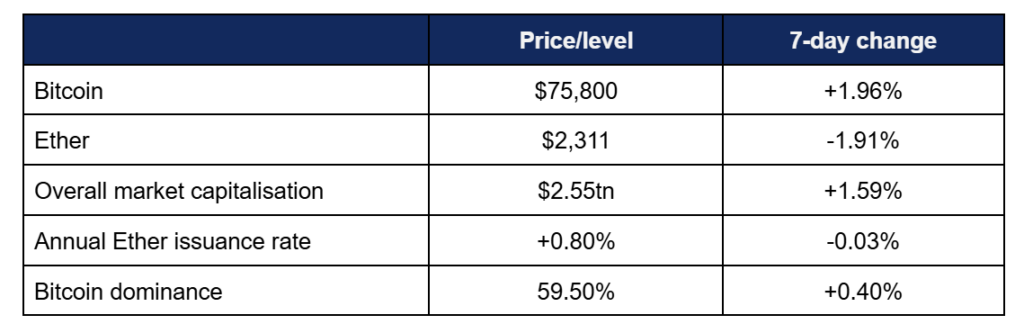
- Digital assets continued their recent bullish momentum, as Bitcoin briefly breached $78,000, hitting a two-month high
- This was partly driven by optimism around progress towards peace in the Middle East and the Strait of Hormuz reopening, leading to a pullback when markets reopened and rhetoric once again turned hostile
- Bitcoin peaked at $78,210 on Friday (its highest value since early February), after a steep climb from a low of $73,620 on Wednesday
- It fell to nearly identical levels in late weekend trading as US-Iran tensions increased, before rallying slightly to end our weekly monitoring period in the green
- Ether displayed similar chart patterns, albeit falling further after the Strait of Hormuz escalations, leading to a Friday high of $2,457, followed by an early Monday low of $2,259
- Although it ended the week at a slight loss, this came in the wake of double-digit growth the previous week, and ETF performance remained positive
- Overall market capitalisation hit an intraweek high of $2.63tn before pulling back, but remains above last week’s highs
- The vast majority of the market showcased growth on the weekly candle
- According to industry monitoring site DeFi Llama, total value locked in DeFi grew pulled back sharply, partly driven by concern over a DeFi platform exploit, to $86.7bn
Digital assets maintained last week’s bullish momentum, despite some late headwinds from US-Iran escalations. Tokenisation and stablecoins remained areas of major adoption and development, Charles Schwab, Morgan Stanley, and Goldman Sachs all voiced support for crypto, ETFs performed strongly, blockchain-based prediction markets attracted more attention (and capital), a new survey revealed Japanese institutional attitudes, and much more.
ETF News
What happened?
- Digital asset investment products reached a third consecutive week of inflows, adding the newest capital since January
- According to CoinShares data published on Monday, crypto asset funds logged a total $1.4bn in inflows
- This included the fact that “total AUM reached US$155bn, with flows representing 0.91% of AUM, the highest weekly intensity year-to-date”
- According to CoinShares chief of research James Butterfill, this strong showing “reflects continued risk appetite recovery on the US-Iran ceasefire extension talks, reinforced by Bitcoin’s break above US$76,000 mid-week, its highest level since the February crash. March CPI at 3.3% year-on-year appears to have been looked through, with core CPI benign at 2.6%, consistent with a supply-driven rather than broad-based inflation impulse”
- Spot Bitcoin ETFs opened the trading week with $291m outflows, before turning positive for the remainder of the week, topping out at $664m daily inflows
- Three days managed to hit nine-figure daily inflows, comfortably cancelling out Monday’s bearish performance
- BlackRock’s IBIT logged the most flows, boasting three nine-figure days between $214m and $292m
- Fidelity’s FBTC and ARK Invest’s ARKB also joined that select club for inflows, adding $163m and $118m respectively on Friday
- Although it didn’t reach such heady heights, Morgan Stanley’s entry as the first Wall Street bank ETF continued to add value, logging nine consecutive days of positive flows post-launch
- Bloomberg chief ETF analyst Eric Balchunas noted that “Bitcoin ETFs now [have] over $1bn in year-to-date flows (having dug out of the outflow hole and then some). Next thing to watch is the cumulative lifetime net flows… This number peaked at $62.8bn, currently $58bn so about $5bn away from hitting new highs there (again, half the battle is to not lose too much in bad times so less hole to dig out of, and I can tell you right now, no type of hot sauce has ever held up as well as spot Bitcoin ETFs in that regard”
- Spot Ether ETFs had their best week since January, with inflows on every trading day
- The best performance came on Friday, as the funds added a total $127m, led by Fidelity’s FETH at $84m
- Although BlackRock’s ETHA scored consistent eight-figure flows in the $30m range (and its ETHB staked Ether ETF continued its positive post-launch run), FETH uncharacteristically beat it twice, also adding $38m on Tuesday
- Goldman Sachs followed in Morgan Stanley’s footsteps, filing for a Bitcoin ETF as the asset becomes increasingly accepted by Wall Street institutions
- Rather than a pure spot play however, Goldman is taking the “premium income” route; appealing to a more conservative risk profile than the typical crypto investor with “a product that generates monthly income by selling options, offering cautious investors a yield in exchange for capped upside during rallies”
Tokenisation news
What Happened?
- Following the firm’s recent launch of a spot Bitcoin ETF, Wall Street’s Morgan Stanley threw its weight yet further behind digital assets this week, as its CFO sang the praises of tokenisation
- Speaking during a Q1 earnings call, CFO Sharon Yeshaya said “How do you think of a tokenised world? How do you think of an onchain world where you can move assets quickly, the same way you’d be able to move those liabilities quickly?”
- She added that tokenisation could help alter portfolio construction and liquidity access for clients; “We would be there to offer different types of products on the asset side… what kinds of things might exist on the lending side for onchain… and how do you also move and think about all of those digital assets”
- XRP issuer Ripple partnered with South Korean insurer Kyobo Life for tokenised settlement of government bonds
- Through Ripple’s custody platform, settlement time should become near-instantaneous, compared to current T+2 executions
- In a press release, Kyobo Life also revealed the potential development of stablecoin-based payment rails alongside Ripple
- Crypto exchange Coinbase is reportedly working alongside fellow digital asset platform Bybit “to explore ways to tokenize, custody and distribute assets such as US public and pre-IPO stocks”
- According to sources at industry publication Coindesk, “Discussions between Bybit and Coinbase are more global in nature, leveraging Bybit’s worldwide reach, particularly in places like Asia, where users may want access to tokenized versions of US stocks”
- UK asset manager Legal & General dived deep into the tokenisation pool this week, announcing $68bn of money-market style funds now available as tokenised shares on the Calastone Tokenised Distribution Network
- L&G’s liquidity investment lead Ross McDonald commented “We are thrilled to make our liquidity funds available on the Calastone Tokenized Distribution Network. Tokenised distribution provides meaningful enhancements in efficiency and reach”
- According to the press release, “Calastone provides the underlying technology for token creation, order routing, trade aggregation, reconciliation and on chain settlement functionality, seamlessly integrating with existing fund administration processes”, and the funds will initially be available on Ethereum and Ethereum-based (EVM-compatible) chains
- Flow Capital put $150m worth of private credit on the blockchain, with aims of scaling the fund to $250m by year-end
- The Hong Kong-based asset manager is using a chain built by Singapore developers DigiFT Tech Pte, rather than the public Ethereum chain
- Flow CIO Jacky Tian told Bloomberg “We are hoping to reach a new pool of investors who are looking for better returns for the stablecoins they hold, and we are seeing that pool grow”
Stablecoin news
What happened?
- French banking giant Societe Generale partnered with browser-based crypto wallet app Metamask to feature its USDCV stablecoin in what Bloomberg called “one of the biggest efforts yet by a major bank to bring digital money to a wider audience”
- Jean-Marc Stenger, CEO of the bank’s digital asset arm FORGE, explained the bank’s backing for the category, stating “Stablecoins enable faster, programmable and more efficient transfers of value while maintaining price stability. From a banking perspective, stablecoins also provide a way to bring traditional strengths – risk management, compliance, transparency and governance – into blockchain‑based systems”
- Bloomberg noted a wider banking adoption of digital asset technology, citing JP Morgan and Citi at “the head of the next payments frontier”, with Citi backing stablecoins, whilst JP Morgan favours its proprietary in-house blockchain solutions like tokenised deposits
- Shahmir Khaliq, global head of services at Citigroup, commented “The real client problem that we were looking to solve is the ability for large multinationals, big banks and broker-dealers and fintechs to be able to move their money around, make payments seamlessly around the world 24/7… Our focus has always been on being able to move money around real time, 24/7, across the globe. This new technology actually gives us a leg up in how we execute that strategy”
- Payment processor Stripe is increasing its integration of stablecoins and blockchain, as part of an internal strategy to become “the AWS [Amazon Web Services] of Money”
- Speaking at an RWA summit, the firm’s head of crypto go-to-market Adrien Duchâteau, said “We’re putting product by product more of our stack onchain”
- He noted that traditional markets can take up to three days to settle transactions (“If you reduce that to zero, that is a magnitude of change”), and that stablecoins greatly simplify cross-border transactions in emerging markets
- Stripe has made major investments in order to bolster its crypto credentials, including the $1.1bn acquisition of stablecoin platform Bridge last year
- USDT issuer Tether rescued DeFi protocol Drift with $148m of its market-leading stablecoin, after Drift fell victim to a hack this month that drained $270m from the protocol
- The incident has led to some concerns over DeFi contagion after another exploit, leading to Ethereum Layer-2 Arbitrum freezing some funds linked to the most recent incident
Crypto Treasury news
What happened?
- Leading treasury firm Strategy executed its biggest Bitcoin buy since 2024, acquiring 34,164 Bitcoin for around $2.54bn, at an average price just below $74,400 per Bitcoin
- The performance of the leading digital asset also had a direct effect on Strategy’s share price, as it rallied 30% over the last week while Bitcoin reached a two-month high
- This brings the firm’s total holdings to 815,061 BTC acquired at an average price of $75,527, meaning that at the time of writing, its treasury is – just barely – back in profit
- The firm also proposed a change to its STRC perpetual preferred share dividends, shifting from monthly payouts to fortnightly
- According to Bloomberg analysts, “the change is intended to stabilize the price of the preferred shares so they trade at par, allowing Strategy to issue new shares without the heavy discounts often required during secondary market offerings”
- Stablecoin giant Tether also added to its Bitcoin reserves, buying $70m to take its total Bitcoin holdings to around $7.16bn as it pursues a policy of converting 15% of realised profit into “digital gold”
- Meanwhile, leading Ether treasury firm BitMine also added to its reserves, bringing Ether holdings up to 4,976,485 Ether, or 4.12% of circulating supply
- In his weekly letter, chairman Thomas Lee wrote “Ether has outperformed the S&P 500 by 2,280 basis points since the war started and remains the single best performing asset in the world (beside crude oil prices). Ethereum continues to benefit from the dual tailwinds of Wall Street tokenising on the blockchain and from agentic AI systems increasingly needing public and neutral blockchains. In our view, there is a lot of meaning to ETH being the best ‘war-time store of value’ and to ETH being the asset leading since the war started”
- He added that the firm continues to be optimistic on timeframes around the current bear market, saying “While many believe the crypto winter may last through the Fall of 2026, our view remains that the crypto winter is much closer to ending… In the past week, we acquired 101,627 Ether, which is the highest pace of buys since the week of December 15, 2025”
What happened: Charles Schwab begins rolling out crypto trading for clients
How is this significant?
- Asset management powerhouse Charles Schwab in the process of launching its long-awaited digital asset trading, as part of a phased rollout
- Speaking to CNBC, CEO Rick Wurster said that “we rolled it out to employees to test it, our employees are loving it, we’ll roll it out to clients in the coming weeks and couldn’t be more excited about that… we’re also excited that many of our clients have built crypto positions outside the firm, and they’ve been asking to hold it at Schwab… we can’t wait to make that happen”
- Transactions will feature a 75 basis point fee, Schwab will custody them directly, and blockchain firm Paxos will take care of “trade execution and sub-custody”
- Due to local regulations, clients in a few US states (Louisiana and New York) are unable to participate, reflecting the continued fragmentation of the US market in the absence of any real federal frameworks
- The launch included the release of educational materials aimed at a more mature investor, which noted the potential increase in risk exposure for new entrants into the asset class
- According to Schwab’s Centre for Financial Research, a traditional moderate risk profile investor (60/40 stocks/bonds) can consider a 2.7% portfolio allocation towards Bitcoin, whilst an aggressive investor (96/4) might consider up to 20%
What happened: Polymarket seeks fresh funding at $15bn valuation
How is this significant?
- Prediction markets featured heavily in the news this week, as one of the leading platforms, Polymarket, moved to add $400m in fresh funding just weeks after raising $600m (at the same valuation) last month
- According to a Bloomberg source, “Polymarket is considering whether to raise the additional $400m from new investors at the $15bn valuation, which includes the new money, or wait until it can attract a higher valuation”
- Although the valuation remains potentially unchanged since March, it should be noted that last month’s funding represented a major jump on its previous raises in 2025, which topped out at $9bn valuation
- This makes Polymarket the second-largest prediction market after NYSE-backed Kalshi, which secured a $22bn valuation also last month
- Prediction markets are attracting wagers for everything from the weather to major geopolitical conflicts, leading to widespread concerns over unlicensed gambling and potential conflicts of interest and political “insider trading”
- Washington is now claiming to crack down on such concerns, with the Associated Press writing “In a highly polarised Congress, the need to guard against the prediction markets being used for insider trading has become rare common ground… The debate is also drawing in the White House, potential presidential candidates and state leaders”
- Such interest reflects what big business the category – partially enabled by blockchain and crypto rails which democratise access to any outcome market – has become, and its potential future growth
- According to data from Dune Analytics, notional monthly volume on Polymarket increased six-fold to $10.6bn in March, and Bernstein analysts predict $1tn volumes by 2030
- Bernstein notes the near-exponential growth of such platforms, writing that “Kalshi and Polymarket, the two largest platforms, [have seen] about $60bn in market volume year-to-date – more than the $51bn in total prediction market volume in all of 2025”
What happened: Nomura institutional survey reveals current Japanese crypto attitudes
How is this significant?
- A new survey from Japanese financial giant Nomura and its crypto arm Laser Digital revealed some insights on digital asset attitudes amongst investors
- Out of over 500 Japanese investment professionals surveyed, 31% have a positive outlook for digital assets, up from a quarter of respondents last year
- 65% view crypto as a portfolio diversifier, and 79% of those considering allocation plan to invest within the next three years
- The majority of institutional respondents are looking at conservative levels of overall exposure, between 2% and 5%
- Additionally, over 60% “expressed interest in staking, lending, derivatives and tokenized assets, reflecting growing demand for yield-generating strategies and more sophisticated portfolio construction”, and 63% are optimistic on stablecoins, for use cases ranging between treasury management, investment in tokenised assets, and cross-border payments
What happened: Cantor Fitzgerald donates $10m to Crypto Super-PAC
How is this significant?
- As the US continues efforts to push through crypto market structure legislation via the CLARITY bill – JP Morgan analysts believe negotiations are approaching a breakthrough – industry players remain intent on safeguarding future political influence
- Wall Street bank Cantor Fitzgerald, founded by current Commerce Secretary Howard Lutnick, donated $10m this week to a political Super-PAC founded by stablecoin giant (and Cantor Fitzgerald client) Tether
- The Fellowship PAC revealed its first donors through filings this week, both with strong ties to the digital asset industry; Tether’s custodian Cantor, and digital asset bank Anchorage Digital (which contributed $1m)
- An Anchorage spokesperson told Bloomberg that the bank “made a corporate contribution to the Fellowship PAC as part of our broader, bipartisan approach to advancing regulatory clarity for digital assets in the United States”, whilst the other two parties didn’t return requests for comment
- The three firms are currently collaborating on Tether’s GENIUS-compliant USAT stablecoin, and upon its founding in September, Fellowship announced it had $100m in funding ready for lobbying efforts
This weekly financial roundup is for informational purposes only and is not financial, investment, or legal advice. Information is based on public sources as of publication and may change. Consult a professional before acting.