



Market Overview
Digital assets logged another week of growth, once again hitting their highest levels since January.
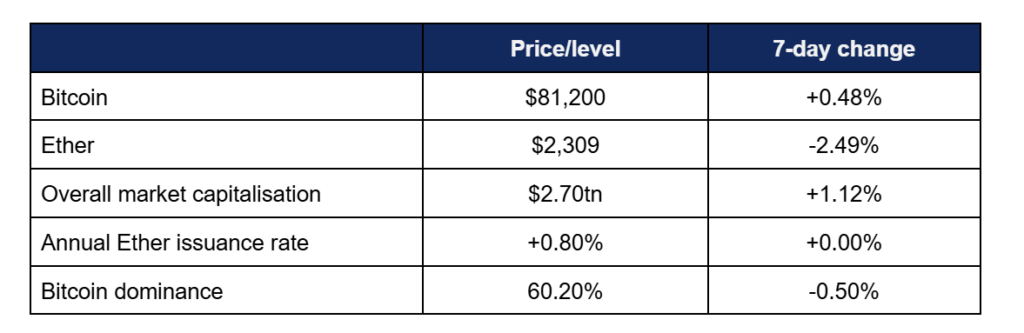
- Digital assets logged another positive performance, albeit cooling slightly from last week’s explosive growth
- Bitcoin rose above $83,000 for the first time since the end of January, peaking at $82,660 on Wednesday before a gradual recovery to current levels following a Friday low of $79,310
- Ether’s post-Friday recovery couldn’t quite keep pace as it ended our snapshot in the red, reaching a Wednesday high of $2,417 before a Friday low of $2,270
- Overall market capitalisation hit an intraweek high of $2.73tn
- Performance across the top 100 projects by market capitalisation was overwhelmingly positive, as only ten tokens (at the time of writing) posted a weekly decline
- According to industry monitoring site DeFi Llama, total value locked in DeFi remained stable at around $85.9bn
Digital assets returned another week of positive performances, featuring activity from several major names within both DeFi and TradFi. BlackRock and Morgan Stanley extended their digital asset exposure and offerings, stablecoins continued to attract attention and growth, and the venture capital sphere saw significant increases in investment, with a singule new fund from a16z eclipsing all the new capital raised by VCs in Q4.
ETF News
What Happened?
- Digital asset investment products made it six consecutive weeks of inflows, significantly increasing the previous week’s figures
- According to CoinShares data published on Monday, the trading week ending Friday the 8th saw $85m inflows, led by $706m from Bitcoin
- CoinShares research head James Butterfill posited that this performance “likely reflects improving sentiment around the CLARITY Act, with senators Tillis and Alsobrooks releasing the final compromise text on stablecoin yield on 1st May and holding firm against banking-industry pushback on 4th May”
- Spot Bitcoin ETFs started strongly with around $1bn inflows across Monday and Tuesday, before reversing into around $415m outflows across Thursday and Friday
- As usual, BlackRock’s IBIT and Fidelity’s FBTC led the way, as both opened the week with consecutive nine-figure inflow days between $133m and $136m
- The largest daily outflow “honour” was claimed by FBTC on Thursday, the only fund to hit nine figures at $129m
- Morgan Stanley’s Bitcoin ETF continued to evade post-launch outflows, accruing $194m of fresh capital over its first month without any daily outflows (albeit featuring several net-zero flow days)
- Spot Ether ETFs recorded four days of inflows, ranging between $4m and $98m
- BlackRock’s ETHA and Fidelity’s FETH dominated the performance, with top daily inflows of $70m and $50m respectively
- In other ETF news, Bloomberg chief ETF analyst Eric Balchunas noted another delay to potential prediction market ETFs, but an imminent trading start for a potential Hyperliquid ETF, based on the crypto derivatives exchange of the same name
Stablecoin news
What Happened?
- Stablecoins once again featured in a broad range of reporting, as the category continues to attract both enthusiasm for its capabilities, and caution from bankers
- ECB president Christine Lagarde warned against potential perceived financial risks from the proliferation of Euro-denominated stablecoins, continuing a long held criticism of the sector by one of the key remaining champions of a major CBDC
- She claimed that risks to the ECB’s monetary sovereignty outweighed potential benefits from Euro stablecoins, and that “If we want to strengthen the international appeal of the Euro, stablecoins are not an efficient way of doing so”
- Speaking at the Consensus 2026 conference in Miami last week, Anchorage Digital Bank CEO Nathan McAuley took the opposite stance on the appeal of and demand for stablecoins, noting that “We have really a dozen to maybe even as many as 20 institutional issuers or large tech company issuers who are going to come in and issue their stablecoin with us”
- The bank also announced a new partnership with stablecoin technology provider M0 to further bolster its capabilities in the field
- At the same conference, John Timoney, head of strategic partnerships at payments infrastructure company Rain, said that in some markets, particularly Latin America, “Stablecoin-based cards could soon account for double-digit percentages of all cards”
- He also noted that retail stablecoin card usage surged by approximately 105% last year, as users converted USDT and other coins to pay for everyday expenses
- In a particular advantage over traditional banking infrastructure, Timoney noted “stablecoin settlement lets card programs settle on weekends and holidays, reducing trapped capital by more than 40% in some cases”
- Stablecoin issuer Circle meanwhile raised $222m for its bespoke stablecoin blockchain Arc, as its Q1 revenue (in opposition to more generalised crypto firms like Coinbase) rose by 20%
- The $222m raised featured sales of ARC tokens for the chain and according to Coindesk analysts “included investment from a mix of Wall Street heavyweights and crypto-native firms, including BlackRock, Apollo Funds, a16z crypto, ARK Invest, CoinDesk’s parent company Bullish, Haun Ventures, Intercontinental Exchange and Standard Chartered Ventures”
- The token is positioned as a “native coordination asset” for the Arc blockchain in a new whitepaper published on Monday, allowing it to be staked (like Ether on Ethereum) in exchange for network governance and a share of fees earned by the network
- CEO Jeremy Allaire called it “one of the most institutionally-ready networks in the world”, and said it’s an “economic operating system” for a variety of businesses ranging from payment providers to capital markets; “We built the highways for USDC. Now we’re opening them to other stablecoin and real-world asset issuers”
- S&P 500 payments firm Corpay announced in a press release that it is partnering with stablecoin specialists BVNK to integrate stablecoin wallets and settlement capabilities across its network of 800,000 clients
- Wallets will be able to store, convert, and transfer stablecoins, displaying balances alongside fiat deposits on Corpay’s platform
- Corpay will also use stablecoins to “increase capital efficiency by improving the movement of funds across its global footprint”
VC news
What happened?
- Digital asset VC and acquisition activity saw a marked increase this week, building on some other large recent raises as a possible indication for green shoots of recovery in the industry
- Andreessen Horowitz (a16z) concluded the $2.2bn raise on one of the largest-ever crypto investment funds, following a16z alum Katie Haun’s $1bn raise last week
- This fund alone exceeds the capital allocated across crypto VC funds in Q4, which reached around $2bn
- According to a16z, the new fund will “invest in projects connecting crypto with traditional finance and artificial intelligence”
- Digital asset exchange Bullish made one of the industry’s largest acquisitions ever, buying Equiniti from Siris Capital for $4.2bn in order to expand its blockchain-based capital markets infrastructure capabilities
- The deal is believed to include $2.35bn in stock and assume $1.85bn of Equiniti debt
- Equiniti is one of the world’s largest transfer agents, marking significant progress in any Bullish strategies around tokenisation of stocks and securities
- Bullish CEO Tom Farley commented “Broad adoption at institutional scale requires three things: end-to-end tokenisation services, a single, unified ledger, and a broad base of blue-chip issuer relationships, at scale. This combination delivers all three”
- Standard Chartered’s VC arm fortified the bank’s involvement in digital assets yet further, investing in crypto trading firm GSR at a unicorn valuation above $1bn
- According to Bloomberg sources, GSR could potentially raise up to another $150m as it is “exploring both organic and inorganic opportunities” to grow its capital market offering
- Prediction market Kalshi confirmed previous unsubstantiated reports of a $1bn Series F raise at a $22bn valuation, including contributions from Coatue, Sequoia Capital, Andreessen Horowitz (a16z), Paradigm, IVP, Morgan Stanley and ARK Invest
- Digital Asset Holdings, the parent company of Canton Network blockchain developers, is currently raising $300m at a $2bn valuation in a round led by a16z, according to Bloomberg sources
- This represents a substantial increase on a $50m raise in December at an unconfirmed valuation
- Ripple closed a $200m debt facility from investment firm Neuberger Berman for its Prime brokerage unit
- Ripple Prime president Noel Kimmel commented “Dependable access to financing and balance sheet strength are critical to institutional participants in today’s dynamic markets. This facility enables us to grow alongside our clients by delivering increased margin capacity, greater responsiveness, and improved capital efficiency”
Crypto Treasury news
What happened?
- Leading treasury firm Strategy resumed its Bitcoin buying practice after a week off, adding 535 Bitcoin for $43m
- This brings its total holdings to 818,869 Bitcoin acquired at an average price of $75,540; bringing a bit of breathing room to its profitability after a prolonged period underwater across Q1 this year
- Notably, reports this week indicated that Strategy could potentially break from its “never sell Bitcoin” mentality in the future—but only in the pursuit of more Bitcoin down the road
- Chairman and founder Michael Saylor was quoted as saying “You buy back Bitcoin with credit, you let it appreciate, and then you sell Bitcoin to pay the dividend… as long as you’re issuing credit in excess of the breakeven point, then this business works and grows forever”
- He added that tax loss harvesting represented a potential legitimate approach if one held long-term horizons on the asset’s value; “We have a $2.2bn tax credit that’s lying on the floor. We’ll probably sell some Bitcoin to fund a dividend just to inoculate the market, just to send the message that we did it”
- However, he was keen to stress that any sells would represent short-term opportunism rather than any changes in long-term thesis, as “In these periods, even if we were to sell one bitcoin, we’d be buying 10 to 20 more Bitcoin. You should be a net accumulator of bitcoin. When I said ‘never sell your Bitcoin,’ I mean make sure if you were to spend it on something, you replenish in the time you spend it”
- Meanwhile, leading Ether treasury firm slowed its rate of acquisition as it nears its desired 5% of total supply, buying 26,659 Ether for $63 million, as opposed to several weeks of acquiring above 100,000 per week
- Chairman Thomas Lee, in his weekly investor letter explained “We have decided to slow down our pace of weekly accumulation from over 100,000 [Ether] per week. Our previous pace of buys would have us reach 5% by mid-July”
- He also maintained his recent optimism regarding the overall market, stating “If Ether closes above $2,100 at the end of May, this would be the third consecutive monthly gain—this has never been seen in a crypto bear market”
- In Switzerland, campaigners dropped requests to add Bitcoin to the country’s national reserves, after failing to collect enough signatures to trigger a plebiscite
- Campaign founder Yves Bennaim told Reuters “We knew from the beginning that it was a long shot. For now, we are going to let the initiative lapse”
What happened: BlackRock announces new tokenised funds
How is this significant?
- Just as week after BlackRock expanded access to its onchain money market fund BUIDL, it further committed to the concept by announcing more tokenised funds
- The world’s largest asset manager filed to launch a “digital class of shares” on Friday for two money market funds, appealing to those who hold capital in stablecoins rather than bank accounts
- The “OnChain Shares” would be issued alongside its long-time tokenisation partner Securitize, the firm behind BlackRock’s market-leading BUIDL on-chain money market fund
- Meanwhile, proposed transfer agent BNY Mellon Investment Servicing, will maintain official ownership records on the Ethereum blockchain, via the widely-used ERC-20 fungible token standard
- One of the proposed tokenised funds is its $6.1bn BlackRock Select Treasury Based Liquidity Fund (BSTBL), investing in cash, US Treasury bills, notes and other short-term securities
- According to Bloomberg sources, the other filing is for “BlackRock Daily Reinvestment Stablecoin Reserve Vehicle (BRSRV)… a newly created tokenised money-market fund aimed at a growing class of investors who manage their finances through crypto wallets and stablecoins, as opposed to traditional brokerages”
- The filings indicate a continued commitment to CEO Larry Fink’s long-running vocal support for the concept of tokenisation, which he believes can transform finance in terms of performance and accessibility
- It should however be noted that these particular funds may not go a long way towards democratisation of investment access; rather than enabling fractionalised ownership via tokenisation, they will limit investors to a minimum $3m investment
- Bloomberg analysts cite stablecoin performance as a key catalyst for creation of the new funds; “passage of the Genius Act—accelerates demand for blockchain-native reserve assets. As more stablecoins come to market, issuers are seeking reserve funds that are both Genius-compliant and tokenized to allow for round-the-clock trading and near-instant settlement”
- According to category data aggregator rwa.xyz, tokenised real world assets have grown by more than 200% over the last year, and a report by Boston Consulting Group predicts a potential market of almost $19tn by 2033
What happened: Morgan Stanley launches digital asset trading, undercutting rivals
How is this significant?
- Banking giant Morgan Stanley followed its recent foray into Bitcoin ETFs (which celebrated one month of trading without any outflows) by moving further into digital assets
- The bank is piloting crypto asset trading on its E*Trade platform and it appears committed to driving volume for the offering, by undercutting key competitors in the field
- Initial assets available will be limited to current industry leader Bitcoin, alongside top smart contract blockchains Ether and Solana
- In an aggressive move, trading fees are 50 basis points, meaning lower costs compared to other TradFi giants moving into the category (Charles Schwab), generalised trading shops (Robinhood) and crypto-native firms like Coinbase
- The firm’s head of wealth management, Jed Finn, commented that the bank believes in the convergence of TradFi and DeFi, meaning more digital asset presence across its business lines; “This is much bigger than trading crypto at a cheaper rate… In a way, the strategy is disintermediating the disintermediators”
- He added “It’s going to be a very competitive in the next couple of years, particularly given the regulatory moats are drying up”
- Crypto trading will be rolled out to all 8.6 million E*Trade clients later this year, opening up the asset class to a large potential audience that previously avoided exposure out of convenience
What happened: Coinbase posts loss in latest results
How is this significant?
- Top publicly-listed US exchange Coinbase displayed the results of the digital asset industry’s bruising Q1 (following up from a vicious Q4), as it revealed both job cuts and declining revenues
- First-quarter revenue dropped 31% for the firm, down to $1.41bn, after a 20% drop in Q4
- This equated to a net loss of $394m, the equivalent of $1.47 a share
- Clear Street analyst Owen Lau commented “They missed on both revenue and adjusted EBITDA, even though we had expected it will be a weak quarter. The result itself is not good enough despite the lower bar”
- CFO Alesia Haas denied concerns over potential competition from entrants like Morgan Stanley using lower fees as a recruitment mechanism; “We’ve always had the view we’d see commoditisation in fee trading. We run fee experiments, and our customers at this point haven’t been price sensitive”
- She added that “We can’t predict the future, as a public company we are always going to be doing what’s right for the company”
- However, Haas also voiced a note of optimism regarding potential breakthroughs in regarding regulatory roadblocks, noting that “The key elements of our rewards program are protected” in the latest draft of the CLARITY crypto market structure bill
What happened: Kraken parent company advances IPO plans
How is this significant?
- Payward, the parent company of US digital asset exchange Kraken, is advancing plans to go public
- Sources speaking to industry publication Coindesk reported that the company is currently conducting a raise at a $20bn valuation
- After initially filing S1 forms to begin the public float procedures last year, Kraken’s potentially listing has become a long-running saga, paused by unfavourable market conditions in Q1 before CEO Arjun Sethi told the Consensus conference in Miami last week that they are “80% ready” to go
- Activity does appear to have ramped up around the company ahead of a potential public listing; Deutsche Börse secured a stake worth $200m last month at a reported $13.3bn valuation, and just this week, the firm acquired Hong Kong-based stablecoin service provider Reap for $600m
- Sethi noted that this marks their largest ever Asian acquisition, and “if you take Europe out, the fastest growing market is Asia, not just revenue but also asset-on-platform. Reap have already done it in Asia. They can expand into the US overnight with us”
What happened: CLARITY crypto market-structure bill faces late lobbying
How is this significant?
- In the US, the long-awaited CLARITY crypto market structure bill continued its slow (and occasionally unsteady) towards potentially passing, as reports emerged of a broad compromise around the sticky issue of stablecoin rewards
- However, as those on the crypto-native side of the aisle appeared to be content with the current state of the bill, some representatives of the incumbent banking industry still appeared opposed
- American Bankers Association CEO Rob Nichols argued that “interest-like rewards” were still too prevalent in the bill, and that “the current proposal would unnecessarily incentivise the flight of bank deposits into payment stablecoins, putting both economic growth and financial stability at risk”
- However, SEC chair Paul Atkins, speaking in Washington, urged passage of the bill to help establish a shared regulatory framework between the SEC and CFTC
- As things stand, the bill is scheduled for a Senate Banking Committee markup on Thursday, nearly four months after Coinbase initially withdraw support over banking industry opposition and plunged the process into chaos
- A key remaining issue is that current bill language doesn’t do much to mitigate perceived conflicts regarding president Trump and his family’s widely-reported crypto interests, but banking committee chair Tim Scott stated “This bill reflects serious, good-faith work across the Committee and delivers the certainty, safeguards, and accountability Americans deserve. It puts consumers first, combats illicit finance, cracks down on criminals and foreign adversaries, and keeps the future of finance here in the United States”
This weekly financial roundup is for informational purposes only and is not financial, investment, or legal advice. Information is based on public sources as of publication and may change. Consult a professional before acting.