



Market Overview
Digital assets pulled back some of their recent gains as perceived risk-on assets reacted negatively to new US inflation figures.
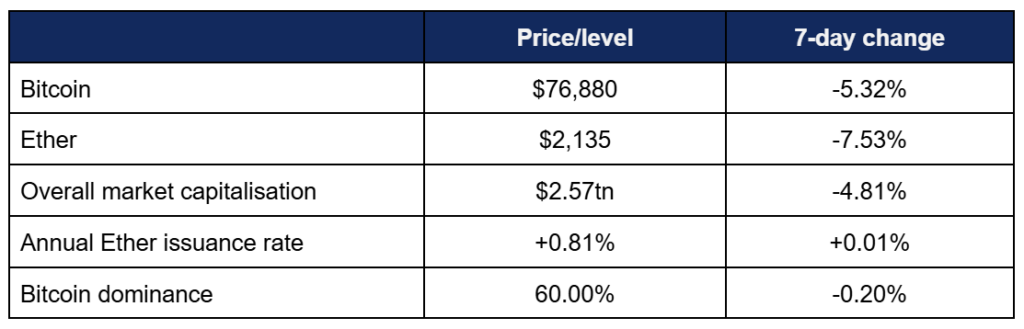
- Digital assets experienced a weekly decline after several weeks of consistent growth
- The market initially responded positively to progress in crypto market structure legislation within the US, before high US inflation data led to widespread de-risking amongst investors and pullbacks across crypto markets
- Bitcoin peaked just below $82,000, hitting $81,950 on Wednesday, before dropping sharply below $80,000 on Friday en route to a weekly low of $76,130 on Monday
- This effectively set Bitcoin’s price back by two weeks, but remains above the $74,000 range where it was trading a month ago
- Ether performed similarly to Bitcoin, topping out at $2,320 on Tuesday, witnessing steep drops on Friday and Monday en route to a low of $2,080 in early trading today
- Overall market capitalisation fluctuated across a wide range this week, with an early high of $2.71tn giving way to a late low of $2.53tn
- Numbers across the top 100 projects by market capitalisation were overwhelmingly red, as the vast majority of altcoins followed Bitcoin and Ether’s declines. Hyperliquid was the only project in the top 10 to return weekly growth, following the debut of several ETFs
- According to industry monitoring site DeFi Llama, total value locked in DeFi fell about $3bn to $82.8bn
Digital assets pulled back after several weeks of consistent growth, fuelled by continued US-Iran uncertainty and higher-than-expected inflation figures. Nevertheless, adoption and development continued rolling out globally, from US megabanks like JP Morgan, to Japanese financial giants including SBI, Nomura, and Mizuho, to leading Korean TradFi firms, Bitcoin-backed insurance issued by Iran, and widespread tokenisation efforts within Saudi Arabia. In the realms of regulation, the CLARITY market structure bill cleared a key hurdle; bringing it one step closer to potentially changing the landscape for digital assets within the United States and across the world.
ETF News
What happened?
- Digital asset investment products logged their first losses in seven weeks, reversing momentum with the third-largest outflows of 2026
- According to CoinShares data published on Monday, the trading week ending Friday the 15th saw $1.07bn outflows, dominated by $982m outflows from Bitcoin products and $249m from Ether equivalents
- However, CoinShares’ Head of Research James Butterfill noted that newer altcoin-based funds fared better, as “11 individual assets still recorded meaningful inflows above US$1m, suggesting CLARITY Act progress helped cushion the broader risk-off tone”
- Spot Bitcoin ETFs featured three days of nine-figure outflows, ranging from $233m to $630m
- IBIT and Fidelity’s FBTC broke their recent strong form by returning the week’s largest losses on Wednesday ($285m and $133m respectively), alongside ARK Invest’s ARKB ($177m)
- Morgan Stanley’s Bitcoin ETF maintained its impressive post-launch run without any daily outflows, adding $39m across three days of positive and two days of net-zero flows
- Spot Ether ETFs underperformed Bitcoin funds, logging five consecutive days of outflows, between $6m and $131m
- However, the outflows were generally at much lower levels than for Bitcoin ETFs, with the second-largest daily losses topping out at $66m
- In other ETF news, Bloomberg ETF analyst James Seyffart highlighted the launch of several Hyperliquid ETFs, with further funds from Grayscale and VanEck based on the popular crypto derivatives exchange still pending
Crypto Treasury news
What happened?
- Leading treasury firm Strategy made one of its largest Bitcoin buys ever this week, adding $2bn worth to its coffers
- This equates to its sixth-largest acquisition ever (and second-biggest in 2026), translating to 24,869 Bitcoin purchased, bringing total holdings to 843,738 acquired for approximately $63.87bn at an average price of $75,700 per Bitcoin
- Late last week, Strategy confirmed plans to “buy back $1.5bn face value of its zero-coupon 2029 convertible notes for approximately $1.38bn, retiring the debt at roughly 92 cents on the dollar”
- Bitcoin sales were listed as one of three potential means for financing this move, although chairman and founder Michael Saylor stressed that the company remains a “net accumulator” of Bitcoin even if it makes short-term sells for various accounting reasons
- Leading Ether treasury firm Bitmine acquired 71,672 Ether over the last week, increasing its share of total supply to 4.37%, well on target for its stated goal of a 5% supply holding
- In the company’s weekly press release, chairman Thomas Lee maintained his recent optimistic outlook despite widespread market pullbacks, writing “The CLARITY Act provides the necessary regulatory clarity for the crypto industry and Wall Street to build the next generation set of financial products and architecture. There are still many steps and hurdles to overcome before CLARITY becomes law. But we believe the probability of passage is higher than the 61% reflected on Polymarket”
- He added that “We view the recent pullback of ETH to below $2,200 as an attractive opportunity. Bitmine is expected to reach the ‘alchemy of 5%’ sometime in 2026”
What happened: JP Morgan files for tokenised money market fund
How is this significant?
- Just a week after BlackRock announced multiple tokenised money market funds, Wall Street titan JP Morgan followed suit, filing for its latest tokenised money market fund on Tuesday
- The new JPMorgan OnChain Liquidity-Token Money Market Fund (ticker JLTXX) follows on from the launch of its first onchain fund, MONY, back in December last year
- It also means that JP Morgan is strengthening its overall presence in the tokenisation space, where MONY has accrued over $100m in assets under management
- However, it still ranks far behind tokenisation veterans Franklin Templeton (which has added nearly $460m over the last 30 days alone) and BlackRock
- Ethereum will once again serve as the blockchain of issuance for the fund’s tokens, allowing investors to hold them in (and transfer them between) personal wallets, and “use them as collateral in crypto markets”
- Underlying assets will be held by a traditional custodian, but several benefits have been cited for tokenising such funds, including faster settlement times
- According to its filing, the new fund will be GENIUS-compliant, and will “invest in US Treasuries and overnight repurchase agreements collateralised by Treasuries or cash”
- New data from Binance research illustrates the scale of growth within the tokenisation field, “Distributed value of tokenised RWA (real-world assets) now sits at US$31.4bn: around five times higher than at the start of 2025”
What happened: Iran proposes Bitcoin-backed insurance for Hormuz crossings
How is this significant?
- According to reports on Monday, Iran has purportedly proposed a new Bitcoin-backed insurance system called ‘Hormuz Safe’ for ships passing through the Strait of Hormuz; thus demonstrating the ongoing value proposition of borderless, decentralised digital assets in combatting sanctions and restrictions
- The reports come via the Fars news agency, citing Iran’s Ministry of Economy and Financial Affairs stating that the Hormuz Safe system “provides Iranian shipping companies and cargo owners with fast, verifiable digital insurance”, settled in Bitcoin
- Fars further explained “Cryptographically verifiable insurance policies will be provided for shipments passing through the Persian Gulf, the Strait of Hormuz, and the surrounding waterways, and payments will be settled in Bitcoin. The shipment will be covered from the moment of confirmation and signed receipt will be given to the owner”
- Hormuz Safe insurance follows on from FT reports in early April that Iran was charging international shipping companies tolls in Bitcoin for passing through the Strait of Hormuz during the ongoing war with the US
What happened: Japanese financial giants reveal crypto fund plans
How is this significant?
- Japan’s Nikkei Asia news agency this week reported that two of the nation’s most established financial heavyweights are both vying to introduce crypto funds
- The Securities arms of both SBI Holdings and Rakuten confirmed plans to launch digital asset investment trusts as soon as the local Financial Services Agency finalises a regulatory framework for them
- Both will allow customers to access digital asset trading through their existing online brokerage accounts
- Nikkei surveyed 18 major firms including Nomura and Mizuho on potentially introducing digital assets, and 11 confirmed plans to do so
- Thus, Japanese crypto ETFs and other investment funds may be coming from 2027 onwards, after the Japanese Diet passed a draft amendment last month classifying crypto assets as financial products rather than payment tools under the existing Financial Instruments and Exchange Act
What happened: Standard Chartered absorbs Zodia crypto custody
How is this significant?
- Global banking giant Standard Chartered is expanding its digital asset footprint by absorbing the crypto custody facilities of Zodia – a subsidiary which it co-founded and backed as a joint venture alongside SBI Holdings and other banks
- Its non-binding offer for Zodia’s custody business was accepted by Zodia shareholders, bringing the capabilities directly in-house for the bank
- Standard Chartered’s global head of financing and securities services, Margaret Harwood-Jones, told Bloomberg that “Merging Zodia’s digital-asset custody business with Standard Chartered’s own will pave the way for offering such services in new markets like the UK and Australia”
- According to a press release, the deal “will see Zodia Custody’s regulated custody activities integrated into SC’s existing digital asset custody Financing and Securities Services business, thereby consolidating the Group’s digital asset custody businesses. The move will drive value by unlocking revenue and cost synergies and enabling a more comprehensive offering to digital asset custodian clients globally”
- In other news of banking crypto custody, Minnesota governor Tim Walz ratified a new digital asset law last week allowing credit unions and banks within the state to hold crypto assets for clients
- This makes Minnesota the first Midwestern state to “enact a unified, explicitly legislative framework covering both state-charter banks and credit unions”
- The law coincides with an incoming ban on crypto kiosks and Bitcoin ATMs within the state, viewed as exploitative and opaque, and any institution wishing to launch custody services “must submit a comprehensive 60-day advance written notice to the Minnesota Commissioner of Commerce detailing their internal risk management and cybersecurity frameworks”
- In other banking news, eBank Revolut introduced its first physical crypto card, allowing customers to directly spend digital assets held at the bank across real-world locations, via existing contactless payment terminals
- The cards will initially be rolled out across the EU, before potential later expansion to other markets
What happened: Saudi Arabia secures $12.5bn real estate tokenisation mandate
How is this significant?
- Industry publication Coindesk published an extensive interview this week with Faisal Monai, the “Architect of Saudi Kingdom’s financial plumbing” and current tokenisation drive
- Monai previously oversaw Saudi Arabia’s payment digitisation overhaul in the early, introducing a single digital pipeline for payments to replace the previous time-intensive system of in-branch cash payments
- Now, he’s leading a campaign to turn tokenisation from a novelty to “core national financial infrastructure” by 2030, including stablecoin-backed settlements
- Through droppRWA, Monai has already secured $12.5bn of tokenised real-world assets on the blockchain, primarily within the realms of real estate
- In April, droppRWA enabled blockchain-based deed transfers, expediting a process that previously took days into one that takes just seconds
- Monai told Coindesk that “Following this successful execution, the infrastructure is slated for a wider rollout across the Kingdom’s multi-trillion dollar real estate pipeline, including designated investment zones”
- He also added that tokenisation provides certainty and safety during times of financial stress, as value can easily be reviewed and mobilised digitally, compared to legacy systems which may lack transparency
- Monai said “Tokenisation is a way to insulate the Gulf’s wealth from economic shocks by removing risks and enhancing resilience. In periods of volatility, the most valuable thing for asset owners is certainty: certainty of ownership, transfer, collateral and settlement”
- He added that these concepts were recently writ large in the region thanks to the undeniable evidence of geopolitical tension; “The weekend of the initial strikes [on Iran] was notable because crypto markets were effectively the only functioning market while traditional exchanges were closed… The dollar remains deeply embedded in the region and will continue to be that way, but Gulf governments are also clearly pursuing faster, more sovereign settlement infrastructure that operates alongside existing rails, not against them”
What happened: CLARITY crypto market-structure passes Senate Banking Committee
How is this significant?
- The long-awaited CLARITY crypto market structure passed a major milestone in the US this week, progressing through the Senate Banking Committee’s markup procedure on Thursday
- This included consideration for over 100 amendments filed to the original text, mostly concerning stablecoins
- Congressional crypto-booster (and bill author) Senator Cynthia Lummis claims the bill is now “within 1%” of securing bipartisan support in Congress, and that CLARITY “is a way to bring this industry into the fold in the US, to make it strong, robust, and serve the American consumer”
- However, the vote was split broadly along party lines at 15.9, indicating not all were similarly satisfied
- The American Bankers Association argued that “the current proposal would unnecessarily incentivise the flight of bank deposits into payment stablecoins, putting both economic growth and financial stability at risk”, and long-time crypto critic Elizabeth Warren warned about more people gaining crypto exposure as a result, leading analysts at TD Cowen to rank odds of legislature passing in the Senate at around 40%
- Some Senate Democrats have raised particular concerns over a lack of ethics provisions, with a particular eye towards president Trump and his family’s well-documented financial interests (and windfalls) within the cryptosphere
- VC giants a16z however argued that a regulated environment is superior to an outright ban and offshoring, as “regulatory uncertainty has not only hindered innovation, it has created a feeding ground for bad actors… Like the Securities Act of 1933, CLARITY creates a once-in-a-generation shift in the U.S. financial regulatory landscape; the kind of shift that creates enormous opportunity”
- This sentiment was echoed by Senator Alsobrooks during the Committee’s markup session: “The truth is this digital revolution is happening with us or without us. Whether or not we regulate it to create the rules of the road or not, it is here”
- Analysts at Bernstein argued that compromises within the bill positioned stablecoin issuer Circle to make gains within the category going forward, given its lack of any existing yield-based reward systems
- Coinbase Chief Legal Officer Paul Grewal disagreed, predicting that the Act will pass “this summer”, and urging banks to accept the compromise
- Bitwise CIO Matt Hougan commented that CLARITY could provide a boost to the wider crypto complex similar to the massive funding that the GENIUS Act unlocked for stablecoin issuers
- Despite this optimism, industry publication TheBlock notes that the markup victory doesn’t guarantee a broader win; “three legislative stages remain before the bill becomes law, despite last week’s markup passage. The Senate Banking Committee version must first be merged with the parallel Senate Agriculture Committee bill into a unified text. The merged bill then requires 60 votes to clear the full Senate floor”
- Additionally, in other regulatory news, Bloomberg reported that “the SEC is expected to release its so-called innovation exemption for tokenised stocks as soon as this week”
- Sources told Bloomberg that “In a surprise move, the SEC is leaning toward a decision to allow the trading of tokens that do not have the backing or consent of the public companies whose shares they track, the people said. These ‘third party’ tokens—effectively a novel way to speculate on the direction of the share price—would be tradeable on decentralised crypto platforms, though not all such instruments necessarily carry the same benefits as normal stocks, such as voting rights or dividends”
- However, the report also notes that “Under the SEC’s proposal, platforms that fail to provide those benefits would lose the right to list the tokens”
What happened: South Korea’s Hana Bank agrees $670m digital asset stake
How is this significant?
- In South Korea, one of Asia’s largest digital asset markets, local TradFi powerhouse Hana Financial Group secured a major stake in Dunamu, the parent company of leading crypto exchange Upbit
- Through its Hana Bank subsidiary, the firm purchased 1 trillion Won of Upbit shares (equivalent to around $670m at the time of writing), according to reports in local media
- According to industry publication Coindesk, this equates to a 6.55% overall stake in the company, making Hana Group its fourth-largest shareholder
- This follows on from (but precedes finalisation of) Dunamu’s $10bn acquisition by Korean tech giant Naver late last year, and comes just one month after the country’s Digital Asset Basic Act legal framework for the industry was passed
- Hana is just one of several major Korean firms to expand its reach within the industry, after the nation’s oldest commercial bank, Woori, confirmed collaboration with crypto firm Moonpay on development of a Won-backed stablecoin last month
What happened: Pro-crypto Kevin Warsh confirmed as next Federal Reserve chair
How is this significant?
- Following Jerome Powell’s departure as Federal Reserve chair, chosen Trump candidate Kevin Warsh will be sworn in on Friday, in a move broadly welcomed by the digital asset industry
- Warsh is widely viewed as a pro-crypto figure, disclosing investments across dozens of digital assets during the vetting process for the post
- He has gone on record as being comfortable with Bitcoin, although he has also called out widespread instances of fraud or opportunism within some digital asset projects
- Bitwise strategist Juan Leon told industry publication Decrypt “Kevin Warsh is the first Fed Chair to endorse Bitcoin and describe it as a useful signal for policymakers, reflecting a shift in institutional legitimacy for crypto. While he’s known as an inflation hawk, his stated belief that rates can move lower as a result of AI-driven productivity gains provide a plausible path to more accommodative liquidity conditions for crypto assets”
- Of course, whether or not this translates into any more favourable stances towards the digital asset industry remains to be seen; Gary Gensler was famously welcomed by the crypto crowd upon his appointment as SEC chair due to a background teaching blockchain at MIT, before he became persona non grata in the industry following a “regulation by enforcement” approach
This weekly financial roundup is for informational purposes only and is not financial, investment, or legal advice. Information is based on public sources as of publication and may change. Consult a professional before acting.