



Market Overview
Digital assets started the year strongly, as traders returned to the asset class amidst renewed investor optimism.
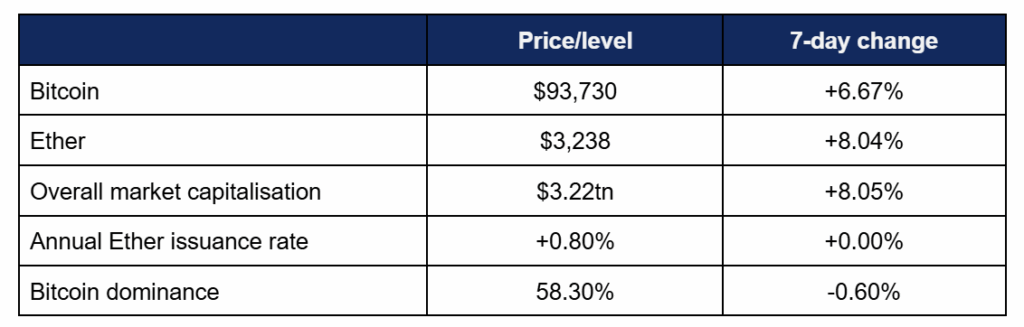
- Bitcoin bounced back from last week’s decline, exhibiting steady upward momentum since closing out 2025 at around $87,500
- The leading digital asset increased from a weekly low of $87,180 on Wednesday to a weekly high of $94,480 on Monday
- This marked Bitcoin’s best performance in over a month, including its longest continuous run above $90,000 since early December
- Ether returned above $3,000 and spent the majority of the week trading there; increasing from a Tuesday low of $2,938 to a Monday high of $3,261
- Open interest has shifted towards the $100,000 price point for the end of January, according to data from derivatives platform Deribit
- Wintermute OTC head Jake Ostrovskis told Bloomberg “direction is consistent – it feels like the market is no longer expecting the worst in terms of downside activity”
- Overall market capitalisation returned above $3tn and sits near its intraweek high of $3.22tn
- This included positive momentum across the wider altcoin complex, with numerous major projects posting double-digit growth
- According to industry monitoring site DeFi Llama, total value locked in DeFi surged almost $10bn to $127.2bn
Digital assets began the year brightly, with strong performance across the ETF complex backed up by endorsements ranging from Accounting’s Big Four to Japan’s finance minister. Although reporting remained limited as trading was truncated by the New Year’s holiday period, there were nonetheless several key developments ranging from M&A to prediction markets to regulation.
What happened: ETF News
How is this significant?
- Digital asset investment products built on last week’s growth, starting the year with strong inflows in a truncated trading week
- According to Coinshares data published on Monday, the trading week ending Friday the 2nd logged around $660m inflows across Bitcoin, Ether and XRP funds
- Coinshares Head of Research James Butterfill noted that whilst overall Bitcoin inflows declined in 2025 due to a bearish Q4, “Ether funds registered $12.7bn in inflows – a 138% annual increase. They were followed by XRP funds with $3.7bn and Solana products with $3.6bn, representing 500% and 1000% growth, respectively”
- Additionally, there was growth in global activity; Germany surged from $43m outflows in 2024 to $2.5bn inflows in 2025, and Canada grew from $630m outflows to $1.1bn inflows
- Spot Bitcoin ETFs logged three days of nine figure inflows over the last four trading days since December 30th, ranging from $325m to $471m
- The only outflows came on New Year’s Eve at $348m
- BlackRock’s closed and started the year(s) with strength, adding $144m, $287m, and $373m on Tuesday, Friday, and Monday respectively
- Other healthy performances included Fidelity’s FBTC ($191m on Monday), and ARK Invest’s ARKB ($110m Tuesday)
- According to late-breaking Monday trading data, spot Bitcoin ETFs had their best day in weeks, adding a total of $697m
- Spot Ether ETFs also returned to overall growth in the New Year, adding $175m and $168m respectively on Friday and Monday, led by BlackRock’s ETHA and both of Grayscale’s funds
- In other ETF news, Grayscale filed to list a fund for TAO, the native token of the AI-centric Bittensor network
- Grayscale chair Barry Silbert said “Decentralised AI is developing quickly, and Grayscale is pioneering access”
Crypto Treasury news
What Happened?
- Leading Bitcoin treasury firm [Micro]Strategy built on last week’s $109m Bitcoin buy with a $116m purchase to kick off the New Year
- These latest additions were funded by at-the-market sales of its MSTR Class A common stock
- The firm’s total Bitcoin holdings now stand at 673,783 Bitcoin, acquired at an average price of about $75,026; crossing the $75,000 threshold for the first time
- It was noted that Bitcoin’s lacklustre Q4 performance meant “a sizeable loss” for the firm, as “The enterprise value of the company is on the verge of dropping below that of its Bitcoin stockpile for the first time in more than two years”
- Leading Ether treasury firm BitMine bought another 33,000 Ether over the last week, bringing total holdings above 4.14 million tokens
- This brings the company closer to its goal of acquiring 5% of total Ether tokens, as chairman Thomas Lee wrote “We are excited about the prospects for Ethereum in 2026 given the multiple tailwinds of US government support for crypto, Wall Street embracing stablecoins and tokenisation… Moreover, the surge in commodity and precious metals in 2025 bodes well for crypto prices in 2026, which tend to follow metal price moves”
- Meanwhile, Japan’s largest Bitcoin treasury firm, Metaplanet, reaped the rewards of its recent return to acquisitions, as its shares jumped over 10% in Tokyo Tuesday trading, buoyed by Bitcoin’s positive price performance
- However, there was a shift away from adoption as another smaller DAT firm moved away from a digital asset treasury strategy after the bruising Q4 market downturn
- Health firm Prenetics (backed by David Beckham) announced it would maintain its current stash of 510 Bitcoin, but not add to it
Prediction market news
What happened?
- The blockchain-based peer-to-peer prediction market industry continued gaining steam heading into the New Year, with several significant developments reported
- Polymarket and Kalshi closed 2025 as the top two largest US funding rounds of the year, accounting for over $3.7bn of $56bn raised globally across fintech firms
- This included the largest overall round of the year, when Polymarket raised $2bn from NYSE owner Intercontinental Exchange in October
- According to Pitchbook data, digital asset-based firms featured in six of the year’s ten biggest raises; Polymarket, Kalshi (on two separate occasions), crypto exchange Kraken, XRP developers Ripple, and stablecoin blockchain Tempo
- The decentralised nature of predictions markets also came into sharp focus thanks to geopolitics this week, after a user made over $400,000 betting on the capture of Venezuelan president Nicholas Maduro before the end of January
- This naturally raised concerns over possible insider trading from people within the US administration or military; pro-crypto congressman Ritchie Torres (a Democrat) responded by filing a bill to prohibit government officials from any prediction markets involving “government policy, action, or political outcome”
- Polymarket also expanded into new markets; it partnered with real estate data firm Parcl to provide crypto-native prediction markets on housing index prices
- Parcl will provide daily housing indices for settlement, whilst Polymarket will operate the markets based on a series of templates, beginning with a focus on large US metropolitan areas
What happened: PwC expanding crypto industry services
How is this significant?
- According to a report in the Financial Times this week, accounting and auditing giant PwC is actively increasing its involvement with the digital asset industry, embracing crypto thanks to greater regulatory clarity
- PwC US Senior Partner and CEO Paul Griggs said the firm would “lean in” to crypto industry projects, specifically citing recent legislative efforts as a catalyst
- He told the FT “The GENIUS Act and the regulatory rulemaking around stablecoins I expect will create more conviction around leaning into that product and that asset class. The tokenisation of things will certainly continue to evolve as well. PwC has to be in that ecosystem”
- Thanks to the more supportive regulatory regime of the Republican administration, PwC has now shifted from “arms-length” to “hyper-engaged” mode; auditing and consulting within the industry, alongside pitching existing clients on crypto (including stablecoins) as a means of improving efficiencies
- One key industry client already on PwC’s books is mining giant Marathon (MARA), audited by the firm
- Most of the accounting “Big Four” have signalled a shift towards digital assets over the last year; KPMG dubbed 2025 a “tipping point” for adoption, and Deloitte published its own Digital Asset Accouting Roadmap in May, updating in December
What happened: South Korea experiences $110bn capital flight due to restrictive crypto rules
How is this significant?
- South Korea, one of the world’s largest and most active digital asset trading markets, experienced around $110bn worth of off-shore transfers last year, as the government’s regulation attempts were marked by delays
- The proposed Digital Asset Basic Act was delayed at the eleventh hour due to disagreements over stablecoin policy, which according to industry publication Coindesk “raised concerns among market participants that Korea’s centralised crypto exchanges (CEXs) are increasingly unable to compete with offshore platforms offering more complex trading products”
- Such concerns have been vocalised within South Korea, where the Aju Press news agency reported in November that “The number of South Korean investors holding large sums in overseas cryptocurrency exchange accounts has more than doubled in a year, reflecting both the global market’s resurgence and growing frustration with South Korea’s restrictive trading environment”
- Current regulations limit South Korean exchanges to spot trading, leading investors to transfer funds onto foreign exchanges offering a fuller suite of services
- A new report by Tiger Research and industry data portal Coingecko found that a total 160tn Won (around $110bn) moved from local to overseas exchanges last year, despite official prohibitions demanding Koreans use Korea-based platforms
What happened: Japanese finance minister supports digital asset integration into stock market
How is this significant?
- Speaking at the first annual trading session of the Tokyo Stock Exchange this week, Japan’s finance minister Satsuki Katayama signalled her support for integrating digital assets across the nation’s existing financial infrastructure, dubbing 2026 “the Digital Year”
- According to Katayama, stock and commodity exchanges can play a “crucial role” in expanding access to digital assets, citing the success of spot ETFs in the US as a prime example and potential inflation hedge for investors
- She stated “For the public to enjoy the benefits of digital assets and blockchain-type assets, the role of securities and commodity exchanges is important… As finance minister, I will fully support efforts by exchanges toward developing such cutting-edge fintech and technology-enabled trading environments”
- Japan has made some moves recently to ease restrictions on crypto, including reclassification of 105 assets as “financial products”, and plans to reduce tax on gains to a flat 20% from a high of 55%
What happened: Apollo sells Bitcoin kiosk firm to Alaskan investment fund
How is this significant?
- Apollo Global Management announced the sale of its cash-to-crypto Coinstar kiosk business this week, to an investment fund focused on delivering returns for indigenous Alaskans
- Arctic Slope Regional Corp. was created as part of a US government settlement with native Alaskans in 1972, and ranks as the largest Native American sovereign wealth fund in the US, according to the SWFI, with more than $1bn in dividend payouts since its founding
- Although exact terms of the deal were not disclosed, Arctic Slope “will repay more than $750m of principal plus all interest [on Coinstar bonds] in early January”
- Apollo acquired Coinstar in 2016, operating a network of nearly 25,000 machines where customers can exchange loose change for cash or crypto
- A pandemic-led cash crunch caused the company to restructure debt, leading to the current payoff for bondholders
- According to private equity industry reports, “the acquisition of Coinstar aligns with ASRC’s strategy to grow its investment base while supporting long-term returns for its shareholders”
This weekly financial roundup is for informational purposes only and is not financial, investment, or legal advice. Information is based on public sources as of publication and may change. Consult a professional before acting.