


Market Overview
Traditional institutions and digital asset firms hit key milestones this week, building strong foundations for the asset class’ future growth.
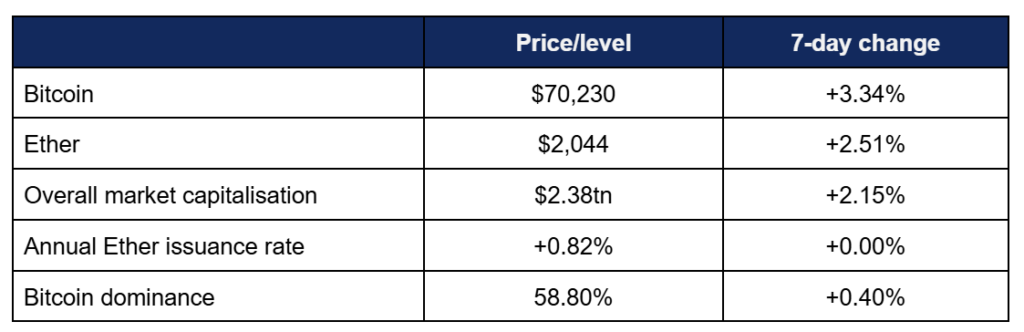
- Bitcoin had another positive week (despite intraweek volatility), comfortably surpassing $70,000 before a global move towards risk-off and oil speculation led to some pullbacks from its weekly highs
- Bitcoin peaked at $73,890 on Wednesday, briefly dropping below $66,000 to a weekly low of $65,920 on Sunday
- This high represented Bitcoin’s best level in a month, well above the $70,750 achieved in mid-February
- A new report by industry analytics firm Glassnode proposed that “the market is moving away from crisis pricing and into a consolidation phase where positioning, rather than panic hedging, becomes the dominant driver of price action”
- In a network milestone, the 20 millionth Bitcoin was mined this week (of a total 21 million limit); leaving the remaining 1 million coins to be mined over the next 114 years
- Ether also performed positively, with a $2,198 peak on Wednesday and a Sunday bottom of $1,918
- Overall market capitalisation reflected the volatility brought by macro conditions, with intraweek highs and lows of $2.49tn and $2.27tn respectively
- According to industry monitoring site DeFi Llama, total value locked in DeFi grew by over $2bn, to $96.9bn
Digital assets performed positively despite significant midweek volatility, with institutional milestones continuing to be reached. Kraken secured Fed payment access and partnered with Nasdaq for tokenised stocks. Indiana became the first US state to mandate the option of crypto in pensions and Kazakhstan’s central bank plans $350M crypto investments.
ETF News
What happened?
- Digital asset investment products netted a second consecutive week of inflows, despite a late momentum reversal due to the escalation of war in Iran
- According to Coinshares data published on Monday, the trading week ending Friday the 6th registered $619m worth of inflows
- Unlike in previous weeks, non-American markets logged overall outflows, as US traders flocked back
- This represented “a week of two halves”, with strong inflows up to Wednesday, before the emerging oil crisis (and inflation risks) led a shift into outflows
- Coinshares Head of Research James Butterfill remained positive, writing “Ultimately, the rise in oil prices offset any potential decline in inflation that might otherwise have resulted from the weak payroll data… Regardless, the overall flow data points to broadly positive sentiment toward the asset class during a period of geopolitical stress”
- Spot Bitcoin ETFs opened the week strongly, with daily inflows of $458m, $225m, and $462m
- When momentum reversed on Thursday, it accounted for daily outflows of $228m and $349m to round off the week
- The week was dominated by BlackRock’s IBIT, as the fund registered three nine-figure inflows (topping out at $322m on Tuesday)
- However, the largest outflows were reserved for Fidelity’s FBTC, which shed $158m of capital on Friday as risk-off investor behaviour returned
- On Wednesday, all but one ETF registered inflows; the holdout being Valkyrie’s BRRR, which had registered its first inflow in weeks the day prior
- Early (but incomplete) reports on inflows yesterday indicated a return to inflows as markets digested the details of US strikes on Iran
- Spot Ether ETFs displayed a slightly more muted pattern, featuring inflows on Monday and Wednesday ($39m and $169m respectively) and three days of outflows (between $11m and $91m)
- The week’s top performer was Grayscale’s 0.15% fee mini-ETF, which added $60m on Wednesday; but perpetual front runner BlackRock also had a good week, as its ETHA fund logged four straight days of eight-figure inflows
- In other ETF news, BlackRock updated its filing for a staked Ether ETF, reducing its proposed base staking fee from a previous 18% of rewards down to 10%
Stablecoin news
What happened?
- The stablecoin sector continued its recent record of activity, with numerous major names from both DeFi and TradFi featuring in reporting this week
- USDC issuers Circle put their (blockchain) money where their mouth is, settling $68m across its eight entities by using its own stablecoin rather than traditional banking rails
- According to CEO Jeremy Allaire, this workflow took about half an hour, compared to wire transfers from banks which typically took between one and three days to clear
- The transactions were executed through the company’s Mint platform, used to create or redeem USDC, and carried out intercompany transfer pricing
- Bloomberg also noted that Circle (along with payment processor Stripe) is currently at the forefront of developing automated payment systems for A.I. agents, potentially replacing network fees of the big credit card issuers
- On a recent earnings call, Allaire said “We’re building a new internet financial system, and I think we’re very optimistic that Circle can play a really key role in this convergence between AI and stablecoins and blockchain”
- These so-called “agentic payments” could prove crucial in a future world where more A.I. agents communicate with – and transact – with each other
- Benchmark-StoneX analyst Mark Palmer told Bloomberg “Microtransactions are a poor fit for traditional rails in terms of cost, latency and programmability. A.I. agents would benefit from programmable money that can be embedded directly into software workflows without long settlement windows”
- Both Circle and Stripe are building their own stablecoin-centric blockchains, where such “nanopayments” could be cheaply and automatically transacted
- According to a Monday press release, global insurance giant Aon recently worked with Coinbase and Paxos to test out insurance premium payments via stablecoin
- The firm called the pilot program “the first known use of stablecoins by a major global insurance broker for premium settlement”
- Transactions were settled on Ethereum and Solana with USDC and PYUSD stablecoins
- CEO Tim Fletcher stated “Our position as a first mover in accepting stablecoin to settle insurance premiums advances our commitment to innovating on behalf of clients to better serve their needs… By building real-world understanding of stablecoins early, we are strengthening our ability to advise on risk, governance and resilience as digital finance evolves”
- Aon’s Head of Corporate Portfolio Strategy John King added “While broader adoption of stablecoins across corporate payments is still emerging, the long-term potential is significant… we are prepared to evaluate efficiency and cost-savings opportunities over time as the technology matures”
- Stripe-owned stablecoin platform Bridge and Visa have expanded the stablecoin-linked card issuance which they first unveiled last year
- On Tuesday 3rd March, the companies confirmed the products are already live in 18 countries, with plans for expansion across a further 100 across Asia Pacific, Europe, and MENA by the end of the year
- Visa’s Head of Crypto Cuy Sheffield commented “Expanding our work with Bridge gives us one more way to bring the speed, transparency and programmability of stablecoins directly into the settlement process. This milestone gives our partners greater choice in how they move value, and it reinforces Visa’s role as a trusted network connecting stablecoins and the global payments ecosystem”
- Jack Dorsey, CEO of payment processor Block, revealed in a WIRED interview that his company will support stablecoins
- He noted that the move goes against his personal philosophy as a Bitcoin purist, but that “our customers want to use them… I don’t think it’s wise to go from one gatekeeper to another”
Crypto Treasury news
What happened?
- Leading treasury firm Strategy added to its holdings made major Bitcoin buys this week, purchasing nearly 18,000 Bitcoin for $1.3bn
- For the sake of accuracy, Strategy bought 17,994 Bitcoin for approximately $1.28bn at an average price of $70,946 bringing total holdings to 738,731 BTC
- The buys were funded by sales of its Class A common stock, MSTR, and perpetual Stretch preferred stock (STRC)
- Leading Ether treasury firm BitMine meanwhile bought 60,976 Ether, ramping up its acquisition rate
- This represented an investment of around $120m, and took company Ether holdings above $9bn
- In a weekly press release Chairman Thomas Lee predicted that better times may be coming for the sector; “We continue to believe that crypto prices are in the late/final stages of the ‘mini-crypto winter. As the adage goes, nobody rings the bell at the bottom… Therefore, BitMine’s strategy is to slightly increase its pace of Ether accumulation”
- Thanks to Ether staking, the company is currently generating around $174m on its holdings, potentially rising to $259m annually (at current prices) when all its tokens are locked as validators and earning yield
Industry VC news
What happened?
- The Wall Street Journal reported that blockchain-based and crypto-friendly prediction markets Kalshi and Polymarket are both considering new funding rounds at $20bn valuations
- This represents a doubling of their previous rounds from last year, as monthly trading volume on both platforms hit around $18.3bn in February according to data from industry publication TheBlock
- Cross-border stablecoin payment platform KAST concluded an $80m Series A round at a $600m valuation
- The round was led by QED Investors and Left Field Capital, and the funds will be dedicated towards product and headcount expansion
- The latter was reflected this week, as the company hired former Binance communications lead Brad Jaffe as its chief communications officer
- Fortune reported that Andreessen Horowitz(a16z)’s crypto arm is raising $2bn for a new fund, its fifth dedicated to the industry
- Sources say the firm wants to close the raise within the first half of the year, and represents a significant increase from the $650m raised by Dragonfly Capital last month (albeit also a significant decrease from a16z’s $4.5bn crypto fund in 2023)
- Zcash Open Development Lab raised $25m in seed funding for development of blockchain privacy technology
- Early investors included Paradigm, a16z crypto, Winklevoss Capital, Coinbase Ventures, and Balaji Srinivasan, amongst others
What happened: Indiana becomes first US state to mandate crypto option in pension plans
How is this significant?
- The US state of Indiana advanced the inclusion of digital assets in retirement plans this week, recognising it as a legitimate investment class
- Indiana governor Mike Braun signed House Bill 1042, essentially mandating state-managed pension plans to offer at least one crypto asset investment option.
- VanEck’s Head of Research Matthew Sigel commented; “Indiana has become the first state in the US to legalise the inclusion of Bitcoin and other crypto assets into state-managed retirement and savings plans”
- A key difference to existing crypto inclusion is that this bill covers not just spot crypto ETFs, but plans holding digital assets directly
- The new bill effectively acts as a “Bitcoin Bill of Rights” in the state, protecting Indiana residents with anti-discriminatory taxation, guaranteeing the right to self-custody, and confirming the individual right to accept crypto as payment.
- According to industry publication Pension Policy International, at least 21 states are currently evaluating investments or actively investing in digital assets.
- On Friday, the Los Angeles Daily News reported that California’s two largest public pension plans, CalPERS (the nation’s largest) and CalSTRS, currently hold around $300m in crypto exposure.
- In terms of potential impact of such news, some analysts believe a 1% allocation across crypto from US pension funds could add $120bn in fresh capital to the market
- Last year, the UK’s Cartwright Pension Trusts fund generated a 56% return from their first year of Bitcoin exposure, and the Wisconsin Investment Board realised $200m in less than a year of holding crypto ETFs
What happened: Kraken becomes first crypto firm to secure Fed Payment access
How is this significant?
- Following several weeks of reports regarding banking charters for crypto firms, and crypto custody charters for TradFi, another major evolution in the industry occurred this week; direct central bank access
- The Wall Street Journal broke news that crypto exchange Kraken now holds “a limited purpose account” from the Federal Reserve bank of Kansas, allowing it to “move money on rails typically reserved for licensed banks”, rather than relying on partner banks
- Kansas City Fed president Jeff Schmid stated “As we know, the payments landscape is actively evolving. Throughout this transformation, the integrity and stability of the US payments system remain our priority”
- Kraken co-CEO Arjun Sethi commented “This milestone marks the convergence of crypto infrastructure and sovereign financial rails. With a Federal Reserve master account, we can operate not as a peripheral participant in the US banking system, but as a directly connected financial institution”
- Meanwhile however, the Bank Policy Institute pushed for continued separation of DeFi and TradFi, stating; “We are deeply concerned that the Federal Reserve Bank of Kansas City has approved an account request for a ‘limited purpose’ master account before the Federal Reserve Board has finalised its policy framework for those accounts”
- US Senator for Wyoming Cynthia Lummis believes the move heralds a new dawn for financial structures, telling CNBC; “This approval is a watershed moment for the digital asset industry… You’re going to see banks buying digital asset companies, digital asset companies buying banks”
- Crypto infrastructure service firm Zerohash became the latest industry entity to apply for a national trust bank charter, following Circle, Ripple, Fidelity Digital Assets and Paxos amongst others
- Chief legal officer Stephen Gardner said “Stablecoins and digital assets are increasingly becoming part of the core financial system. Applying for a National Trust Bank Charter is a natural next step in offering robust global licensing coverage and continuing to expand our product offering”
- A US banking lobby could push back against these new charters, and is reportedly weighing a lawsuit, according to The Guardian on Monday
- The report claims that the Bank Policy Institute’s member banks “contend that granting these firms a national charter provides an official federal imprimatur without subjecting them to the same stringent capital and compliance requirements as fully fledged banks”
What happened: Digital asset exchange benefits from increased oil trading appetite
How is this significant?
- In a sign of the continued confluence between digital and traditional markets, oil has emerged as the second-most popular trade on crypto derivatives exchange Hyperliquid, behind only Bitcoin
- Oil-linked perpetual futures exceeded $1.8bn in daily volume on the exchange, which unlike traditional markets operates 24/7/365
- Appetite for tokenised crude contracts was catalysed by the ongoing war in Iran and a major oil producer putting pressure prices
- Tokenised gold and silver contracts also saw increases as investors flocked to traditional risk hedging assets, but Bitcoin remained by far the venue’s most popular trade, logging over $2.8bn daily volume
- Bloomberg noted that “Hyperliquid has grown rapidly into one of the largest venues for perpetual futures trading, and an upgrade last year allowed third-party developers to launch contracts tracking assets beyond crypto – including commodities and equity indexes”
What happened: NYSE parent company invests in crypto exchange at $25bn valuation
How is this significant?
- Intercontinental Exchange (ICE), the parent company of the New York Stock Exchange (NYSE), made a major investment in digital assets this week, acquiring a stake in crypto exchange OKX at a $25bn valuation
- Fortune broke the news on Thursday, the latest in several moves by NYSE, including last year’s $2bn bet on blockchain-based prediction platform Polymarket
- Although the exact size of the investment wasn’t disclosed, some sources claimed that ICE spent $200m on its minority stake
- Some analysts voiced surprise at the choice of OKX – traditionally stronger in Asia and a relative newcomer to the US market – but the company represents an existing customer base of 120 million for new tokenised equity products
- ICE’s Strategic Initiatives VP Michael Blaugrund commented “On-chain infrastructure is going to become a critical component of trading clearing, settling and capital formation… Our plan is to ensure that we have either developed our own capabilities to provide those solutions or to find the leading firms in the world that are building those frontier capabilities”
- NYSE customers will gain access to crypto-based futures and OKX customers will be able to trade tokenised securities on NYSE’s upcoming platform as per the deal
What happened: Nasdaq partners with Kraken for tokenised stock trading
How is this significant?
- Crypto exchange Kraken hit the headlines twice this week; for securing Fed Payments access, and for revealing a collaboration with Nasdaq
- The two will work together developing “a system for issuing and trading tokenised versions of stocks and other exchange-traded products”, potentially rolling out the service within the next year
- These tokenised stocks would confer all the same rights and privileges (such as voting and dividends) as traditionally-issued stocks
- Nasdaq initially outlined its vision for stock tokenisation last September, and now appears to be realising it alongside crypto-natives Kraken (or rather, its parent company Payward)
- According to details shared by both companies “the system will rely on Kraken’s xStocks framework, which provides tokenised exposure to publicly traded equities on blockchain networks”
- Nasdaq president Tal Cohen commented “Tokenisation has the potential to unlock the benefits of an always-on financial ecosystem – enhancing how investors access markets and how issuers engage with shareholders”
- Kraken co-CEO Arjun Sethi added “Tokenisation improves market infrastructure at the asset layer by enabling equities to exist as interoperable instruments across regulated financial systems and open blockchain networks while preserving issuer rights and price integrity”
- In other tokenisation news, the Bank of Canada successfully completed a tokenised bond issuance worth CAD$100m, as part of a pilot named Project Samara
- The bond in question had a maturity of under three months, and pilot participants included RBC Dominion Securities, RBC Investor Services Trust and the TD Securities division of Toronto-Dominion Bank
What happened: Kazakhstan Central Bank allocates $350m to crypto investments
How is this significant?
- Reuters reported on Friday that Kazakhstan is preparing for state-level exposure to the digital asset industry, with a significant chequebook
- Central bank governor Timur Suleimanov confirmed “a portfolio of up to $350 million from gold and foreign exchange reserves for investment in crypto assets… including companies that deal in digital assets”
- This only represents a fraction of the country’s $69.4bn gold and forex reserves, but nevertheless a significant step in the history of countries deliberately pursuing a crypto investment policy
- Deputy central bank chair Aliya Moldabekova told Reuters “We are not talking about any large investment in cryptocurrencies. We are currently selecting companies that deal with digital assets, for example those involved in cryptocurrency infrastructure”
- According to central bank officials, this evaluation process should conclude in March, with investments being made in April and May
This weekly financial roundup is for informational purposes only and is not financial, investment, or legal advice. Information is based on public sources as of publication and may change. Consult a professional before acting.