



Market Overview
Digital assets posted a third positive week, emerging as a potential hedge amid ongoing geopolitical conflicts and uncertainty.
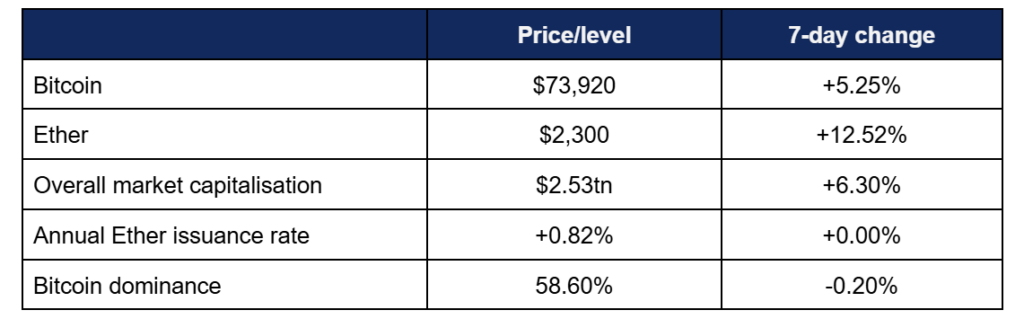
- Digital assets built on recent bullishness, recovering further from their yearly lows in February
- The Strait of Hormuz closure may have highlighted the potential benefits of digital assets, which can move across borders instantly, with no single party able to control or restrict their distribution
- Whilst stock markets suffered, digital assets performed positively, with double-digit recoveries for numerous projects within the top 100 market capitalisations
- Bitcoin briefly breached $75,000 on Monday (16/03) , its strongest showing in well over a month
- Bitcoin increased steadily throughout the week and peaked at $75,860 on Monday, up from a low of $69,110 on Wednesday
- Some analysts believe Bitcoin may be approaching (but hasn’t quite reached) the point where previous markets bottomed, based on numerous indicators including trading price vs on-chain cost basis
- Ether moved similarly but outperformed Bitcoin, from a Wednesday low of $2,011 to a Monday high of $2,377
- Investor sentiment on the Fear & Greed index improved markedly, moving into “neutral” territory at 43/100
- Overall market capitalisation peaked at $2.57tn on Monday
- According to industry monitoring site DeFi Llama, total value locked in DeFi surged around $4bn, moving back above $100bn
Digital assets showed renewed bullish momentum this week, holding firm despite ongoing geopolitical tensions and broader market uncertainty. Institutional adoption continued to gain traction as banking giants Standard Chartered, HSBC and Wells Fargo made notable moves. Mastercard launched a new industry program with 85 partners, and Ripple initiated a $50 billion share buyback.
ETF News
What Happened?
- Digital asset investment products recorded a third consecutive week of inflows, as institutional buying power continued to return
- According to Coinshares data published on Monday, the trading week ending Friday the 13th proved lucky, as it logged $1.06bn inflows
- This pushed year-to-date flows back into positive territory, making up for a five-week negative run throughout January and February
- Bitcoin accounted for the majority of these inflows, as Coinshares Head of Research James Butterfill claimed recent performance “reinforced digital assets, particularly Bitcoin, as a relative safe haven compared with other asset classes. Since the onset of the Iran crisis, total assets under management (AuM) in digital asset ETPs have risen by 9.4% to $140bn”
- Spot Bitcoin ETFs logged a week of exclusively inflows for the first time this year, including four trading days of nine-figure flows
- BlackRock’s IBIT once again dominated, as the only fund to record nine-figure flows (on each of the four days)
- These positive flows ranged between $115m to $189m, with the lowest weekly returns (on Thursday) still accounting for $46m
- Fidelity’s FBIT was the next-best performer, also delivering five consecutive positive trading days, ranging from $15m to $60m
- Bloomberg’s chief ETF analyst Eric Balchunas pointed out that ETFs remain the largest group of Bitcoin holders, ahead of treasury firms, with BlackRock-custodied Bitcoin exceeding the holdings of arch-advocates Strategy
- Spot Ether ETFs also experienced a week of positive performance, with four consecutive days of inflows following a negative open on Monday
- This included the launch of BlackRock’s new staked Ether ETF on Thursday, featuring a first-year fee waiver of 0.12%
- The fund, ETHB, debuted strongly with $44m inflows, but came second in daily returns after Fidelity’s FETH, which logged $52m the same day
- Overall, it was neck-and-neck between BlackRock’s Ether complex and FETH, as most other firms returned net zero weeks
- In other ETF news, $1.8tn asset manager T. Rowe Price updated its October filing for a new crypto basket ETF, adding new assets to its potential roster of between five and fifteen tokens
- Unlike most crypto ETFs, the proposed fund would be actively managed, cycling between a diverse collection of crypto assets depending on market conditions
- The filing claims it “will be rebalanced using quantitative models that incorporate fundamentals, valuation and market momentum, with the goal of outperforming the FTSE US Listed Crypto Index”
Stablecoin news
What happened?
- Stablecoin adoption and development continued advancing internationally, as banks and institutions embrace the potential payment improvements offered by the technology
- Hong Kong’s South China Morning Post newspaper reported that the finance hub is set to grant its first batch of licences for stablecoin issuance
- This follows Stablecoin Ordinance regulations passed last August, with the paper noting “the number of licences and timetable…. remain[s] subject to change, but sources said a possible date was March 24th”
- HSBC and Standard Chartered are understood to be amongst the first cohort of licensees, according to sources
- The Hong Kong monetary authority reportedly favours bank-led issuance for the assets, believing they “can provide greater safety while promoting broader adoption”
- Bank of England’s deputy governor Sarah Breeden revealed that the UK could revise previous policies for maximum stablecoin holding limits, following backlash against the plans
- Under the terms of its current proposed regime, announced in November 2025, individuals would be limited to £20,000 worth of any single stablecoin, and businesses £10m
- These plans faced backlash from both individuals and industry businesses, as it marks a much tougher environment than the US under GENIUS regulations
- Breeden said these proposals were meant to mitigate “the very real risk” of customers shifting deposits from banks to stablecoins, but added “We proposed holding limits as a way of managing that risk… We are open to feedback on other ways of achieving it”
- Benoit Marzouk, CEO of sterling-pegged stablecoin issuer Tokenised GBP, told Bloomberg. “There’s really a small window to get things right… It could be really damaging for the UK, if we had this limit for both retail and companies. As a business, you can’t do anything with £10m [limits]”, particularly as issuers can’t necessarily track which blockchain addresses are associated with which individual holders on secondary markets
- Leading stablecoin issuer Tether was the subject of a Bloomberg Feature this week, where CEO Paolo Ardoino described the company as “almost like a mix between Google and Blackstone”, noting that the US is the subject of its expansion plans in a post-GENIUS landscape
- Tether has experienced a dramatic about-turn in fortunes, from regulatory pressure under the Biden administration to participation in a $100m crypto Super-PAC
- It’s noted that the company now holds over 140 different investments in its portfolio, as part of a long-running revenue diversification plan
Crypto Treasury news
What happened?
- Leading treasury firm Strategy executed its biggest Bitcoin acquisition since January, building on last week’s $1.3bn buy
- The firm bought 22,337 Bitcoin for $1.6bn, funded by $1.2bn sales of its perpetual Stretch preferred stock (STRC), and $400m of Class A common stock
- This reflected the largest sale of its Stretch stock since initial creation in July, offering 11.5% annual payouts
- This included a $50m Stretch buy from Vivek Ramaswamy’s Strive Inc, which is also pursuing a Bitcoin reserve strategy and currently holds 13,300 Bitcoin
- Some analysts disagreed as RIA Advisors Portfolio Manager Michael Lebowitz told Bloomberg “They’re putting a lot of risk on the table if Strategy can’t perform. Any Strive shareholders should be outraged”
- Leading Ether treasury firm BitMine also upped its previous week’s purchase; albeit from 60,976 Ether to 60,999
- This represents its largest addition of the year, as the company remains on track for its goal of holding 5% of the total Ether supply
- In the company’s weekly press release chairman Thomas Lee noted digital assets’ emerging role as a potential conflict hedge; “Since the start of the Iran war, crypto prices have outperformed and Ethereum has outperformed the S&P 500 by 2,450 basis points. In our view, higher oil is triggering concerns of slowing growth for the global economy. And when investors worry about growth, they buy ‘growth stocks’ including MAG7, software and crypto”
- Finally, leading Japanese Bitcoin treasury firm Metaplanet raised $255m from institutional investors via a share premium, designed to fund future Bitcoin buys
- Company CEO Simon Gerovich said the financing package includes “additional firepower” to a potential $531m in pursuit of the company’s 210,000 Bitcoin goal
Industry VC news
What happened?
- Several companies within the digital asset sphere concluded significant raises or advanced IPO plans this week, reflecting a continued improvement in overall sentiment regarding the industry
- Digital asset wealth management platform Abra announced it would go public via an SPAC merger, valuing the firm at $750m
- Under the terms of the deal, Abra would rebrand as “Abra Financial Inc.”, trade on Nasdaq under the ABRX ticker, and gain $300m cash currently held by SPAC firm New Providence Acquisition Corp. III
- CEO Bill Barhydt commented “We believe that Bitcoin, stablecoins and the tokenisation of real-world assets are quickly becoming the backbone of the future financial system”
- Digital asset accounting firm Cryptio closed a $45m Series B round, capitalising on increased institutional adoption of the asset class
- Valuation was not publicly disclosed, but the raise tripled its $15m Series A round from 2022
- Meanwhile, Bitpanda Vice President Vishal Sacheendran outlined his company’s IPO ambitions in an interview with Coindesk
- Sacheendran says “Bitpanda is expanding globally by bringing crypto rails to banks and institutions”, with a focus on Europe, Latin America, and the Middle East
- The company is reportedly planning a public listing via the Frankfurt stock exchange this year, valued between 4bn and 5bn Euros
What happened: Circle and Binance join Mastercard crypto program
How is this significant?
- Payment processing giant Mastercard launched a new Crypto Partner Program on Thursday, announcing in a press release that “Digital assets are entering a new phase”
- The firm believes that crypto “is increasingly being applied to solve practical, real-world needs – often behind the scenes – from cross-border remittances to B2B money transfers”
- As a result, it is kicking off the Mastercard Crypto Partner Program; “a new global initiative that brings together more than 85 crypto‑native companies, payments providers, and financial institutions to create a forum for meaningful dialogue and collaboration as this space continues to mature”
- This includes major digital asset firms such as Binance, Circle, Gemini and Ripple, alongside various banks and fellow payment processors PayPal
- The new program builds on Mastercard’s existing efforts in the crypto category, with the goal of unifying standards and “translating technical innovation into scalable, compliant use cases that can operate across markets and integrate seamlessly into everyday commerce”
- In other Binance news, the exchange sued Wall Street Journal publishers Dow Jones this week, alleging the newspaper falsely claimed staff were fired after raising compliance concerns regarding Iran-linked accounts
- Binance published a blog refuting the paper’s claims, and a spokesperson told industry publication Coindesk “Binance categorically did not dismantle any compliance investigation. The WSJ continues to report the same falsities. As a result, we have filed a lawsuit against the Wall Street Journal for defamation”
What happened: Ripple launches share buyback program at $50bn valuation
How is this significant?
- Digital asset giant Ripple, issuer of the XRP token, is running a massive share buyback program at a $50bn valuation, after a previous effort at a $40bn valuation “saw low participation from employees, who were reluctant to sell”
- The new buyback drive is worth $750m according to reports, and reflects a 25% increase in valuation since the firm raised $500m funds in November from backers including Citadel
- Despite the XRP token facing a similar value decline as the rest of the market since Q4 2025, activity on its blockchain network remains strong, including a recent milestone of total $100bn processed and its RLUSD stablecoin achieving $1bn market capitalisation within a year of launch
What happened: Wells Fargo Bank files digital asset trademarks
How is this significant?
- American banking giant Wells Fargo appears geared towards an increased presence within digital assets, following new trademark filings uncovered by journalists
- A Tuesday trademark filing for “WFUSD” indicated a potential crypto platform by the bank, as supporting documentation indicated WFUSD would offer “crypto asset payments processing”, “execute trades of digital assets”, and provide “services featuring software for tokenisation of assets”
- Given the industry standards of the -USD suffix, Wells Fargo could also be developing a proprietary stablecoin or tokenised deposit system under the trademark, but no spokesperson returned requests for comment at the time of publication
- This is the latest of several incursions into the category by major US banks, and follows on from Wall Street Journal reports last year that stablecoins are an area of particular interest from major banks
What happened: Stanley Druckenmiller forecasts crypto-powered financial future
How is this significant?
- In a recent interview with Morgan Stanley, billionaire investor Stanley Druckenmiller continued his history of pro-crypto proclamations, believing that digital assets could form a foundational part of future financial infrastructure
- Druckenmiller praised the underlying technology, saying “I assume our whole payment systems will be stablecoins in 10 or 15 years… [they’re more] efficient, quicker and cheaper… Blockchain and the use of stablecoins are incredibly useful in terms of productivity”
- However, he did question the sheer breadth of digital assets available, calling some “a solution in search of a problem”
- He also noted the potential for evolution within the category, citing the example of its leading asset shifting from its original “peer-to-peer electronic cash system” proposal to its current position as an investment asset
- “I’m actually disappointed it [Bitcoin] ended up becoming a store of value because it wasn’t originally needed for that. But it’s become a brand, and people love it. So it’s probably going to be a store of value”
- Druckenmiller also voiced doubt over the (very) long-term viability of the Dollar as a global reserve quality, musing “We’re doing everything we can to destroy it. But I’m 72, it’ll probably outlive me. I doubt it’ll be the reserve currency in 50 years, but I don’t have a clue what would be. Maybe some crypto thing I hate”
What happened: Digital asset trading firm BlockFills files for bankruptcy
How is this significant?
- Despite some recent recovery and a wave of adoption, good news has been too little, too late for some, as many industry firms are still suffering from the brutal crypto winter conditions of the last 6 months
- This includes institutional lender BlockFills, which filed for bankruptcy this week following $75m losses and suspension of withdrawals last month
- According to documents seen by Coindesk, the company has entered a voluntarily Chapter 11 restructuring, with liabilities of $100m to $500m versus assets of $50m to $100m
- The company issued an official statement on the matter, saying “a voluntary chapter 11 filing is the most responsible path forward in order to preserve the value of the business and maximise recoveries for stakeholders. This filing will allow the firm to implement an orderly restructuring while maintaining transparency and oversight through the court-supervised process”
- The firm primarily served institutional clients, providing “liquidity, financing and risk-management services”
- A lawsuit from Dominion Capital last week alleged that these financial pressures were not just the result of market conditions, but claimed the firm “misappropriated and improperly retained millions of dollars in customer crypto assets, commingled client funds and concealed significant losses”
What happened: Standard Chartered launches South Korean crypto firm with Hana Group
How is this significant?
- South Korea’s Yonhap news agency reported this week that global bank Standard Chartered (SC) is entering one of Asia’s largest crypto markets, via a partnership with local financial powerhouse Hana Group
- The Korean financial conglomerate has signed a memorandum of understanding with SC, to “leverage the combined expertise and networks to expand their global presence in traditional finance”
- According to the reports, joining initiatives would include the development of digital assets and stablecoins
- Hana Group chairman Ham Young-joo stated “We will create new growth opportunities through synergy in digital assets and other future financial sectors”
- Both firms have a history within digital assets, with SC co-founding Zodia and offering spot trading for institutional clients, whilst Hana owns a 25% stake in crypto custodian BitGo’s local venture
What happened: Ghana kicks off year-long virtual asset trading pilot program
How is this significant?
- Ghana moved to gradually introduce digital assets within its economy this week, officially announcing a year-long pilot program for companies to “test their products and services in a controlled environment”
- The country’s securities regulator has approved 11 companies as participants, including five exchanges and three tokenisation firms
- As Africa’s top gold producer, this includes a gold tokenisation program by the company Africoin, with gold-backed securities custodied by GoldBod
- After six months of the pilot program, regulatory-compliant companies with “market ready” offerings will be provided full licences to provide their services to a wider audience outside the pilot program parameters
- According to recent reports, around 17% of adult Ghanaians have dealt in virtual or digital assets, leading central bank governor Johnson Asiama to declare his desire that “emerging activity is brought within clear, accountable, and well-governed boundaries”
This weekly financial roundup is for informational purposes only and is not financial, investment, or legal advice. Information is based on public sources as of publication and may change. Consult a professional before acting.