



Market Overview
Digital assets pulled back further this week as escalation of geopolitical tensions led to greater investor caution across most markets
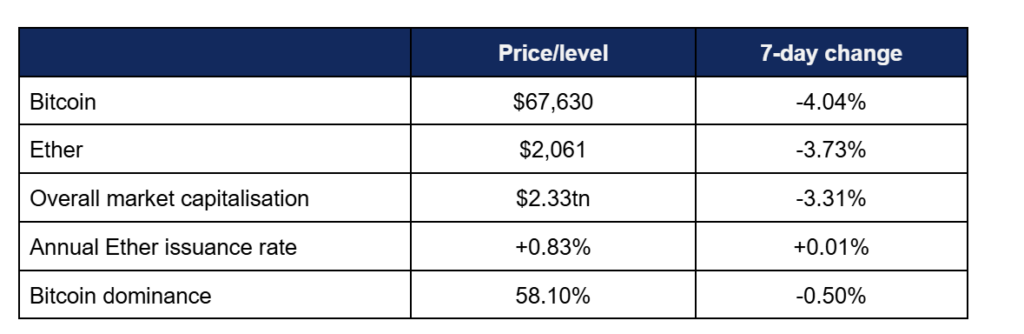
- Bitcoin peaked at $71,920 on Wednesday, before declining into the weekend and hitting a weekly low of $65,400 early on Monday
- However, despite its declines since Q4 2025, some analysts believe bullish times lie ahead; in a Tuesday note, Bernstein wrote that “Bitcoin market structure has matured”, evidenced by fewer cascading liquidations than in previous cycles and greater institutional demand via ETFs
- Ether echoed Bitcoin’s charts, with a Wednesday high ($2,194) and a Monday low ($1,967) before a moderate rally to current levels
- Overall market capitalisation hit a weekly low of $2.27tn
- According to industry monitoring site DeFi Llama, total value locked in DeFi fell around $2.3bn, to $92.1bn
Digital assets pulled back further from recent gains, as escalating global conflicts lessened investor risk tolerance. ETFs moved into outflow mode for the first time in five weeks, but crypto adoption continued despite market headwinds; Franklin Templeton moved to tokenise ETFs, Fannie Mae accepted a crypto-backed mortgage product, NYSE parent company Intercontinental Exchange increased its exposure to the industry, and much more.
ETF News
What Happened?
- Digital asset investment products experienced overall outflows for the first time in five weeks, as traders consolidated into risk-off mode due to geopolitical uncertainty
- According to Coinshares data published on Monday, the trading week ending Friday the 27th logged $414m outflows
- Coinshares Head of Research James Butterfill cited several factors behind this shift in momentum, most notable “the increasingly drawn-out nature of the Iran conflict and the prospects of higher inflation, with June FOMC interest rate expectations now flipped from rate cuts to rate hikes”
- However, he also noted that the US market bore the brunt of bearishness, as products in Canada and Germany registered weekly inflows in the eight-figure range as “German and Canadian investors saw the recent price weakness as an opportunity”
- Spot Bitcoin ETFs opened the week strongly with $167m inflows, before closing the week with $171m and $226m outflows respectively
- BlackRock’s IBIT was responsible for the vast majority of these flows, adding $161m on Monday before falling to four consecutive days of outflows
- Fidelity’s FBIT returned two days of eight-figure inflows, between $42m and $83m
- No other funds registered any inflows whatsoever, but the vast majority of them posted net-zero flows
- Bloomberg chief ETF analyst Eric Balchunas revealed that Morgan Stanley’s latest amended Bitcoin ETF filing shows the lowest fees of any spot product, undercutting IBIT by 11bps
- He notes “This means none of their advisors will feel conflicted using it and they have shot at getting outside assets. Smart. Launch prob in next two weeks”
- Spot Ether ETFs logged five days of outflows, ranging from $8.5m to $92.5m
- However, this did include BlackRock’s new ETHB staked Ether ETF continuing its post-launch run of inflows, closing out the week with $97m and $44m inflows on Thursday and Friday
- This may partly explain outflows from BlackRock’s first Ether ETF, ETHA, which does not offer any yield on holdings, perhaps encouraging investors to reallocate into the new fund
- In other ETF news, T-Strive applied for a digital asset treasury ETF, whilst LeverageShares applied for multiple inverse Bitcoin volatility ETFs
Crypto Treasury news
What happened?
- Leading treasury firm Strategy took a break from adding to its Bitcoin treasury, the first time in 13 weeks without a purchase
- In contrast, leading Ether treasury firm BitMine made its largest purchase of the calendar year, adding 71,179 Ether, worth over $140m at the time of writing
- In the company’s weekly update, chairman and CEO Thomas Lee outlined the company’s thesis for these increased buys; “As the Iran war enters its 5th week, ETH and crypto outperformed the broader market with ETH outperforming equities by 1,160bp. This is a marked contrast to Gold (a traditional store of value), which has underperformed by more than 750 basis points. Crypto is demonstrating itself to be a good ‘war time’ store of value”
- He added “the inverse correlation of crypto (and equities) to oil has been increasing and is at the highest levels in the past year. This is logical. Until equity markets become comfortable with the future trajectory of oil prices, rising oil is a headwind for equities and crypto. And in a sense, the crypto winter likely ends when the upside risk to oil prices peaks… our base case is ETH is in the final stages of the ‘mini-crypto winter.’ In the past week, we acquired 71,179 ETH compared to an average of 45k to 50k weekly prior to that”
What happened: Franklin Templeton to tokenise ETFs for 24/7 trading
How is this significant?
- $1.7tn asset management giant Franklin Templeton is taking its latest in a long line of steps supporting digital assets, by tokenising multiple funds to train on-chain via crypto wallets, at all hours
- The move comes in partnership with digital asset firm Ondo Finance, and “will initially be available in Europe, Asia-Pacific, the Middle East and Latin America” as Franklin awaits further US regulatory clarity, as the proposed market structure bill appears to be advancing with a potential April markup)
- According to Bloomberg, the tokenisation will take a unique form; “Ondo will purchase shares of the Franklin ETFs and issue tokens through a special-purpose vehicle that passes through the financial exposure to holders. Investors own rights to the return stream rather than the underlying shares – [freeing] the tokens to be used as collateral or plugged into decentralised finance applications in ways that registered fund shares cannot”
- Franklin Templeton believes that an audience of crypto-native investors who don’t use traditional brokerages is large enough to justify the move, where tokens are held directly in a user’s personal blockchain wallet
- The five funds in question span a range of industries, including US equity, gold, and corporate bonds
- In the last year, tokenised assets grew from $8bn to $26.5bn, according to Bloomberg data
- Franklin’s Head of Innovation Sandy Kaul said “You can think of this as a new distribution channel. These ETFs represent a good mix of different exposures. And it gives a good test case for us to see what is really striking the appetite to this a new audience”
- Franklin was one of first major financial institutions to become involved with digital assets, launching the first on-chain money-market fund, BENJI, back in 2021
- Bloomberg analysts declared that “broader implications could be significant. Tokenised ETFs may reduce settlement risk and counterparty exposure by enabling near-instant settlement. They could also improve capital efficiency by allowing assets to be reused more seamlessly as collateral”
- Industry publication ETFstream noted that fellow ETF issuer WisdomTree is “actively exploring” tokenised ETFs
- The company’s Head of Digital Assets Will Peck noted that “We want to see exposures beyond just money market funds being available and tradeable on-chain. The ability for exposures to exist in a way that customers want to hold them on chain with a good trading experience around them, that’s something we’re working on and we view that as being the next evolution”
What happened: Fannie Mae to accept mortgages backed by crypto
How is this significant?
- On Thursday, the Wall Street Journal reported that US mortgage association Fannie Mae will accept crypto-backed mortgages for the first time, further cementing digital assets within the American financial landscape
- In particular, mortgage issuers Better Home & Finance and leading American exchange Coinbase have teamed up on a new product which “allows borrowers to pledge Bitcoin and USDC stablecoin as collateral for a separate loan used to fund the down payment, rather than selling those assets to raise cash”
- This enables long-term crypto investors to preserve potential future upside, whilst also minimising collateral lost to capital gains taxes
- Since Federal Housing Agency director Bill Pulte first supported crypto within mortgage risk assessments last year, the concept has gained steam, but this represents the first product with the specific backing of Fannie Mae
- The mortgages are structured as conforming loans backed by Fannie Mae
- Better Home CEO Vishal Garg told Bloomberg “crypto democratizes the ability of regular Americans to access financial instruments that’s only for the traditionally wealthy”
- Additionally, the loans aren’t at risk of liquidation from any fluctuations in digital asset pricing, but only from delinquency on repayments
- Coinbase’s Mark Troianovski commented “People who are sitting on Bitcoin or USDC can put a roof over their head without needing to sell it, without needing to incur capital gains. We are giving people access to housing in a way that is very similar to how private bankers serve some of the wealthiest customers. They don’t sell assets to buy stuff; they actually take loans against assets”
What happened: NYSE parent company increases crypto footprint
How is this significant?
- Intercontinental Exchange (ICE), the parent company of the New York, increased its involvement in the crypto field this week via multiple streams
- The Wall Street Journal wrote that NYSE partnered with tokenisation firm Securitize “to develop a 24/7 Tokenised Securities Platform”
- According to the reports, “Securitize will become NYSE’s first digital transfer agent, allowing it to create shares for stocks and exchange-traded funds as digital tokens on a blockchain”
- In a press release, Intercontinental Exchange said that “The companies plan to collaborate on the development of standards for digital transfer agents and tokenisation agents participating in the digital ecosystem, with a focus on establishing regulatory, operational, and technology requirements for institutional-grade tokenized securities infrastructure”
- The announcement came just a few days after Nasdaq received SEC approval to list tokenised equities, indicating the momentum behind the concept following backing from luminaries including BlackRock CEO Larry Fink
- Later in the week, ICE invested another $600m in prediction platform Polymarket, following on from an initial $1bn investment last year, potentially rising to $2bn
- A press release noted the move as part of an equity capital fundraising move by Polymarket, and outlined the potential for a potential further $40m of Polymarket securities purchases from existing holders
- However, NYSE is unlikely to increase its exposure beyond current levels, saying on Friday that it has “completed its obligations” within the scope of last year’s initial investment, with the total amount to be disclosed after Polymarket completes current fundraising
What happened: Bitpanda enters tokenisation race
How is this significant?
- European digital asset broker BitPanda “is launching a blockchain [on Ethereum Layer-2 Optimism] to let European banks and fintechs issue and settle tokenised assets under rules such as MiCA and MiFID II”, according to reports this week
- Its new “Vision Chain” will settle via compliant stablecoins, teaming up two of the most adopted contemporary digital asset themes in one package
- BitPanda CEO Lukas Enzersdorfer-Konrad commented “Tokenisation is expected to redefine capital markets. European financial institutions have been ready for this shift for years, but the infrastructure has been missing”
- A report by Ripple and Boston Consulting Group last year estimated that tokenisation could grow over 50% a year, hitting nearly $19tn by 2033
- In other tokenisation news, London-based Monument Bank revealed plans to tokenise up to £250m ($335m) in customer deposits on the Midnight network public blockchain
- According to industry publication Coindesk, “the deposits will remain interest-bearing, fully backed, and protected by the U.K.’s Financial Services Compensation Scheme”
- Monument plans to offer tokenised deposit functionality through its banking-as-a-service platform in future, with the current offering extended to “mass affluent” retail customers with investable assets between £50,000 and £5m
- Meanwhile, Australia’s central bank has shifted its focus from “if” to “how” vis-a-vis the subject of digital tokens
- Assistant governor Brad Jones highlighted tokenisation as an area of particular promise, addressing existing inefficiencies worth up to $17bn
- “We have now seen enough to warrant intensified focus on how some of the potential benefits might be realised, consistent with system-wide stability. Realising even a fraction of these potential benefits in coming years will require longstanding impediments to innovation in Australia’s financial system to be addressed”
- He added “The bottom line is this – a financial system that is more dynamic and resilient to technological disruption is in our national interest”
What happened: SWIFT advances blockchain plans
How is this significant?
- Interbank transfer system SWIFT announced on Monday that it has “completed the design phase of its blockchain-based shared ledger, and is now actively building the first iteration that will enable interoperability between bank’s tokenised deposits to facilitate 24/7 cross-border payments”
- This advances plans first announced at the Sibos conference in September last year, when SWIFT CEO Javier Pérez-Tasso called it “the infrastructure stack of the future”
- It now moves into its MVP phase; run and built bespoke by SWIFT, but on Ethereum-compatible (i.e. EVM) infrastructure
- SWIFT cited numerous benefits from blockchain integration, including “faster payment execution, better liquidity visibility, reduced reconciliation efforts and interoperability across institutions… support for advanced interbank processes spanning programmable corporate payment flows, foreign exchange PvP and cash movements for securities transactions”
- The company’s ledger chief Jonathan Ehrenfeld stated “We’re focused on delivering the best possible cross-border payments experience, whatever form value takes. Adding a blockchain to our infrastructure will bring the benefits of digital finance into the ecosystem seamlessly and safely, at scale and without compromising the trust and resilience that are essential to global finance”
- SWIFT’s blockchain ledger project is being built in conjunction with over 40 institutions, including the likes of JPMorgan Chase, Bank of America, HSBC, Deutsche Bank, and Emirates NBD
What happened: US Department of Labour proposes new rule for crypto retirement plans
How is this significant?
- Under a new proposed rule, the US Department of Labour (DoL) wants to allow fiduciaries “maximum discretion and flexibility in selecting any particular investment as a designated investment alternative”
- This includes so-called alternative investment classes such as digital assets and commodities
- The rule builds on an executive order by President Trump last year, and was dubbed “a victory for Wall Street”, although some remain wary of adding more volatile asset classes to traditional retirement portfolios
- Labour secretary Lori Chaves-DeRemer stated “This proposed rule will show how plans can consider products that better reflect the investment landscape as it exists today”
- US Deputy chief of labour Keith Sonderling commented “The department’s days of picking winners and losers are over. Our rule clearly spells out that managers must evaluate any and all potential product offerings by following a prudent process. This proposal is decidedly neutral and refrains from saying that any asset class is any better or worse than other investment types, as the law requires”
- The new proposal comes just a few weeks after the state of Indiana passed a bill requiring public pensions to offer at least one crypto option for retirement plans
- Even if passed, the new DoL rule may need time to take effect, TD Cowan analyst Jaret Seiberg wrote “Our initial read is the Department of Labor appears to have gone as far as it could using its regulatory authority to protect fiduciaries… Yet we remain sceptical that this will encourage fiduciaries to include alternatives in 401(k) plans until the courts have concurred that this language protects advisors from litigation. That means it could be several years before we see the real impact from this proposal”
This weekly financial roundup is for informational purposes only and is not financial, investment, or legal advice. Information is based on public sources as of publication and may change. Consult a professional before acting.