



Market Overview
Digital assets recovered some recent losses, allowing Bitcoin to close out April on a positive footing.
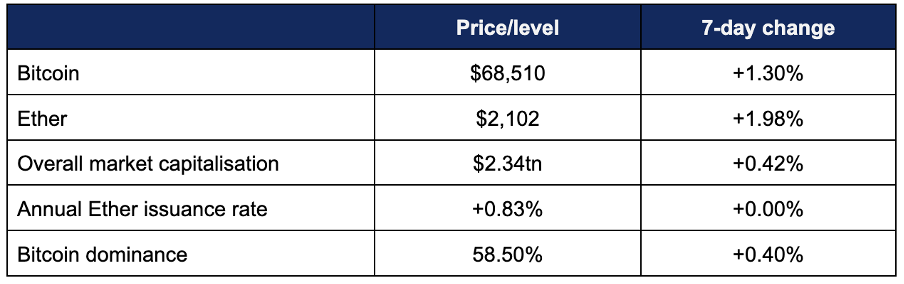
- Digital assets posted some modest gains, as perceived risk assets rallied on reports of potential progress towards a US-Iran ceasefire
- This allowed Bitcoin to close April slightly up from the month’s opening value, snapping a five-month losing streak for the leading digital asset
- Bitcoin peaked at $70,240 on Monday, recovering from a Thursday low of $65,900
- Ether showcased more intraweek volatility, peaking at $2,165 on both Wednesday and Monday, falling to lows of $2,020 in between on Thursday
- Overall market capitalisation ranged between $2.28tn and $2.39tn throughout the week
- Gains were mostly limited to the top digital assets, as market sentiment remained too uncertain for altcoins to flourish, with Bitcoin and Ether both widely overperforming the category as a whole
- According to industry monitoring site DeFi Llama, total value locked in DeFi remained unchanged at $92.2bn
Digital assets recovered some of their recent losses, as markets rallied on renewed hopes of a US-Iran peace deal. Although trading was truncated by the Easter public holidays, developments and adoption continued at a strong pace; Franklin Templeton set up its own crypto division, Charles Schwab opened up its waiting list for Bitcoin and Ether trading, New Hampshire became the first US state to develop a crypto-backed municipal bond, Standard Chartered backed a new digital asset unicorn, and much more.
What happened: ETF News
How is this significant?
- Digital asset investment products experienced mixed performance during a trading week truncated by the Easter public holidays
- Due to Easter Monday, CoinShares did not publish any global summaries at the time of writing, but examination of US ETF flows (which tend to form the vast majority of overall volume and capital movement) showcased overall inflows for Bitcoin products, and modest outflows for Ether
- Spot Bitcoin ETFs posted three days of inflows (Monday, Tuesday, Thursday) around one day of outflows (Wednesday) during the truncated trading week
- Thursday was anomalous for its low overall flows ($9m overall inflows with most funds registering net-zero), as traders appeared to log off early for the long weekend
- Meanwhile, Monday and Tuesday combined for $187m inflows, compared with $170m outflows on Wednesday
- BlackRock’s IBIT was once again responsible for the majority of flows, logging $98m on Tuesday, and shedding $87m on Wednesday
- The next-best performance came from ARK Invest’s ARKB, which added $33m on Monday
- Spot Ether ETFs in contrast opened the week with two days of modest inflows ($5m and $31m) before experiencing larger outflows ($7m and $71m) during the latter trading days
- BlackRock’s new ETHB staked Ether ETF continued its post-launch inflow run until Thursday, when it registered net-zero flows
- Meanwhile, the asset management giant’s first Ether ETF, ETHA, logged both the largest daily inflows ($25m) and outflows ($47m)
- According to late-breaking (but incomplete) Monday figures, both Bitcoin and Ether ETFs returned to strong growth when markets reopened, with nine-figure inflows for both reported at the time of writing
- In other ETF news, BlackRock added a ticker ($BITA) to its S1 filing for a proposed new Bitcoin Premium Income ETF, leading Bloomberg’s chief ETF analyst Eric Balchunas to speculate a launch within “weeks, not months” for the “highly anticipated sequel” to its existing record-breaking ETF
What happened: Franklin Templeton launches crypto division
How is this significant?
- The Wall Street Journal broke news this week that TradFi titan Franklin Templeton is extending its digital asset involvement, setting up a new crypto division via acquisition
- According to a press release on Wednesday, the $1.7tn AUM firm agreed to acquire 250 Digital, a spinoff from crypto venture firm CoinFund, to create a new entity called Franklin Crypto in what CEO Jenny Johnson described as “an exciting addition for Franklin Templeton”
- A company statement said the new division “will expand Franklin Templeton’s existing suite of crypto and blockchain VC investment offerings and will broaden the firm’s digital assets investment management platform”
- Former CoinFund executive Christopher Perkins will co-lead the new unit, commenting; “Crypto’s institutional moment has arrived, and Franklin Crypto will help our global clients navigate this complex and rapidly evolving asset class by delivering the expertise, knowledge and digital asset products that meet their sophisticated investment needs”
- Franklin’s head of innovation Sandy Kaul indicated to the Journal that the company is filtering out current bearish conditions as short-term noise, saying “This big selloff that we had in the crypto markets is creating a very unique opportunity that really made us all decide that this is the right time to pull the trigger”
- This builds on the firm’s existing 50-strong digital asset division, and follows on from last week’s news about the firm tokenising multiple ETFs to trade on-chain via crypto wallets, showcasing continued corporate enthusiasm for the asset class
- The acquisition is expected to close this quarter, with the firm considering its own BENJI tokens (from its on-chain money market fund) as a potential payment mechanism
What happened: Citadel-backed crypto firm seeks banking charter
How is this significant?
- EDX Markets, a digital asset exchange backed by Citadel Securities and Fidelity, became the latest firm in the space to apply for a banking trust charter, as enthusiasm around stablecoins continues to grow within the US
- If approved, EDX will be able to “provide custody, asset-management and principal-trading services while continuing to conduct order matching for its customers”
- CEO Tony Acuña-Rohter told Bloomberg “without a doubt that the next wave of crypto will be the large banks… in order for us to be able to service these firms, we think it gives us a competitive advantage to be an OCC-chartered trust”
- The company believes that such an entity would provide additional safety compared to the vertically-integrated “one-stop-shop” approaches of many crypto firms, arguing that “moving the custody, asset management, and trade settlement services into an OCC-chartered national trust bank [provides] customers with the most secure regulatory structure possible”
- Meanwhile, leading US exchange Coinbase was granted conditional approval for its trust charter, dubbing it “a significant milestone in Coinbase’s long pursuit of regulatory clarity… the result of years of investment in compliance, engagement with regulators, and belief that the right path forward for crypto is through the system—not around it”
- In a blog post regarding the decision, Coinbase clarified that it will not become a commercial bank, take retail deposits, or conduct fractional reserve banking; rather, the charter “is about bringing federal regulatory uniformity to the custody and market infrastructure business we have been building for years”
What happened: Charles Schwab opens waiting list for Bitcoin and Ether trading
How is this significant?
- Industry publication Coindesk confirmed this week that investment management giant Charles Schwab ($11.9tn AUM) remains on track to open its digital asset trading facilities within the first half of the year
- A company spokesperson told Coindesk “We remain on track to launch our spot crypto offer in the first half of 2026, starting with Bitcoin and Ether”
- This remains on track with previous statements by CEO Rick Wurster early last month, with a gradual rollout following internal testing and early access for a select group of clients
- Schwab has now opened a waitlist for potential users to acquaint themselves with its “Schwab Crypto” account (“coming soon”) and the asset class in general
- The page also notes that while the service is not yet active, “you can get exposure to crypto in multiple ways at Schwab: ETPs that invest in a variety of crypto assets, ETFs and mutual funds that invest in crypto futures or the broader crypto or digital asset ecosystem… and a variety of crypto futures (for approved accounts)”
- However as things stand, the company does not accept crypto asset deposits or disperse them for settlement, indicating that the firm may be taking a walled garden approach with its platform, rather than allowing users direct control over their individual blockchain wallets
- Wurster appears broadly bullish on digital assets, recently commenting that stablecoins are “likely to play a role in transacting on blockchains”
What happened: New Hampshire approves Bitcoin-backed bonds
How is this significant?
- New Hampshire became the first state in the union to officially issue a digital asset municipal bond, backed by Bitcoin and managed by a mining firm
- The New Hampshire Business Finance Authority is aiming to sell $100m of bonds through two series, with Bitcoin mining firm Cleanspark borrowing proceeds from the sale and making bond payments from Bitcoin collateral deposited into a trust
- Rated as Ba2 (i.e. highly-speculative) by Moody’s, the vehicle incorporates some mechanisms to address the comparative volatility of digital assets; the trust will be liquidated if Bitcoin’s price falls below certain levels, to pay bondholders in full
- James Key-Wallace, executive director for the New Hampshire Business Finance Authority told Bloomberg “If for some reason it doesn’t work, New Hampshire is not the one paying. We’re creating the environment for this innovation without putting taxpayer dollars on the line”
- New Hampshire governor Kelly Ayotte commented “I’m proud that New Hampshire is once again first in the nation to embrace new technologies with this historic Bitcoin-backed bond. This is an innovative way to bring more investment opportunities to our state and position us as a leader in digital finance without risking state funds or taxpayer dollars”
- In other regulation-linked news, prognosis for progress on the CLARITY digital asset market structure bill was mixed; TD Cowen analysts voiced an “increasingly pessimistic” outlook, deeming a recent compromise on stablecoin yields as insufficient, and noting that even senators appeared to be reducing the odds of passage this year
- However, Coinbase chief legal officer Paul Grewal was more publicly optimistic, telling FOX Business “I think we’re very close to a deal. We’re seeing a real recognition that rewards are important, but also other key elements of the bill are critically important to making sure that President Trump’s vision of the United States as the crypto capital of the world is fulfilled”
- Meanwhile, France’s Lightning Stock Exchange (LSE) is preparing for the debut of Europe’s first on-chain stock market, allowing for tokenised IPOs
- According to a release, the exchange “plans to list French aerospace supplier ST Group on April 9th”, pushing the concept of tokenisation further within the regulated EU financial space
- Meanwhile, Bermuda-based OpenEden issued HYBOND, the “first tokenised product tied to BNY Investments’ Global Short-Dated High-Yield Bond strategy”
- According to Coindesk, “The new token gives qualified investors 1:1 exposure to a managed portfolio of short-dated corporate bonds overseen by BNY Investments, a unit of BNY”
- OpenEden CEO Jeremy Ng was quoted as saying “Tokenisation has proven its product market fit with cash-equivalent and treasury strategies. HYBOND represents the next step by bringing actively managed corporate bond exposure on-chain within a regulated framework”
What happened: Crypto investment news
How is this significant?
- Several major investments and funding rounds took place this week, reflecting continued institutional interest in the future of digital assets
- Belgian-based firm Keyrock became a digital asset unicorn, as the crypto services firm secured a Series C round led by Standard Chartered via its SC Ventures arm, valuing it at $1.1bn
- In a press release, Keyrock CEO Kevin de Patoul said “In 2026, we’re pushing for more growth in our services, client base, and geographic reach, as we look to gain greater market share and reinforce our position as a leading player”
- SC Ventures CEO Alex Manson added “Our investment in Keyrock reflects our conviction that sophisticated liquidity infrastructure is foundational to the evolution of digital asset markets. As tokenised assets scale, we believe full-service providers, like Keyrock, will play an important role”
- The new funding will help grow the firm’s asset management and wealth division, following an acquisition of its own last year
- Elsewhere, Cross River Bank raised $50m to expand its facilities within the crypto sphere, adding fresh capital to a 2022 raise at a $3bn valuation
- The new investment was led by T.Rowe Price, with anonymous sources saying it was based on an undisclosed, but slightly higher, valuation
- Founder and chairman Gilles Cade commented that “the investment reflects continued backing for Cross River’s strategy of combining lending, payments, cards and crypto infrastructure with an AI layer aimed at strengthening compliance and risk management”
What happened: Leading South Korean fintech reportedly developing digital asset ecosystem
How is this significant?
- Reports in local news outlet Blockmedia indicate that Toss, one of South Korea’s largest fintechs, is considering an entry into the digital asset space, with its own ecosystem including a blockchain and proprietary token
- Sources say the firm is still deciding between a Layer-1 chain or Layer-2 Ethereum scaling solution (or both), with delays due to the country’s stalled Digital Asset Basic Act crypto rulebook release
- Several major South Korean firms are considering their own entry into the space, but are currently held back by the lack of rules set in stone
- Last June, Toss already filed trademarks for TOSSKRW, indicating the creation of its own stablecoin once regulation allows
- In a request for comment, a Toss spokesperson told Blockmedia “We view digital asset-based financial infrastructure as a key future area and are preparing accordingly. We are recruiting talent with relevant capabilities and broadly reviewing possibilities for collaboration with various partners, while prioritizing efforts to secure the necessary technology”
What happened: Crypto Treasury news
How is this significant?
- Leading treasury firm Strategy returned to Bitcoin purchases this week, adding 4,871 Bitcoin for approximately $330m
- Due to the Easter public holiday, leading Ether treasury firm didn’t report any new acquisitions on Monday, but Japanese firm Metaplanet became the third-largest Bitcoin treasury company following its most recent additions
- It reported 5,075 Bitcoin purchased in Q1 2026 for $398m, leapfrogging Bitcoin miner Marathon holdings, after the latter sold $1.1bn of Bitcoin in Q1 to fund a debt buyback
- Meanwhile, XRP developers Ripple upgraded its enterprise treasury management system, enabling “native digital asset capabilities… letting corporate finance teams hold, view and manage XRP and [Ripples’s stablecoin] RLUSD alongside traditional fiat balances for the first time within a single platform”
This weekly financial roundup is for informational purposes only and is not financial, investment, or legal advice. Information is based on public sources as of publication and may change. Consult a professional before acting.