



Market Overview
Digital assets made major gains, as Bitcion breached $80,000 for its best levels since January.
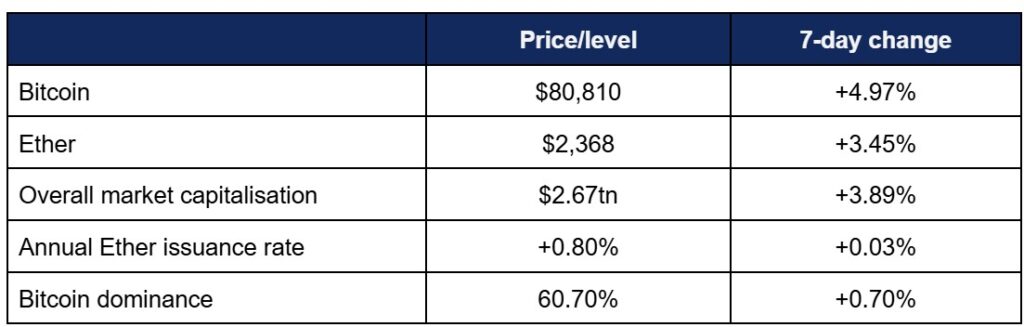
- Digital assets posted a week of great growth, as investor sentiment improved, leading to several assets posting their best prices since January
- Bitcoin breached $80,000 on Monday as the US asserted more control over the Strait of Hormuz, before advancing past $81,000 in early morning trading today
- Bitcoin increased steadily throughout the week, increasing from a Wednesday low of $75,020 to a high of $81,290 earlier today
- Ether performed similarly, rising consistently after bottoming out at $2,228 on Wednesday, culminating in a $2,393 top on Monday
- Both Bitcoin and Ether posted substantial gains across April; Bitcoin delivered its best month in a year with a 12.7% increase, with Ether also posted consecutive monthly growth, at 7.3%
- Overall market capitalisation sits near its intraweek high at the time of writing, rising from a weekly low of $2.52tn
- Performance across the top 100 projects by market capitalisation was broadly positive, with around three-quarters of (non-stablecoin) projects registering weekly increases
- According to industry monitoring site DeFi Llama, total value locked in DeFi recovered slightly, to $85.4bn
Digital assets continued their recent bullishness, as both Bitcoin and Ether closed April with consecutive monthly gains, before Bitcoin posted its best performance since January in early trading today. Catalysts for this shift in investor sentiment included advances in the US-Iran peace process, Jerome Powell leaving his post as Fed chair, and potential progress on the long-awaited CLARITY crypto market structure bill. Adoption and advances continued globally, as BlackRock enhanced its onchain money market fund further, the DTCC targeted October for the launch of tokenised securities, Western Union officially launched their stablecoin, and much more.
ETF News
What happened?
- Digital asset investment products logged a fifth consecutive week of inflows, making up for a weak start with strong Friday trading
- There was no CoinShares data published on Monday due to the Early May bank holiday in the UK, but overall flows across the complex remained positive thanks to strong late trading driven by a combination of renewed US-Iran optimism, and Jerome Powell’s departure as chair of the Federal Reserve
- Spot Bitcoin ETFs featured three days of losses between $90m and $263m, before returning to gains and logging $630m inflows on Friday
- BlackRock’s IBIT and Fidelity’s FBTC featured in the upper echelon of both outflows and inflows, as the only funds to hit nine figures in both, and on Friday, they hit inflows of $284m and $213m respectively
- Bloomberg chief ETF analyst Eric Balchunas noted that IBIT had the 11th-largest inflows of any ETF in April at nearly $2.4bn; “baller number considering it’s the only ETF on list with negative YTD return. Typically only see that with Vanguard ETFs (their invs buy rain or shine). Good sign for long-term viability of category.”
- Morgan Stanley’s Bitcoin ETF maintained its run of no outflows since launch, but this included several days of net zero flows
- Spot Ether ETFs logged overall outflows after closing in the red Monday through Wednesday, before rallying on Friday with $101m positive flows
- The most notable performance came from Fidelity’s FETH, which usurped category leader BlackRock with $49.4m inflows on Friday; marginally higher than both BlackRock’s staking and non-staking ETFs combined
- In other ETF news, Reuters reported on Monday that the SEC is delaying the debut of prediction market ETFs, seeking more clarity on matters of function and investor safety
- Unlike most ETFs tied to benchmarks like Bitcoin price or the S&P 500, the proposed prediction market products would behave more like the binary yes-no outcomes of the underlying platforms
Crypto Treasury news
What happened?
- Leading treasury firm Strategy paused its traditional weekly Bitcoin buys, ahead of its Q1 earnings release
- Founder Michael Saylor however indicated that normal (acquisition) service would be resumed imminently, tweeting “No buys this week. Back to work next week”
- Its Ether-based counterpart BitMine however continued its acquisition action, spending nearly $238m to buy 101,745 Ether
- This puts the firm 86% towards its “Alchemy of 5%” goal of total Ether supply
- Chairman Thomas Lee, in his weekly investor letter, sounded a very optimistic tone, citing progress on the crypto CLARITY legislation push, and proclaiming that “Crypto Spring, in our view, has commenced and like past cycles, investor sentiment and conviction are muted and bearish even as crypto prices strengthen… Bitmine has maintained the increased pace of Ether buys in each of the past four weeks, as our base case Ether is in the final stages of the mini-crypto winter”
- Top Czech central bank official Ales Michel proposed the inclusion of Bitcoin within the nation’s reserves, speaking at the Bitcoin 2026 conference and showcasing a portfolio with 1% Bitcoin delivering higher returns without equivalent increase in risk
- He stated “When you add an asset like this, the whole portfolio can work better. Return can go up, and risk stays about the same”
Prediction market news
What happened?
- Alongside news of a delay to proposed prediction market ETFs, prediction markets continued attracting attention across a spectrum of reporting
- Major crypto perpetuals exchange Hyperliquid proposed adding prediction markets to its platform, potentially forming an instant triumvirate alongside category leaders Kalshi and Polymarket
- Unlike Hyperliquid’s existing perps-based business model, predictions (or “outcome tokens” as per their proposal) wouldn’t feature leverage on the exchange, reducing the risk of user liquidation on momentary fluctuations
- Hyperliquid handled nearly $220bn volume in March, more than both leading prediction markets combined
- Both Kalshi and Polymarket recently announced moves into crypto perpetuals, so some may view this as a case of “turnabout is fair play” for Hypermarket
- The potential entry of a new major player in the space also opens up the possibility of new approaches within the category; Syncrasy Capital investor Sunny Shi told Bloomberg “Sophisticated traders will be able to take advantage of portfolio margin and figure out ways to generate alpha from these two different market types. A way that you wouldn’t be able to see like on Polymarket or Kalshi, where today most of it is just betting. It’s just like single-sided betting”
- However, unlike Kalshi and Polymarket, which are actively courting US bettors, Hyperliquid is an offshore exchange which restricts US users, leading analysts to expect “activity concentrated outside the US in markets that have not had access to mainstream prediction platforms, such as cricket betting in countries like India”
- Following recent controversy around potential market manipulation and insider trading. Prediction markets are working to appear more legitimate as they become more established and raise greater funds
- As part of this tide, a Thursday press release revealed blockchain forensics specialists Chainalysis partnering with Polymarket to develop new fraud detection tools designed to combat insider trading
- Polymarket commented that blockchain by its nature enhances market honesty; “More transparent markets built on blockchains unlock the ability to proactively detect threats and report them to law enforcement and regulators with credible, on-chain data. This sends a clear signal: insider trading, in addition to all types of fraud and market manipulation, is not welcome on Polymarket, and those who attempt it will be identified”
- The company’s chief legal officer Neal Kumar added “You can’t go a day without hearing about insider trading. There’s a lot of noise because, quite frankly, our platform is public and so when you build in a glass house, everyone can see what’s inside”
Stablecoin news
What happened?
- Stablecoin leader Tether was in the news several times this week, following the publication of its latest quarterly report
- Headline figures included a $1.04bn net profit in a “highly volatile” first quarter, alongside excess reverses increasing to a record $8.23bn
- Additionally, the firm bought more than 6 tons of gold during Q1 as part of its ongoing asset diversification strategy; bringing total gold reserves to $20bn
- This does however represent a marked decline from previous gold acquisition, as it previously purchased 21 tons in Q4 2025
- In other Tether news, the company invested in Argentine crypto app Belo, a digital wallet concentrating on the LatAm region where currency instability has stoked demand for the firm’s USDT stablecoin as an inflation hedge
- Belo CEO Manuel Beaudroit commented “Tether is looking for distribution and they see Belo as a player that can help strongly push the use of USDT, both in the client-facing level and in the infrastructure level”
- Meanwhile, payment processing giant Visa increased the footprint of its stablecoin settlement pilot to nine blockchains, adding Base, Polygon, Canton Network, and the stablecoin-centric chains Arc and Tempo
- Rubail Birwadker, Visa’s global head of growth products and strategic partnerships, stated that “Our partners are building in a multi-chain world, and they expect their options to reflect that reality… partners can choose the networks that best fit their needs, while relying on Visa to provide a common settlement layer across all of them”
- Visa’s chief competitor Mastercard also advanced its stablecoin capabilities, as stablecoin unicorn Rain joined as a principal member to integrate with the company’s prepaid credit cards
- Rain added in a press release that “Beyond card issuance, Rain and Mastercard will explore settling select program flows onchain using regulated stablecoins. This matters because settlement can be capital-intensive and create operational constraints”
- On Monday, Western Union officially launched its Solana-based USDPT stablecoin
- In a press release, the remittance pioneer said the launch “reflects a broader shift in how global payments are evolving, as established financial institutions adopt regulated digital assets as core infrastructure going forward”
- Western Union also noted several services to support USDPT, including global exchange support, Stable by Western Union (“a consumer-facing spend capability launching in 2026 in 40+ countries”), and Treasury and Agent Settlement
- Meanwhile, Coinbase’s asset management arm released a tokenised stablecoin credit fund, issued on the Ethereum, Solana, and Base blockchains
- The fund, under the ticker CUSHY, “targets institutional investors seeking yield from lending activity tied to digital assets”
- According to Coinbase Asset Management president Anthony Bassili, “Stablecoins are the bedrock of the next financial era. With CUSHY, we are fusing the efficiency of digital rails with the rigor of traditional credit”
Japan news
What happened?
- Despite a wider reputation towards financial conservatism, Japan featured prominently in digital asset developments and reporting this week, as the global appeal of crypto attracts increased interest in the Land of the Rising Sun
- Japan Exchange Group (JPX), operators of the Tokyo stock exchange, stated that digital asset ETFs could debut in the country next year, if legislators respond to existing demand by updating regulations
- JPX CEO Hiromi Yamaji acknowledged “solid interest” in launching or trading funds from various asset managers, telling Bloomberg TV “We’re ready to work on it once legislation and tax treatment are made clear”
- Last Monday, Japanese digital asset exchange Bitbank launched a crypto credit card, allowing users to pay bills with digital assets held on the exchange
- The new “EPOS Card” comes through a partnership with local TradFi Marui Group
- Additionally, according to translations by industry publication TheBlock, “cardholders will also have access to crypto cashback, earning 0.5% crypto rewards based on monthly spending”
- In other Bitbank news, Japanese TradFi powerhouse SBI Holdings announced plans to acquire a stake in the exchange last week
- SBI described the decision as part of its drive to expand its digital asset footprint and “strengthen its position” ahead of anticipated regulatory changes
- The company already announced plans for a majority stake in Singaporean crypto firm Coinhako back in February, and offered an onchain XRP bond in February as part of this strategy
- In April, the Japanese Diet approved a draft bill classifying crypto assets as financial products, potentially bringing them within the remit of the same bill that governs stocks and securities
What happened: BlackRock brings money market fund to crypto exchange
How is this significant?
- BlackRock, the world’s largest asset manager, deepened its involvement with digital assets further this week, expanding access to its onchain money market fund BUIDL
- The $2.5bn tokenised fund will be available on crypto exchange OKX, with funds custodied by Standard Chartered, in a move that Bloomberg described as “the latest sign that Wall Street infrastructure and digital-asset markets are converging”
- Under the new partnership, OKX traders can post BUIDL tokens as collateral, allowing them to earn interest on their capital even as their funds sit idle
- According to analysts “The setup solves a basic inefficiency: cash posted as collateral on crypto exchanges has traditionally earned virtually nothing”
- The facility is initially limited to OKX customers in the MENA region, with regional CEO Rifad Mahasneh commenting “This product was designed to minimise risk rather than add the layers of risk. It becomes more efficient collateral and productive collateral… The novel idea is that you can still generate yield on that custody in both cases [whether custodied on-exchange or by Standard Chartered”
- The deal comes about a year after OKX agreed a similar collateral-mirroring program with Franklin Templeton and its BENJI fund
- Tokenisation enables a myriad of new possibilities such as this for capital utilisation, and the partnership builds on BlackRock CEO Larry Fink praising the technology in his annual investor letter this year
What happened: DTCC targets October for launch of tokenised securities
How is this significant?
- Leading Wall Street clearing house the Depository Trust & Clearing Corporation (DTCC) issued a statement on Monday that it will pilot “limited production trades of tokenised securities”, before rolling out a full launch of the service in October
- The service will be delivered via its Depository Trust Company (DTC) tokenisation service, “designed with feedback and collaboration from more than 50 financial industry firms”
- According to a press release, participants in the design read like a veritable TradFi A-Z who’s who, including major banks like Citi, JP Morgan, Lloyds, Morgan Stanley, State Street, and Wells Fargo, to name just a few
- Company CEO Frank LaSalla commented “DTCC continues to galvanise a broad cross-section of industry leaders to facilitate ongoing, robust dialogue that drives widespread digital assets adoption and advances innovation. Our vision is coming to fruition: launching our tokenisation service and successfully bridging TradFi and DeFi”
- He added “We believe tokenisation will significantly change how markets work and operate, bringing new levels of liquidity, transparency and efficiency to investors”
- DTCC received a green light to explore this new technology late last year, following an SEC no-action letter than enabled the tokenisation of highly liquid assets on pre-approved blockchains
- A shift towards tokenisation will include several benefits for entrenched industry players, including 24/7 trading and faster settlement, as DTCC’s digital asset head Nadine Chakar commented “Tokenisation is an important and critical step toward building tomorrow’s digital infrastructure”
What happened: Crypto market structure bill makes progress
How is this significant?
- In the US, the long-awaited CLARITY crypto market structure bill made progress this week, leading to renewed hopes that some legislation for the digital asset market could potentially be signed into law this year
- Representatives of Coinbase – the publicly-listed exchange which withdrew support for a previous version of the bill – said over the weekend that a compromise had been reached on stablecoin yield provisions, the major sticking point of previous conflicts between the crypto and banking industry negotiators
- Under the new language of the bill, stablecoin rewards cannot be offered in a manner “economically or functionally equivalent” to deposit interest, but can be provided in regard to account activity
- Chief policy officer Faryar Shirzad tweeted “In the end, the banks were able to get more restrictions on rewards, but we protected what matters – the ability for Americans to earn rewards, based on real usage of crypto platforms and networks”, and CEO Brian Armstrong called to “mark it up”
- Elsewhere in the halls of power, oft-cited concerns regarding potential crypto conflicts of interest or influence over politicians continued; the President Trump-linked World Liberty Financial (WLF) project counter-sued crypto billionaire Justin Sun, alleging defamation from his lawsuit where he claims they froze his funds
- Bloomberg investigated WLF over apparent discrepancies between token amounts held by the team during initial filings and present day, with WLF claiming “white glove” transactions with private buyers as the cause
- Thus far, early investors have had 20% of their tokens unlocked for sale, but are unable to transact the rest, leading Bloomberg to write “What is unfolding has no precedent in American financial life. A sitting president’s family holds financial stakes in a live token project – one setting governance rules, directing treasury sales, collecting proceeds – while the people who signed up find themselves with limited options to exit”
- Meanwhile across the pond, Reform UK party leader Nigel Farage has drawn scrutiny and accusations of parliamentary rules breaches after failing to disclose a £5m donation from a crypto investor (and Britain’s largest political donor) Christopher Harborne
- Reform however argued that the donation’s classification falls under exemptions for (very substantial) “purely personal gifts”
Haun VC raises $1bn for new funds
What happened?
- Haun Ventures, the crypto-centric VC set up by digital asset investment (and Andreessen Horowitz) veteran Katie Haun, disclosed its latest funds this week, after closing a $1bn raise
- Two VC funds (with respective focuses on early- and late-stage investments) will receive an even split of the capital, with a particular eye on the confluence of crypto and A.I.
- In an interview, Haun commented “There are deep, transformational shifts going on within technology. One of those is A.I.; another one is digital assets”, but stressed that rather than pivoting to A.I. funds, “We want to do A.I. that is in our lane”
- Haun Ventures originally launched with an unprecedented $1.5bn warchest for crypto and blockchain investments in 2022; a Bloomberg source said that “Haun’s new fund is slightly smaller than the last because the team expects less dramatic changes to liquid token prices”
- In other news of digital asset deals, industry titan Payward closed a $550m cash and stock deal to acquire derivatives exchange Bitnomial
- Payward is the parent company of crypto exchange Kraken, which recently confirmed a confidential filing to go public
- The acquisition will thus allow Payward (and Kraken) to “offer regulated crypto derivatives in the US without relying on a patchwork of third-party venues”
- Meanwhile, digital asset firm MoonPay acquired Israeli crypto security firm Sodot for $100m in an “institutional push”, announcing intentions to “launch a new unit focused exclusively on catering to institutional demand for digital assets”
This weekly financial roundup is for informational purposes only and is not financial, investment, or legal advice. Information is based on public sources as of publication and may change. Consult a professional before acting.