



Market Overview
Digital assets closed the week virtually unchanged, rallying from lows after reports of progress on US-Iran peace talks, before dipping again late on following renewed US air strikes.
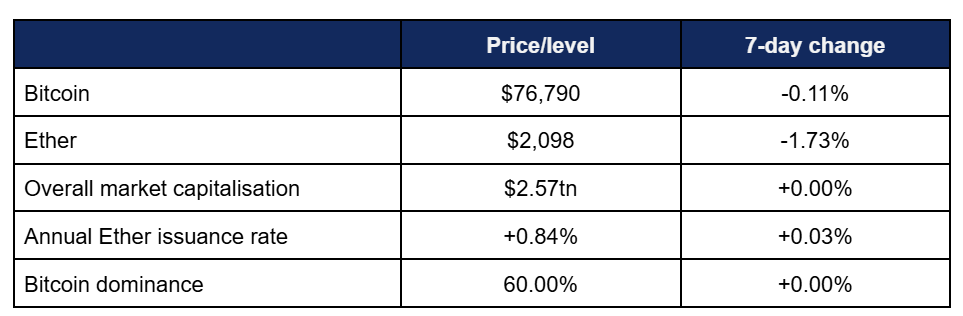
- Digital assets rallied somewhat from last week’s losses, closing the week on a par with last week’s reporting period, thanks to sudden shifts in both directions caused by the ongoing US-Iran war
- Markets received mixed signals, as delegations gathered in Qatar to discuss peace negotiations, before sudden strikes on the Gulf coast revived investor caution
- Bitcoin hit a weekly high of $78,040 on Thursday, before falling sharply to a seven-day low of $74,310 on Saturday
- It subsequently rallied back to levels near $78,000, before the late-breaking news of new missile strikes led to a further pullback in early trading this morning
- One additional factor cited in momentum stalling was ETF investors selling off as Bitcoin reached its average acquisition price since the funds launched, with investors hedging their bets amidst continued global uncertainty
- Ether peaked at $2,140 on Thursday, followed by a nadir of $2,021 on Saturday
- Overall market capitalisation briefly dipped below $2.5tn for a weekly low of $2.49tn, before rallying to current levels
- Performance across the top 100 projects by market capitalisation varied, as some altcoins outperformed strongly to keep the overall market flat
- According to industry monitoring site DeFi Llama, total value locked in DeFi fell almost $1bn to $81.74bn
Digital assets weathered geopolitical volatility and uncertainty to end the week virtually unchanged. Whilst Bitcoin and Ether ETFs logged poor performance as traders hedged their bets, altcoin products saw an influx despite challenging market conditions as bids rotated rather than disappeared. The wider stablecoin complex saw a great deal of activity, including developments across multiple currencies, Nasdaq gained approval for Bitcoin index options as NYSE’s parent company partnered with crypto exchange OKX for perpetual oil futures, Japan, Korea, and the US all witnessed regulatory progress, and much more.
ETF News
What happened?
- Digital asset investment products experienced a second straight week of losses, logging their largest outflows since January
- Monday marked the largest single-day outflow since January 29th, as losses lessened (but continued) throughout the remainder of the week
- Spot Bitcoin ETFs lost $649m on the Monday in question, led by $448m of capital flight from BlackRock’s market-leading IBIT fund
- Throughout the rest of the week, outflows persisted, but topped out at around half of Monday’s levels, with three days of $105m outflows or below
- Only two funds in total returned any inflows, both at very modest levels; ARKB on Thursday, and Morgan Stanley’s MSBT the day prior
- However, despite the widespread sell-offs across the crypto ETF complex, MSBT continued its post-launch run of zero outflows, as it logged four days of net-zero flows in addition to its singular day of $1m inflows
- Spot Ether ETFs hit ten consecutive days of outflows, ranging from $86m on Monday to $6m on Friday
- Outflows came almost exclusively from BlackRock’s market-leading ETHA fund, leading to a situation where multiple other funds actually registered (minor) net weekly inflows
- These included BlackRock’s Ether staking ETF (ETHB), alongside Bitwise’s ETHW, as the majority of the other ETFs experienced an entire week of net zero flows
- However, despite these significant outflows from the majors, industry analysts posited that “The institutional bid hasn’t disappeared – it’s rotating”
- Although Bitcoin and Ether ETFs faced major redemptions, newer altcoin-based products did add significant inflows to their AUM
- ETFs based on XRP accrued $22m, alongside Solana ETFs ($16m), and new funds for the Hyperliquid derivative exchange’s proprietary HYPE token ($72m)
Stablecoin news
What happened?
- A new report by JP Morgan found that stablecoins maintain a significant lead over tokenised money market funds, despite the yield benefits of the latter
- Analysts led by managing director Nikolaos Panigirtzoglou wrote that money market funds are stifled by the bureaucracy that comes with their status as securities
- Panigirtzoglou stated “We doubt that tokenised money market funds would grow beyond 10%-15% or so of the stablecoin universe, unless there is a regulatory change that reduces the structural disadvantage arising from tokenized money market funds classified as securities”
- Analysts at Grayscale also compared the two asset types, noting that the $320bn market capitalisation of stablecoins is now approaching the largest government money market funds, such as those issued by Fidelity, Vanguard, and JP Morgan
- Following feedback, the Bank of England may reportedly drop previous proposals around maximum stablecoin holding limits for both individuals and businesses
- Under its initial plans from last November, individuals would be limited to £20,000 worth of major stablecoin holdings, whilst businesses faced a £10m limit
- On Tuesday, deputy governor Sarah Breeden said instead “One option, also set out in the consultation, would be temporary guardrails on the total amount of a coin that could be issued. Reviewed regularly, that approach could achieve the same aim at lower cost to the sector and allow a wider range of high-value payment use cases, including for corporates”
- The original plans faced a backlash, especially from industry businesses, for potentially stifling growth of the category as the UK formulates its own draft legislation for digital assets
- The ECB also (once again) warned about the perceived dangers of stablecoins, according to Reuters reports
- Central bank chief Christine Lagarde pushed back on a policy brief from the Bruegel think tank, which argued for more permissive stablecoin policies in order to grow them from their current state as a “rounding error” within a sector dominated by dollar-denominated coins
- Lagarde remains one of the key proponents of a Digital Euro CBDC, rather than embracing the rise of stablecoins post-GENIUS regulation, recently stating “The case for promoting Euro-denominated stablecoins is far weaker than it appears”
- Amsterdam-based consortium Qivalis seems to strongly disagree with Lagarde’s opinion, as it added another 25 banks to its group developing a Euro-backed stablecoin
- This brings the total number of institutions in the group to 37 across 15 European nations, with new entrants including major lenders like ABN Amro, Intesa Sanpaolo, and Nordea Bank
- In contrast to Lagarde’s dismissals, Qivalis board chairman Howard Davies stated “This infrastructure is essential if Europe is to compete in the global digital economy whilst preserving its strategic autonomy”
- Euro-denominated stablecoin market capitalisation currently stands at around $700m, compared with over $320bn for dollar-denominated tokens
- Meanwhile, other economies are increasingly being supported by stablecoins denominated in their national currencies; leading issuer Tether released a statement on Monday outlining GELT, a stablecoin “designed to serve as a ‘digital representation’ of the Georgian Lari, enabling lower transaction costs, faster settlement, and programmable payments”
- GELT will purportedly feature “substantive compatibility” with GENIUS regulation, potentially easing Georgian market access to the US
- Georgian Prime Minister Irakli Kobakhidze endorsed the asset, stating “Together with visionary partners like Tether, Georgia is laying the foundations for a more connected, transparent, and digitally empowered financial world”
- Tether also featured in numerous other reports this week, as the world’s leading stablecoin issuer remains busy within and without the category
- It launched a pilot project with Trafigura around stablecoin payments at petrol stations within crypto-friendly El Salvador
- It also acquired Softbank’s 26% stake in Bitcoin treasury firm TwentyOne Capital, worth a potential $679m
- This continues the firm’s diversification and Bitcoin acquisition policies, as it continues to build revenue streams beyond stablecoins
- Finally, German firm Allunity plans to offer a Swedish Krona(SEK)-backed stablecoin, alongside payment infrastructure for A.I. agents
- The proposed SEKAU coin “will be fully-backed by krona reserves and issued under the European Union’s Markets in Crypto-Assets (MiCA) framework”, with AllUnity CEO Alexander Höptner identifying Sweden as a key candidate for stablecoin adoption, thanks to its transition to a cashless society
Regulatory news
What happened?
- SEC chair Paul Atkins this week delayed the launch of ETFs based on prediction markets, saying the mechanisms for such funds require more consideration
- Atkins wrote that the agency will seek more public input before moving forward on such funds; “Novel products raise novel questions, and I appreciate the willingness fund sponsors have shown in delaying the effectiveness of a number of novel ETFs, including event contract ETFs, while we consider the implications”
- The SEC also announced late delays to its planned innovation exemption for tokenised securities listings, citing concerns over potential third-party issuers
- Bloomberg Law sources said that a key concern for former regulators “is guaranteeing that tokenised assets carry the same rights as regulated securities, such as dividends and voting rights”
- SEC commissioner Hester Peirce tweeted that “I’ve always expected that it’d be limited in scope & would facilitate trading only of digital representations of the same underlying equity security that an investor could purchase in the secondary market today, not synthetics”
- Blockchain-based prediction platform Polymarket was blocked in Indonesia, following accusations of online gambling after some users opened markets on the possibility of an early end to president Prabowo Subianto’s term
- The Communications and Digital Ministry stated “The government will not allow any form of online gambling in Indonesia”
- Meanwhile, a New York Times report claimed that the CFTC “purged” staff who opposed approvals for firms linked to the Trump family, including Polymarket, Crypto.Com, and Gemini Titan
- A new attempt at a US Strategic Bitcoin Reserve dropped previous proposals for a one million Bitcoin hoard, but extended the minimum lockup period for any holdings to 20 years
- The bipartisan bill, the American Reserve Modernization Act of 2026” (aka ARMA), argues for “a Strategic Bitcoin Reserve and separate Digital Asset Stockpile for non-Bitcoin assets held by the federal government and managed by the Treasury”
- South Carolina governor Henry McMaster signed a new bill into law, banning any potential CBDCs, and establishing a framework for crypto (including “exempts crypto assets used for payment from any additional tax, withholding, assessment, or charge by the state or local governments”)
What happened: Blockchain.com files for US IPO
How is this significant?
- Industry veteran and digital asset financial services company Blockchain dot com became the latest to file to go public in the US, following in the footsteps of the likes of Coinbase, Bullish, stablecoin issuers Circle, and Gemini
- An announcement on Thursday confirmed the filing of confidential paperwork with the SEC, but no further details were disclosed regarding share issuance or valuation
- Reports last year suggested the firm considered a public float via an SPAC vehicle, but it now appears most likely to launch under its own steam
- Other crypto companies currently considering IPOs include tier-1 exchange Kraken, hardware wallet manufacturer Ledger, and Ethereum ecosystem developers Consensys
What happened: Japan unveils plans for national A.I. blockchain
How is this significant?
- Japan’s ruling Liberal Democratic Party (LDP) formally approved a policy concept proposal to develop a new national blockchain featuring A.I. elements
- The “Next-generation A.I. & Onchain Finance Concept” aimed to develop “automated financial infrastructure that supports 24/7 agentic commerce via blockchain networks” at a national level
- The proposal noted that in the face of rising agentic A.I. use, blockchain can mitigate many risks associated with artificial intelligence, thanks to its “tamper-resistant, verifiable, and programmable characteristics”
- The proposal also supported a joint stablecoin effort by three Japanese megabanks, and can now expect LDP support in discussion with other parties regarding an evolution from “proposal” to “government policy”
- This follows on from recent reports of local TradFi giants SBI and Rakuten adding digital asset trading to their existing online brokerage accounts, as Japan increasingly embraces and legally recognises digital assets within its financial infrastructure
What happened: South Korea considers scrapping crypto tax plans
How is this significant?
- Leading Asian crypto market South Korea may walk back plans for a 22% tax rate on digital asset income, after a petition seeking a repeal gained the requisite number of signatures within eight days
- Petitioners argued that the proposals discriminated against crypto investors, following the previous abolition of income taxes on established financial instruments such as stocks and bonds
- Furthermore, the original petitioner argued that the tax plans didn’t factor in the higher relative volatility of digital assets markets, rendering the petition “fundamentally a question of how the government views and plans to nurture the future of the financial industry and digital assets”
- The plan has already faced numerous delays due to its unpopular nature in a country where crypto features on the campaign trail, but as recently as last month, the national tax agency confirmed plans for its introduction
What happened: Nasdaq secures approval for Bitcoin index options
How is this significant?
- An SEC order on Friday confirmed approval for Bitcoin index options on the Nasdaq, granted on an “accelerated basis”
- Bloomberg identified the move as “the latest sign that Wall Street is becoming more tightly integrated with the world of digital assets”
- The options will be cash-settled European style options, eliminating the risk of getting exercised when in the money
- Although Bitcoin options have existed since 2020, this marks their introduction to the US equity markets, representing growth in access
- Nasdaq head of US options David Barrett told Bloomberg “[the approval] represents an important step in expanding regulated, transparent access to digital asset derivatives”
- The approval follows a policy shift led by SEC chair Paul Atkins directly, who commented earlier in the month that the US had to invite traders in rather than force them out; “The experience of the offshore growth and implosion of FTX demonstrates the folly of pretending that Americans will not be harmed if we do not address innovative technologies and thereby force them offshore”
What happened: Crypto Custodian Copper considers $500m company sale
How is this significant?
- London-based crypto custodian Copper is considering a company sale worth half a billion dollars, according to reports by industry publication Coindesk this week
- The company is a key player in the institutional scene, with its ClearLoop system and off-exchange settlement growing in popularity following the FTX crash in 2022
- Sources told Coindesk that Cantor Fitzgerald has been appointed to help handle the sale, but neither firm returned any requests for comment at press time
- In other news around valuations, digital asset infrastructure developer Zerohash is seeking new funding after previous plans for an investment from Mastercard fell through, following the latter’s $1.8bn acquisition of BVNK
- During the Mastercard discussions, it was widely reported that the payment processing giant was considering a $250m investment at a $1.5bn valuation; this itself followed Zerohash withdrawing from a full acquisition by Mastercard at a $2bn valuation
- Now, sources indicate that Zerohash is raising from multiple sources at a valuation above $1.5bn, placing it well in excess of the $1bn valuation during its Series D2 round in September last year
- In other funding news, Deutsche Bank and Nasdaq backed blockchain analytics firm Elliptic in a $120m round, alongside British Business Bank and JP Morgan
- This values the firm at around $670m, with CEO Simone Maini saying the influx of capital will “expand adoption of Elliptic’s services and grow its global presence”
- RWA perpetual futures firm Variational meanwhile raised $50m from Dragonfly, Bain, and Coinbase, with funding earmarked to expand its derivatives trading service, according to a press release
What happened: NYSE parent company teams with crypto exchange for perpetual oil futures
How is this significant?
- Intercontinental Exchange (ICE), the parent company of the New York Stock Exchange, teamed up with digital asset exchange OKX this week to deliver perpetual oil futures
- According to a press release, OKX will launch the perpetual futures “based on ICE’s Brent Crude and WTI Crude energy benchmarks”
- Haider Rafique, Global Managing Parter at OKX, commented “Oil markets are critical to the world economy… Bringing them into regulated perpetual futures is exactly the kind of bridge between traditional and digital markets that market participants have been asking for”
- This will open access to such benchmarks to OKX’s existing userbase of 120 million retail traders
- The popularity of such perpetual products within the crypto sphere has already been demonstrated by derivatives platform Hyperliquid, which generates $1.6bn daily volume and $1.3bn open interest for similar products on its exchange
- This follows on from an investment ICE made in March, establishing a strategic relationship where OKX was valued at $25bn in a move designed to “build the next generation of financial infrastructure”
This weekly financial roundup is for informational purposes only and is not financial, investment, or legal advice. Information is based on public sources as of publication and may change. Consult a professional before acting.