



Market Overview
Digital assets suffered a major pullback this week, as traders reacted negatively to the escalation of the US-Iran war.
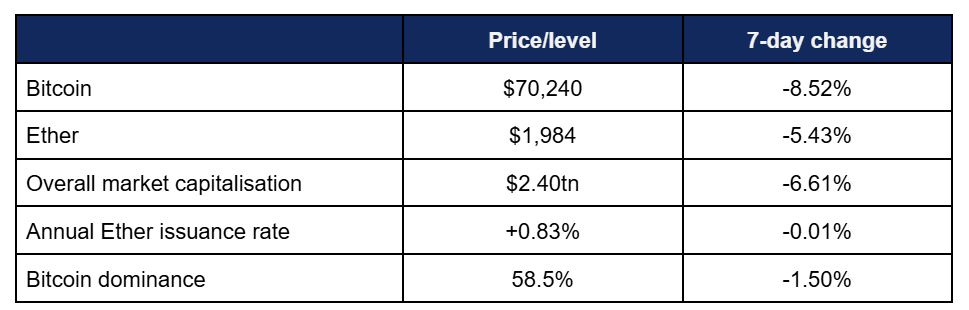
- Digital assets surrendered recent gains, as previous optimism around US-Iran peace talks gave way to a surge in fighting and renewed blockades that unsettled the perceived risk-on crypto markets
- Bitcoin dropped as ETF outflows continued, before market shock from leading treasury firm Strategy’s first Bitcoin sale since 2022, falling from a peak of $77,710 on Tuesday to a low of $70,180 in the early morning hours of today
- Ether also hit a Tuesday high at $2,136, but fell faster before stabilising sooner; dropping below $2,000 on Thursday, and bottoming out at $1,959 on Monday
- Overall market capitalisation fell in line with the leading assets, as the majority of altcoins followed suit and ended the week in the red; with a few notable exceptions such as Hyperliquid’s HYPE (benefitting from recent spot ETF launches) and Stellar’s XLM (buoyed by a DTCC partnership), which both delivered significant double digit growth
- According to industry monitoring site DeFi Llama, total value locked in DeFi dropped by just over $2.5bn to $71.9bn
Digital assets succumbed to increased investor caution following escalating conflicts in the Middle East and an uncharacteristic sell by leading Bitcoin treasury firm Strategy. Following weeks of intense activity, reporting across stablecoins also took a breather, but there was nonetheless significant progress elsewhere, including in tokenisation of both securities and central bank transfers, crypto confiscations within the Iran War, and South Korea’s flagship company investing in the country’s leading digital asset exchange.
ETF News
What Happened?
- Digital asset investment products had a third straight week of losses, with the second-largest outflows of the year
- According to CoinShares data published on Monday, digital asset investment products registered $1.67bn of outflows in the trading week ending May 29th
- This included worsening performance across the entire crypto complex, “with altcoin participation collapsing from 11 assets in inflows 3 weeks ago to just five this week”
- CoinShares’ head of research James Butterfill identified geopolitics as a key driver for these conditions, writing “Iran-related risk-off has now overwhelmed any cushioning effect from CLARITY Act progress”
- Spot Bitcoin ETFs reached ten consecutive days of outflows, with weekly performance bottoming out on Wednesday at $733m
- Throughout the rest of the holiday-shortened trading week, daily outflows stood between $125m and $334m
- As in the last week, IBIT dominated these unfortunate metrics, with three days of nine-figure outflows, including $528m on Wednesday
- Grayscale’s GBTC shed $105m the same day as the only other fund in the nine-figure club
- Morgan Stanley’s MSBT was the only fund to register any inflows, at $4m, but it experienced its first post-launch outflows on Friday, to close out with $1m weekly outflows
- Spot Ether ETFs also continued their recent run of overall outflows, albeit at far more modest levels than the Bitcoin funds
- Outflows peaked at $121m on Thursday, whilst the rest of the week ranged between $18m and $67m and were dominated by the market’s largest fund, as BlackRock’s ETHA reached $80m outflows on Thursday
- However, BlackRock’s ETHB staking ETF escaped the outflow trend entirely, delivering two days of net-zero flows and two days of positive performance up to $9m
- Fidelity’s FETH led inflows with $11m on Friday, as four separate funds showcased positive returns to close out the week
- Elsewhere in ETFs, issuer VanEck launched the first spot ETF for exposure to Binance’s proprietary BNB token, as senior investment analyst Patrick Bush wrote “BNB has been one of the most resilient major cryptocurrencies through the recent market cycle, roughly flat over the past year while most Layer 1 peers experienced significant drawdowns”
- Meanwhile, Grayscale entered the arena for Hyperliquid’s HYPE token, undercutting competitors with a 0.29% management fee
Stablecoin news
What happened?
- Following a week of major activity last week, reporting around stablecoins cooled down somewhat this week, with banks (both central and commercial) dominating the agenda
- ECB executive board member Isabel Schnabel reiterated Christine Lagarde’s statements last week that a Digital Euro retail CBDC is preferable to Euro-backed stablecoins as a means of raising the currency’s international profile
- Speaking at a Bank of Korea conference, Schnabel stated “Central banks and regulators need to be ready to adapt regulation, monetary policy implementation and payment infrastructure in an agile manner to safeguard financial stability, preserve monetary control and anchor their currency’s role in the digital age”
- She added “many of the advantages of stablecoins arise from the technology on which they are based… It remains to be seen whether, in such an environment, stablecoins can find their place in the financial system just as money market funds did 50 years ago, or whether other innovations, like tokenised deposits, will prove to be the more promising alternative”
- Meanwhile, JP Morgan CEO (and long-time crypto critic) Jamie Dimon spoke out against stablecoins in a FOX Business interview, claiming they could become “a huge problem”, and that “the banks will not accept” current proposals on stablecoin activity rewards under the CLARITY market structure bill
- Dimon believes that the current bill still stands too close to paying interest on stablecoin holdings – which banks believe could cause capital flight from existing accounts – and that stablecoins must hold equal protections to bank accounts
- Stablecoin issuer Paxos achieved SEC approval as an officially-registered clearing and settlement agency
- Paxos CEO Charles Cascarilla commented “Our clearing agency registration is the result of seven years of work with the SEC. Most importantly, it allows us to offer the most complete infrastructure for our partners to continue evolving with the market and blockchain technology”
Crypto Treasury news
What happened?
- One of the key items to emerge in this week’s reporting on digital asset treasuries was the news that leading Bitcoin reserve company Strategy – for the first time since 2022 – sold some Bitcoin rather than acquiring it
- The sale in question was modest at $2.5m (or 32 Bitcoin according to filings), but nonetheless represented a significant enough break from the company’s playbook that it may have catalysed further selloffs on Monday
- Strategy CEO and chairman Michael Saylor had previously indicated that the company will remain a net acquirer of Bitcoin, but was open to short-term sells in order to “help fund distributions on its preferred stock offerings” and other financial reasons
- Holdings remain far beyond those of any other companies in the treasury space, at around 843,706 Bitcoin, and year-to-date, it has acquired approximately 2.6 times more Bitcoin than has entered the market via mining rewards
- Meanwhile, leading Ether treasury company BitMine also had a subdued week, slowing down its acquisition pace with a $52m buy of Ether, bringing its holdings to 4.49% of total Ether supply
- Chairman Thomas Lee indicated its continued goal of a 5% supply control in his weekly letter, reflecting “In our view, Ether prices are not reflecting the strengthening of Ethereum fundamentals, but then again, this is not surprising given we are in the early stages of crypto spring. Bitmine is expected to reach the ‘alchemy of 5%’ sometime in 2026”
- The company currently stakes around 4.7 million Ether, generating an annualised revenue of $258 million from validator rewards for securing the blockchain
Regulatory news
What happened?
- Several prominent voices in and around finance spoke out both in favour of and against the current crypto CLARITY market structure bill, with battlelines broadly drawn down DeFi and TradFi lines
- Big voices in politics including Donald Trump, Paul Atkins, and Cynthia Lummis have all pushed for Congress to pass the bill, but it remains to be seen whether it will be able to break through partisan lines
- Coinbase chief policy officer Faryar Shirzad told FOX Business that CLARITY “will be the biggest financial regulatory bill since Dodd-Frank”
- He claimed “CLARITY will become the biggest bipartisan moment of 2026… notwithstanding concern from the banks, it creates a broad range of new powers for banks who want to get into the crypto sector”
- However on the same channel, JP Morgan CEO Jamie Dimon declared CLARITY “dead on arrival”, and that banks would “fight the CLARITY Act markup” but added that “if we lose, we’ll live”
- Dimon was very candid as to his opinions on CLARITY proponent (and Coinbase CEO) Brian Armstrong, claiming he overrepresented support for the bill, stating [and this is a direct quote] “he’s full of sh*t”
- Elsewhere in the regulatory space, the CFTC moved to dissolve a 2025 settlement with Gemini, claiming the judgement was a remnant of the previous regime, and didn’t represent current thinking on the industry
- In a press release, the CFTC claimed enforcing the settlement terms “serves neither the CFTC’s mission nor the public interest”
What happened: Digital asset firms file for and delay IPOs amidst market uncertainty
How is this significant?
- After news of Blockchain.com’s confidential IPO filing last week, more news emerged of industry firms and public floats this week
- On the positive side, institutional brokerage FalconX confidentially filed for an IPO, with a source disclosing Cantor amongst the banks advising the firm on going public
- The same source however added that the process won’t be immediate, as FalconX will likely wait until the end of the year in light of current market conditions
- During the pre-FTX collapse bull market in 2022, FalconX raised funds at an $8bn valuation
- On the other side of the IPO spectrum, Grayscale decided to postpone its plans for a public listing due to current bearish conditions
- A source told Coindesk that Grayscale is “unlikely to restart the process until the fourth quarter at the earliest”, whilst a spokesperson said “Due to the SEC-mandated quiet period [following a confidential filing last November], we are unable to comment at this time”
- Grayscale aren’t the first firm to make such a call, as hardware wallet manufacturers Ledger likewise decided to delay IPO plans until they perceive a more buoyant and stable market
What happened: Binance reveals ambitions for 3 billion users by 2030
How is this significant?
- Although market conditions across the digital asset industry have proven less than favourable over the last year, the world’s largest exchange appears unfazed, as Binance claims “When the market is bad, we build”
- In an interview with CoinDesk, the exchange’s head of VIP and Institutional, Catherine Chen, outlined the company’s master plan, which includes a significant growth in its user base
- She stated “It is true, the market is going through a hard time,” Chen said. “There is still some regulatory development, we are seeing some of our competitors either struggling or perhaps shifting their focus”
- However, she disclosed that Binance currently boasts 310 million “actual active individual users”, a figure which the exchange plans to boost approximately tenfold
- By 2030, Binance aims to register three billion users, as digital assets become increasingly institutionalised
- Chen told Coindesk “Financial institutions are increasingly merging with crypto exchanges and blockchain infrastructure providers. They don’t want to be building all that infrastructure themselves”
- Additionally, she revealed that Binance now boasts “sovereign-grade asset management”, and “now accepts tokenised money market funds from institutional giants BlackRock and Franklin Templeton as eligible triparty ecosystems”
- She stated that digital assets can help traders minimise fees and maximise efficiencies; “Whether it is equities, treasury, or debt, this is the way forward. People have finally figured out that you don’t magically change the fundamental characteristics or price of an asset by tokenising it. It is fundamentally an improved form to ensure better accessibility”
What happened: DTCC partners with Stellar blockchain for tokenised securities
How is this significant?
- Wall Street clearinghouse giant DTCC continued its push towards tokenisation this week, partnering with the Stellar (XLM) blockchain for a tokenised securities platform
- According to a press release, DTCC will connect its tokenised platform Stellar’s network to move TradFi assets onto blockchain rails
- These assets could appear on the Stellar blockchain from H1 2027 onwards
- Furthermore, “highly liquid assets” such as indices and treasury debt instruments could also be tokenised, as future use cases within the partnership
- DTCC previously indicated it will begin limited trading of tokenised assets in July, ahead of a wider rollout of such assets from October onwards
- However, it should be noted that this partnership is by no means an exclusive agreement, and instead will feature as one factor within DTCC’s vision of a multi-chain future
- Frank La Salla, President and Chief Executive Officer of DTCC, stated that “This collaboration represents another step forward in DTCC’s efforts to build an open, interoperable digital infrastructure that bridges traditional and digital markets”, whilst the firm’s global head of digital assets Nadine Chakar indicated “multiple layer-1 and layer-2 network” connections are forthcoming
What happened: US claims to have confiscated $1bn in Iranian crypto
How is this significant?
- In a recent FOX Business interview, US Treasury Secretary Scott Bessent indicated that as part of the country’s ongoing war with Iran, US agencies have managed to seize approximately $1bn of digital assets from Iranian wallets
- He said these efforts fall under the current “Operation Economic Fury” sanctions package aimed at reducing the regime’s overseas income
- Additionally, a Treasury press release stated it has “cracked down on Tehran’s global shadow banking networks; designated networks supplying weapons and other military components to Iran; sanctioned a corrupt Iraqi official who has facilitated the sale of oil along with Iran-backed militias operating in Iraq”
- Earlier in the conflict back in February, data from blockchain forensics firm Chainalysis estimated the size of Iran’s crypto-based shadow-banking industry at $7.8bn in 2025, although it should be noted that much of this involved regular Iranian citizens hedging themselves against government monetary policy
- Separate analysis around the same time identified that the country’s central bank accumulated over half a billion dollars in the USDT stablecoin, as part of attempts to stabilise the rial
What happened: Samsung secures stake in top Korean crypto exchange
How is this significant?
- According to reports in the Korean press this week, the country’s best-known business, Samsung, is the latest to seek exposure to the country’s top crypto exchange, Upbit
- The Korea Herald wrote that three separate Samsung affiliates are acquiring 4% of Upbit’s parent company Dunamu, based on filings with South Korean regulators
- Samsung Securities investment bank will acquire a 2% stake, whilst IT and credit card arms of the company will acquire 1% each
- In total, these stakes are worth around $408m, and represent the latest in several sales by Dunamu, after Hana Bank acquired a 6.6% stake a fortnight ago, followed by an even larger stake for Hanwha Securities last week
- Dunamu itself was acquired by Korean tech giant Naver late last year for $10.27bn, alongside minority stakes for another local tech leader, Kakao
- This isn’t Samsung’s first foray into the crypto space, since it preloaded crypto wallet infrastructure onto its flagship Galaxy smartphones since 2019
What happened: BIS praises blockchain-based prototype for cross-border payments
How is this significant?
- The Bank for International Settlements (BIS) released the findings from its Project Agorá program with several major global banks this week, finding that “tokenisation can improve wholesale cross-border payments”
- Following two years of testing in simulated transactions across multiple jurisdictions, the results were promising enough to greenlight an evolution featuring real-value transfers, as Institute of International Finance head Tim Adams unequivocally stated “It will benefit the entire financial system”
- The study concluded that tokenisation “address[es] long-standing inefficiencies in wholesale cross-border payments at scale, while preserving the safety and integrity of settlement in central bank reserves”
- Project Agorá included participation from the central banks of England, France, Japan, Korea, Mexico, Switzerland, the Federal Reserve Bank of New York, and “more than 40 private sector financial institutions”
- The BIS report also found it to be feasible from a regulatory perspective, as “settlement finality [was] achievable across all seven participating jurisdictions. Further work is needed to define technical, operational and contractual requirements best aligned with the legal frameworks in each jurisdiction”
- The findings indicated more future development, stating “Project participants, including central banks, have expressed strong and sustained interest in further exploring the potential benefits of the prototype. Future work is expected to involve an enhanced role for the private sector, supported by continued and active engagement from participating central banks”
This weekly financial roundup is for informational purposes only and is not financial, investment, or legal advice. Information is based on public sources as of publication and may change. Consult a professional before acting.