



Market Overview
Digital assets fell to yearly lows in the wake of continued conflict, cascading liquidations, and increased investor caution following last week’s sells by top Bitcoin treasury firm Strategy.
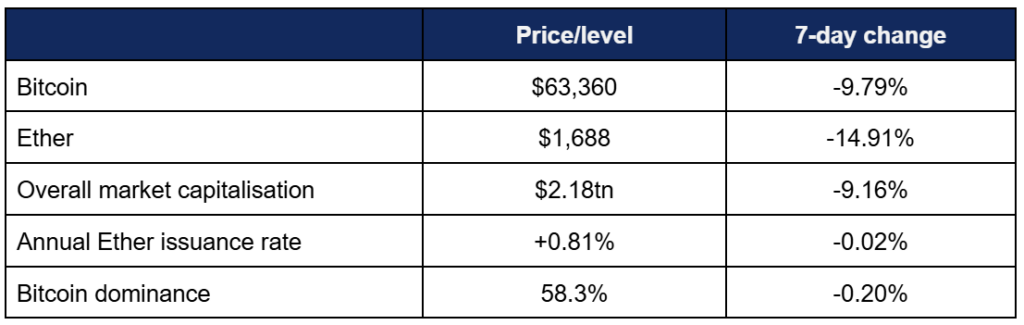
- Digital assets faced what analysts termed “a bruising week”, punctuated by the longest run of daily losses since last August, culminating with Bitcoin dropping below $60,000 and falling to its lowest levels since Trump’s election, before staging a modest rally to current levels
- This bearish momentum can be attributed to the confluence of several factors including ongoing conflict, digital asset treasury shock, and retail distraction from A.I. hype affecting wider markets
- Sells led to cascading liquidations, driving Bitcoin as low as $59,160 during weekend trading with lower volume and liquidity; the first time Bitcoin traded below $60,000 since September 2024
- The violent downturn led some to dig up earlier bear market forecasts to try and predict when this crypto winter may end, with several pointing towards February predictions from Stifel calling for a $38,000 Bitcoin bottom, based on the historic trend of percentage declines from cycle peaks
- Ether moved within the same patterns but fell further relatively; peaking at $1,984 on Tuesday enroute to a Saturday low of $1,522
- Overall market capitalisation dropped accordingly but is currently up over $100bn from its intraweek low of $2.06tn
- Majors and altcoins suffered in tandem, with only a handful of projects across the top 100 by market capitalisation delivering any weekly gains
- According to industry monitoring site DeFi Llama, total value locked in DeFi remained unchanged at $71.9bn despite these decreases, indicating some opportunism as more users deposited to DeFi platforms to counteract the broader declines in asset values
ETF News
- Digital asset investment products posted a fourth consecutive week of outflows, as investors confidence for risk-on assets remained low amidst the continuing US-Iran war
- Outflows accelerated amongst Bitcoin products, but there was some brief respite as both Bitcoin and Ether ETFs posted some modest inflows towards the end of the week to slow the bearish momentum of early trading
- Spot Bitcoin ETFs suffered through four trading days of nine-figure outflows (ranging from $326m to $519m)
- Tuesday proved the bloodiest day in the market with $519m overall outflows, including $389m from IBIT
- Thursday offered some respite from the recent trend with a return to inflows, albeit at very modest levels of $3m total
- Morgan Stanley’s MSBT was a key outlier amidst the market meltdown, delivering four days of inflows and one day of net-zero flows, ending the week with over $35m in fresh capital
- This continued its strong run of post-launch performance, featuring only one day of outflows, with net zero redemptions during the first month of trading
- An announcement on Friday indicated that Morgan Stanley Wealth Management will allow high net-worth clients to “lend their crypto assets to Galaxy Digital in return for shares in spot crypto exchange-traded products, including the recently launched Morgan Stanley Bitcoin Trust”
- Spot Ether ETFs mirrored the trend of Bitcoin products (as usual at more modest levels), with four days of outflows and inflows on Thursday
- Despite outflows being significantly lower (peaking at $90m on Tuesday), the Thursday inflows actually exceeded spot Bitcoin products, as Ether funds added $19m, exclusively from BlackRock’s market-leading ETHA
- Early (but incomplete as of writing) Monday results for both Bitcoin and Ether ETFs indicated a return to inflows, perhaps indicating seller exhaustion or traders viewing depressed prices as an opportunity at these levels
Crypto Treasury News
What happened?
- Strategy followed its controversial first Bitcoin sale since 2022 last week with a major acquisition this week
- The firm returned to acquisition mode, cancelling out last week’s 32 Bitcoin sale with a purchase of 1,550 Bitcoin for $101.3m according to a Monday filing
- However, despite “buying the dip” caused by its own sales, Strategy currently remains significantly underwater on its holdings, as a post-acquisition boost only partially lifted prices from their depressed state
- Strategy founder and chairman Michael Saylor published an essay outlining his perception of the Bitcoin market, arguing that there are four major Bitcoin ideologies (Maximalists, Capitalists, Technologists, and Fundamentalists) who all play a role in the asset’s success
- He wrote “The mission is not to choose between purity and adoption, or between innovation and stability. The mission is to ensure that Bitcoin remains Bitcoin while the world builds on it”
- Clear Street managing director Brian Dobson commented “The recent sale did raise some alarm. But today’s purchase should assuage those concerns. I would see this as a positive signal and a public illustration of confidence from one of Bitcoin’s top investors”
- Meanwhile, leading Ether treasury firm BitMine also “bought the dip” following price crashes, making its largest purchase of the year in acquiring 126,971 Ether last week, valued at approximately $214 million at current prices
- In its weekly update press release, chairman Thomas Lee wrote “We increased our buying as we believe this pullback in Ether prices does not reflect the strengthening of Ethereum fundamentals”
Regulatory News
- Regulatory efforts proceeded across several jurisdictions this week, indicating continued international interest in securing digital asset frameworks despite ongoing market headwinds
- In the US, more than 200 entities – crypto companies, grassroots organisations, trade groups, and individuals – delivered a letter urging the Senate to move forward with a floor vote for the long-delayed CLARITY market structure act
- The letter from lobbying group Stand With Crypto stated that nearly three million advocates across all 50 states are pushing for the bill’s passage, arguing that “The CLARITY Act gives Congress the opportunity to keep innovation, jobs, investment, and market activity here at home while strengthening America’s role as the global leader in digital asset innovation”
- Meanwhile, before there’s even any certainty on CLARITY, US politicians from the House Ways and Means Committee have started drafting up legislation on crypto taxation
- Bloomberg scored an early look at the proposed measures, and wrote that they “would extend to digital assets holders benefits and safe harbors available to investors in traditional securities, while also subjecting crypto assets to tax restrictions that already apply to traditional assets”
- The UK’s regulatory body, the FCA, proposed allowing authorised funds to allocate up to 10% of their capital towards digital asset ETNs
- This follows on from the FCA lifting a ban on crypto ETNs in October last year, although that relaxation only applied to retail investors
- Under the new proposal, qualified investor schemes face no caps on digital asset ETN exposure
- Asset management trade body The Investment Association backed the proposal, and head of innovations, John Allan, told industry publication TheBlock “We welcome this sensible and pragmatic step from the FCA to allow funds to access crypto exposure through regulated ETNs as it supports innovation within a well-understood framework”
- In the major Asian crypto market of South Korea, police are launching investigations into local Polymarket users over potential illegal gambling breaches, according to reports in the local press
- Due to their novel nature and peer-to-peer executions, prediction markets remain a challenge for regulators globally, generally falling in a grey area beyond centralised gambling and bookmaking platforms and customs
- The South Korean probes in particular seem to have been triggered by outcome markets being tied to local elections; a key differentiator of prediction markets, which were brought into mainstream consciousness by Polymarket’s exposure to US election, and continue to feature amongst users
What happened: Digital asset market drops to post-Trump lows
- These cascades were catalysed by caution following Bitcoin treasury giant Strategy’s first Bitcoin sells since 2022, widely reported across legacy financial media including the Wall Street Journal
- Despite the fact that the sale of 32 Bitcoin (to fund preferred dividends) only represented 0.0038% of its total holdings, the break from its long-time “never sell Bitcoin” policy eroded broader confidence in digital asset treasury firm acquisition policies
- EMJ Capital founder Eric Jackson told Bloomberg “The Bitcoin price chart used to be the entire crypto story. It isn’t anymore. Price and adoption are not the same metric for crypto, and they shouldn’t be”
- However, these reports also noted that despite the wider market downturn, some areas of the digital asset complex continue to return strong performance
- This includes the stablecoin sector, which according to a McKinsey report in February doubled its annual payment volume in 2025, and sits near record levels of market capitalisation
- Another area of growth remains blockchain-based prediction markets, which have grown so much that some governments are starting to crack down on them
- Bloomberg analysts concluded that “In earlier eras, that might have looked like an existential threat. Instead, it increasingly resembles something else: maturation… Bitcoin still matters enormously. It just matters less exclusively than it once did”
- Bitunix analyst Dean Chen told the publication that macroeconomic strains continue to weigh on the sector; “If gold is competing with the US dollar, then Bitcoin is effectively competing with global liquidity. When markets increasingly believe higher interest rates will persist for longer and that the cost of capital will remain elevated, investors naturally reduce allocations to non-yielding assets”
- Bloomberg quoted VettaFi research head Roxanna Islam encapsulating the argument; “The crypto industry is still maturing toward institutional use cases rather than retail speculation. Financial institutions are focusing on longer-term utility and infrastructure despite volatile Bitcoin prices”
- Despite current pressures, institutional industry insiders remain bullish; Coinbase head of institutional strategy John D’Agostino told CNBC that “I can tell you that the family offices and the government and sovereign funds that are putting the effort into buying this asset class are not unhappy at being able to buy it at a discount. They loved it at $125,000, they liked it at $100,000, and they love it even more at $65,000”
- He added “We’re still at about $100bn of bitcoin ETF exposure. The price has dropped almost 50% from the peak, and we’ve only seen about 15% drawdown in the retail interest”
What happened: JP Morgan and HSBC to tokenise bonds in Hong Kong
- As part of Hong Kong’s ongoing efforts to cement its spot as an Asian crypto hub, the city’s central bank (the HKMA) issued a statement this week outlining the creation of “an expert group to drive the development of tokenised bonds”
- According to the statement, the HKMA’s program features several major institutions, including JPMorgan Securities, HSBC, Standard Chartered Bank, and UBS from the banking sector, alongside crypto natives Ant Digital, and HashKey
- HKMA has previously issued digital green bonds on several occasions itself, but the new group is focused on the legal and regulatory frameworks for independent tokenisation efforts
- HashKey CEO Xiao Feng told industry publication TheBlock “Scaling up the commercial adoption of tokenised bonds is not merely a matter of technology implementation, but a systematic undertaking that requires the coordination of legal and regulatory frameworks, underlying infrastructure and the broader industry ecosystem”
What happened: Sam Bankman-Fried applies for presidential pardon
- Disgraced FTX founder and former CEO Sam Bankman-Fried hit the headlines again this week, after news emerged that he formally applied for a presidential pardon from his 25-year incarceration for the fraud that led to FTX’s collapse
- Bloomberg reported that although Trump has pardoned several people already during his term, Bankman-Fried is one of few who has actually followed the Justice Department processes for pardon applications
- Despite sitting in prison, “Bankman-Fried has been using social media and interviews with conservative news outlets [including FOX Business] to angle for executive relief from President Donald Trump”
- The FTX founder is currently waiting on a decision from New York’s federal appeals court to throw out his conviction entirely, so he has requested a “pardon after completion of sentence” in case it succeeds
- If Bankman-Fried succeeds in his plea for clemency, it will represent a rapid about-turn, as Trump told the New York Times earlier this year that he had no plans to pardon Bankman-Fried
What happened: Goldman Sachs partners with digital asset firms for tokenised real estate
- Investment banking giant Goldman Sachs made significant strides within the tokenisation space this week, partnering with Apex and Archax to launch a blockchain-native tokenised real estate fund
- Shares of the fund will be tokenised via Goldman’s proprietary GS DAP blockchain platform, with infrastructure provider Ownera and real estate investment manager LRC Group also included
- Goldman Sachs global head of digital assets Mathew McDermott indicated further developments forthcoming; “Issuing blockchain native fund units on GS DAP enables investment in real estate assets with precision while unlocking more seamless transferability in the future”
- According to a press release, the “fund combines blockchain-native issuance with established fund structures… designed to enhance operational efficiency and transparency, while enabling potential future transferability and maintaining robust governance and regulatory oversight”
- This follows several major developments in tokenisation this year, including reports last week regarding Wall Street clearing house DTCC’s plans to expand tokenised securities across multiple blockchains
- In other tokenisation news, data revealed that tokenised equities have reached a total market capitalisation of $5.5bn, representing 147% growth since the start of the calendar year
- According to industry publication TheBlock, “the trajectory reflects a broader shift in how crypto-native users are seeking equity exposure, increasingly through onchain instruments rather than traditional brokerage accounts”
- This figure appears set to increase further, as major digital asset exchanges including Kraken and ByBit will offer tokenised exposure to the highly-anticipated SpaceX IPO
- TheBlock analysts noted that “Pre-IPO and IPO-adjacent exposure has traditionally been gated behind institutional relationships or secondary market brokers. Tokenisation lowers that barrier materially”
- At the confluence of tokenisation and IPOs, BlackRock’s tokenisation partner Securitize secured SEC approval for its key filing to go public via a SPAC merger
- This leaves it one shareholder vote away from final approval; if passed, Securitize will debut on the New York Stock Exchange via the ticker SECZ
What happened: Major US banks work on tokenised deposits to combat stablecoins
- The Wall Street Journal broke news this week that numerous major American institutions – including JP Morgan, Citi, and Bank of America – are joining together to create a shared tokenised deposit system to combat crypto and potential deposit flight towards stablecoins
- According to a March report by Jefferies, stablecoins are viewed as a real threat by the banking establishment, based on estimates that “stablecoins could drive a 3% to 5% runoff in core deposits over the next five years and shrink average bank earnings by about 3%”
- The shared deposit network will allegedly be launched through The Clearing House in H1 2027, allowing “bank deposits to move across blockchain infrastructure with round-the-clock settlement”
- The WSJ stated that The Clearing House is optimistic on multinational adoption of the concept, and CEO David Watson commented “This is a big move for the banks” leading to a “radically different” future around onchain payments
- Reid Noch, vice president of U.S. equity market structure at TD Securities, told industry publication Coindesk “Following the GENIUS Act, a competition seems to be emerging between stablecoins, tokenised deposits and tokenised money market funds to become the preferred onchain cash instrument”
- He added that blockchain provides numerous advantages over legacy financial rails, as “Anyone who has ever wired money, especially internationally, knows the process can be expensive and often takes one or two business days to complete”
- Cody Carbone, head of industry lobbying group Digital Chamber, hailed the news as a victory for the wider digital asset ecosystem; “The biggest banks in America are voluntarily coming onchain. When the country’s largest institutions decide the future of finance runs on blockchain, they’re proving exactly what our industry has been building toward all along”
- Unlike stablecoins, tokenised deposits remain entirely within the banking system, with less freedom for customers to hold and transfer within personal blockchain wallets
This weekly financial roundup is for informational purposes only and is not financial, investment, or legal advice. Information is based on public sources as of publication and may change. Consult a professional before acting.