



Market Overview
Digital assets rallied from last week’s significant losses, hitting a fortnightly high as news of a peace deal in the US-Iran war buoyed investor confidence across perceived risk-on assets.
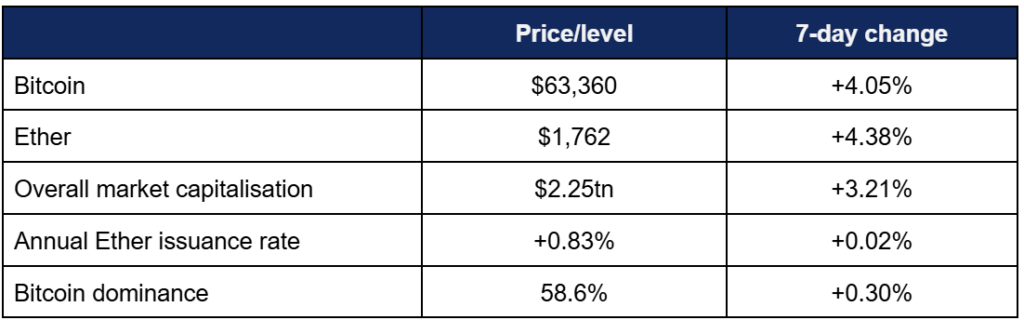
- Digital assets rallied after last week’s losses, with Bitcoin (at the time of writing) up over 10% following its worst week since the FTX crash
- Bitcoin and Ether both bounced back as major assets benefitted from news about a US-Iran peace deal
- Bitcoin displayed consistent growth, with a steady upward trajectory throughout the week
- Bitcoin increased from lows of $60,780 on Tuesday to a peak of $67,220 in the immediate aftermath of peace treaty news on Monday
- Ether’s price action decoupled from Bitcoin’s this week, showcasing flat range-bound performance between $1,620 and $1,680 before sudden surges on Sunday and Monday in the wake of reports around the peace deal
- The weekly low came on Thursday at $1,609, before rising to $1,844 on Monday afternoon
- Overall market capitalisation ranged between $2.11tn and $2.3tn throughout the week
- The vast majority of projects within the top 100 returned green candles over the last seven days, with Hyperliquid as the standout performer in the top 10
- According to industry monitoring site DeFi Llama, total value locked in DeFi increased slightly to $72.1bn
Digital assets rallied after last week’s rout, as news of a US-Iran peace deal restored market confidence somewhat. Several major institutional names across asset management and banking deepened their involvement in the space, tokenisation demand continued to grow, international regulatory efforts advanced, the football World Cup shed further light on the nascent field of blockchain-based prediction markets, and more.
ETF News
What happened?
- Digital asset investment products reduced their bearish momentum, but still posted a fifth consecutive week of outflows
- Bitcoin ETFs managed to close the week with a return to inflow mode, even before the US-Iran peace deal was announced
- Spot Bitcoin ETFs went from four trading days of nine-figure outflows (between $326m to $519m) to one day of nine-figure outflows, at $214m
- BlackRock’s market-leading IBIT fund led the losses, with two days of nine-figure outflows between $149m and $233m
- Indeed, IBIT’s $233m capital flight on Monday accounted for the entirety of the day’s outflows; four other funds (Fidelity’s FBTC, Bitwise’s BITB, ARK Invest’s ARKB, and Morgan Stanley’s MSBT) all actually posted healthy inflows that same day, ranging from $5m (MSBT) to $63m (ARKB)
- Wednesday faced the largest overall outflows, as IBIT’s $149m were compounded by $88m from Grayscale’s converted GBTC fund
- Morgan Stanley’s MSBT continued its post-launch run of positive performances, as one of several funds (alongside FBTC, BITB, ARKB, WisdomTree’s BTCW, and Grayscale’s 0.15% fee mini-ETF)
- The week closed with positive performance on Friday, as $86m inflows were spread across five funds, led by $57.7m inflows at IBIT
- Spot Ether ETFs reversed this pattern, opening the week with $82m inflows on Monday, before four days of outflows
- Fidelity’s FETH returned the best weekly performance, accounting for $27m of $82m of Monday inflows
- Meanwhile, BlackRock’s ETHA featured the largest daily outflows, shedding $21m on Wednesday
International news
What happened?
- Reports in the local media this week indicated that South Korea’s finance ministry will treat tokenised stocks the same way as traditional securities rather than digital assets, meaning they will be taxed accordingly
- This may have caught some traders off-guard, operating under the assumption that such assets will fall under the country’s forthcoming virtual asset tax regime, active from 2027 onwards
- A ministry official told local publication Bloomingbit that “Although tokenized stocks formally take the form of virtual assets, they are substantially closer to securities”
- Japan meanwhile “is poised to pass legislation bringing cryptocurrencies under the same regulatory framework as stocks, a move that’s set to expand access to digital assets”
- According to Bloomberg reports, the bill to classify crypto assets as financial instruments passed the lower house of the Japanese Diet on Thursday, meaning potential ETF issuances and lower taxes
- Masato Yoshizawa, a representative for the Financial Services Agency’s policy and markets bureau, signalled (very) cautious support within the economy; “We aim to foster more innovation by creating a sound trading environment… We’re not necessarily giving crypto a stamp of approval, but we’re aiming for healthy market growth”
- This represents the latest stage in slow progress for such plans, entering the home straight after regulatory efforts ongoing since 2024
- Overview of exchanges will become stricter within the new regulatory framework, but capital gains taxes fall from a 55% maximum to a flat 20% across all bands
- In Hungary, crypto asset trading will be decriminalised, following Viktor Orban’s defeat in the country’s recent general election
- Under the Orban regime, trading digital assets could carry a prison term, leading firms like Revolut to suspend services within its borders
- However, the prohibition only went into effect in July last year, potentially making this one of the shortest crypto bans on record
Crypto Treasury news
What happened?
- Leading Bitcoin treasury firm Strategy added further to its reserves this week, a fortnight after its controversial first Bitcoin sale in four years moved markets into uncertainty
- Strategy spent approximately $100m acquiring 1,587 Bitcoin at an average price of $63,024, according to its latest filings
- This brings total holdings to 846,842 Bitcoin; around 4% of the total supply cap, indicating why any surprise sales by the firm could kick off further market panic
- Meanwhile, leading Ether treasury firm BitMine bought even more of its chosen asset, adding $136m worth of Ether following a preferred stock sale
- Its total treasury now stands at around 5.62 million Ether, as the company remains committed to its goal of securing 5% of the asset’s total supply
- In its weekly press release, chairman Thomas Lee explained the rationale of the major buy, saying “We are maintaining a somewhat elevated pace of buying as we believe this pullback in Ether prices does not reflect the strengthening of Ethereum fundamentals”
VC News
What happened?
- Numerous major deals and investments were confirmed within the crypto sphere this week, as VC activity continued its recent renaissance in spite of ongoing market challenges
- Stablecoin giant Tether continued its income diversification push, leading a $1.4bn round for German robotics firm Neura
- Other participants included Amazon, NVIDIA, and Qualcomm
- In a press release, Tether called it “One of the Largest Robotics & Physical AI Investment Rounds on Record”, and indicated the deal also means it will “provide and deploy some of its core technologies into NEURA Robotics’ ecosystem”
- Tether has established form for the robotics market, investing in Italian startup Generative Bionics previously
- Digital Asset, developers of the Canton blockchain network, disclosed a $355m deal to bring capital markets onchain this week
- The round was led by $100m from Andreessen Horowitz (a16z)’s main crypto fund, whilst other major institutional names included the Abu Dhabi Investment Authority, and Citadel Securities
- This exceeded a previous $300m funding goal at a $2bn valuation stated last month
- A16z general partner Ali Yahya told Bloomberg that institutions are calling out for tokenised assets and the infrastructure to handle them; “They are the team that has done the best job at understanding what institutional customers actually want… It brings privacy and compliance to the table, while it preserves some of the core benefits that blockchains bring to the table as a technology”
What happened: Citi launching tokenised share offering
How is this significant?
- On Thursday, the Wall Street Journal reported that global banking powerhouse Citi is launching a new blockchain-based platform for private wealth clients to gain access to tokenised shares of private companies
- The offering is initially limited to clients from outside the United States, due to regulatory requirements amidst a trend of companies waiting longer than previously to go public
- Citi will issue and hold the so-called “Digital Depository Receipts”, using blockchain infrastructure built by Swiss market operator SIX, although the bank indicated it could potentially support public blockchains in the future
- A Citi spokesperson told industry publication Coindesk that “Our focus with Digital Depositary Receipts is to continue to expand responsible access to digital asset markets”, arguing that the tokenised receipts “could make private-market investing simpler and more transparent than some existing structures”
- The Journal confirmed from Citi sources that the bank is currently in discussions with multiple large private companies, but no specific names were disclosed
- Citi’s decision reflects a long-standing interest in tokenisation; it recently joined a consortium of major banks to develop a tokenised deposit network, and as early as 2023, Citi published predictions on the potential scale of tokenised securities, forecasting a $4tn value by 2030
- In other tokenisation news, tokenised pre-IPO share markets for SpaceX’s hotly-anticipated public float managed to accurately predict pricing, but failed to secure sufficient exposure
- Bloomberg noted that “For much of the week before SpaceX’s public debut, the perpetual contract traded inside what became the stock’s first-day range despite bouts of sharp volatility. By the time the company opened on Nasdaq, the crypto market had already compressed toward the opening price, offering a public, around-the-clock view of investor expectations before traditional trading began”
- Indeed, perpetual futures on crypto derivatives exchange Hyperliquid reached over $1.3bn in trading volume as part of pre-float speculation
- However, attempts to sell actual tokenised shares alongside perpetual contracts faced limitations, as not all exchanges (or partner firms such as xStocks) were able to secure enough allocations, and had to refund investors after failing to buy the underlying assets on launch
- One crypto industry executive told Bloomberg “It’s an unfortunate lesson learned for those who expected an allocation. But, across crypto, pre-IPO perps once again demonstrated their utility as an important tool for early market access and price discovery”
- Meanwhile, Singapore’s DBS Bank unveiled plans to offer tokenised gold to retail customers on its Digibank platform, managed by in-house infrastructure
- Investment product head James Tan commented “While our retail investors have been able to buy gold funds, access to physical gold has been largely available to only institutional and accredited investors… we are now leveraging tokenisation to broaden access, enabling more retail customers to invest in gold in a safe and meaningful way”
What happened: BlackRock files for novel Bitcoin ETF
How is this significant?
- The world’s largest asset manager, BlackRock, is building on the success of its IBIT spot Bitcoin ETF with the launch of a new product, allowing customers to earn yield on the leading digital asset
- The Bitcoin Premium Income ETF (BITA) will generate income by actively selling call options – primarily on BlackRock’s own IBIT ETF
- IBIT remains by far the largest Bitcoin ETF on the market, despite a recent trend of outflows during the most bearish portions of current crypto winter conditions
- It peaked at around $96bn AUM last October, after breaking numerous records for various ETF milestones
- Bloomberg chief ETF analyst Eric Balchunas tweeted that he expects Goldman Sachs to launch a similar product in early July, following initial filings in April
What happened: World Cup casts more light on prediction markets
How is this significant?
- Following the quadrennial kick-off of the FIFA World Cup this week, prediction markets once again entered the spotlight, with some analysts forecasting a significant increase in both revenues and profile
- Bernstein analysts called the event a “watershed moment for prediction markets”, as the first major global sporting tournament since their rise to relevance, predicting a potential $5bn to $10bn uplift in overall platform volumes
- In a Monday client note, analysts led by Gautam Chhugani noted that prediction markets are Robinhood’s fastest-growing product line since launch, estimating 286% year-on-year revenue increases for the trading platform
- They claim the World Cup could move the category beyond its current niche placement as a political wagering/forecasting tool, and into the proper cultural mainstream
- In particular, the analysts see potential growth within the US, due to strong perceived overlap between the country’s large Hispanic population and their traditional enthusiasm for the sport most Americans know as “soccer”
- Leading crypto exchange Coinbase is offering World Cup prediction markets via its partnership with top platform Kalshi
- Meanwhile, Bank of America analysts released a report titled “Prepping for perps: perpetual futures and more gamification”, where they predicted “the lines between finance, crypto, and betting to continue to blur over the coming years, and the culture of speculation continues to accelerate”
What happened: Japanese banking giants aim for joint stablecoin issue by March 2027
How is this significant?
- Japanese megabank Mitsubishi UFJ Financial Group (MUFG) confirmed this week that it is establishing a “council to explore operational frameworks and prepare for the issuance of stablecoins” alongside the nation’s other two megabanks, Sumitomo Mitsui Financial Group (SMBC) and Mizuho Financial Group
- According to the statement on MUFG’s website, the trio will act as “joint settlors and a trust bank or similar institution will act as trustee”
- MUFG further said that the banks plan to finalise issuance by next March
- This represents the latest stage in a long-awaited plan for official Yen-pegged stablecoins, as Japan’s financial watchdog supported the three banks’ joint-issuance plans as early as last year
- The largest Yen-pegged stablecoin currently is JPYC, with an issuance of $18m, as the Japanese market seemingly awaits the entry of these more trusted and established institutions
This weekly financial roundup is for informational purposes only and is not financial, investment, or legal advice. Information is based on public sources as of publication and may change. Consult a professional before acting.