



Market Overview
Digital assets exhibited mixed performance with slight overall declines, as US-Iran peace talks faltered and analysts raised the possibility of interest rate hikes from the Fed this year.
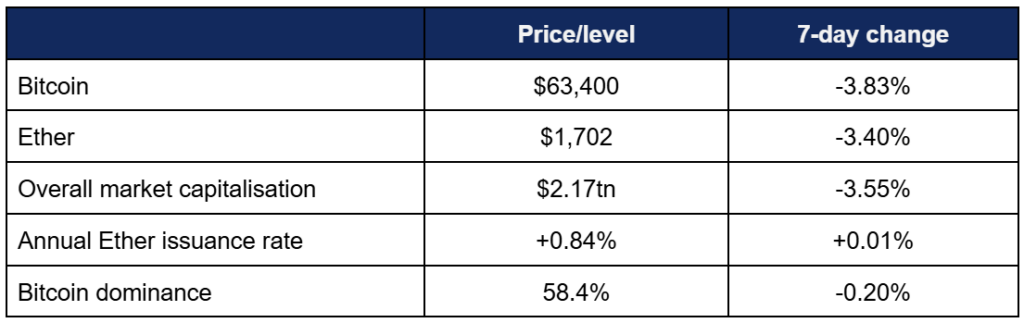
- Digital assets lost momentum after last week’s rally, as initial proclamations of a US peace deal with Iran turned out to be premature, and the status of the Strait of Hormuz remained in flux
- Bitcoin closed the week at a loss after a promising early performance, whilst Ether finished slightly down
- Bitcoin peaked in early trading, hitting $66,790 on Tuesday, before a gradual decline throughout the week enroute to a Friday low of $62,320 as peace talks seemingly soured and rate hike concerns were raised
- Bitcoin did rally slightly among talks of some progress in treaty negotiations, briefly topping $65,000 on Monday before retreating to current levels
- Ether’s chart pattern moved in lockstep with Bitcoin’s, with a Tuesday high of $1,833 giving way to a Friday bottom at $1,677
- Overall market capitalisation ranged between $2.15tn and $2.24tn throughout the week
- The majority of the market responded to challenging and uncertain conditions with investor caution, as only a handful of projects within the top 100 by market capitalisation returned any significant gains
- According to industry monitoring site DeFi Llama, total value locked in DeFi increased by over a billion dollars to $73.2bn
Digital assets posted slight losses after last week’s rally, as initial optimism over a US-Iran peace deal cooled as talks stalled and uncertainty continued. Forecasts of rate hikes from the Federal Reserve also spooked markets, leading to greater risk-off behaviour from investors. However, there was still a raft of positive adoption news from across the world, as tokenisation efforts increased, the Bank of England unveiled a more supportive policy position on UK stablecoins, Ethereum benefitted from a new “node” of developers, Baillie Gifford entered the onchain space, and much more.
ETF News
What happened?
- Digital asset investment products continued their recent trend towards outflows, albeit at lowered levels
- During a trading week truncated by the Juneteenth public holiday, both Bitcoin and Ether products logged a mixed week of outflows and growth
- Spot Bitcoin ETFs uncharacteristically didn’t feature any days in the nine-figure range; neither for capital flight nor accrual
- Outflows topped out at $91m on Thursday, whilst daily inflows were limited to $10m on Tuesday
- BlackRock’s market-leading IBIT was entirely responsible for Thursday’s outflows as it shed $97m overall, but it did also feature the week’s largest inflows with $66m on Monday
- The next-largest daily inflows for any fund were $16m (also IBIT), whilst a handful featured some daily flows in the $10m-$14m range during a sedate trading week
- However, the largest weekly outflows came from Grayscale’s converted GBTC fund, which saw sell-offs of $124m on Monday to counteract IBIT’s inflows
- Morgan Stanley’s MSBT continued its post-launch run of positive performances, and was the only fund to feature inflows on every trading day of the week
- Early but incomplete trading data for Monday indicates a possible return to inflow mode, with over $100m in positive flows spread across ARK Invest’s ARKB, Fidelity’s FBTC, and Grayscale’s 0.15% fee mini-ETF
- Spot Ether ETFs meanwhile started the week with consecutive inflow days, before reversing course with two days of outflows
- The trading week closed close to net neutral, as inflows ranged between $10m and $23m, whilst outflows sat between $13m and $29m
- BlackRock’s ETHA accounted for nearly all the daily inflows with $17m and $18m in the first two trading days. It also featured the largest outflows of the week, shedding $13m on Thursday
- In other ETF news, Bloomberg chief ETF analyst Eric Balchunas reported a new Franklin Templeton ETF filing to invest stock dividends into Bitcoin, and new Morgan Stanley filings for Ether and Solana ETFs
- The proposed fee on the latter two would be 14bps; “the cheapest in the US and the world”
VC News
What happened?
- XRP developers Ripple Labs secured a major stake in leading African fintech platform Flutterwave this week, valuing the firm at $3.3bn
- Exact equity terms were not publicised, but the valuation does exceed previous funding rounds for the company
- CEO Olugbenga Agboola told Bloomberg “Ripple’s interest in Flutterwave stems from a shared goal of moving money quicker and better… they’re participating at the equity level, which means obviously they get to participate on the upside”
- Flutterwave currently operates in 35 countries across Africa, and developed its own stablecoin-based cross-border payments solution last year
- Agboola also noted the recent acquisition of a microfinance banking licence in Nigeria, freeing them from reliance on partner banks; “We plan to do a lot more around that. “We want to do a lot of mergers and acquisitions. That is very key for us as we see an opportunity to consolidate payments in Africa, that is what we want to do”
- Digital asset trading app FOMO raised $75m in a Series B round at a $550m valuation, according to a Monday press release
- The non-custodial consumer app was founded by veterans from dYdX, and the new raise represents a drastic jump from previous total funding of $19m
Crypto Treasury news
What happened?
- Leading Bitcoin treasury firm Strategy purchased $34.9m worth of Bitcoin last week, funded by the sale of common stock
- This equated to around 520 Bitcoin according to regulatory filings
- However, the company is currently struggling to escape the shadow created by its recent break from its historic “never sell Bitcoin” policy, as its STRC Stretch preferred shares are now trading at their largest discount since launching last year
- Meanwhile, lesser-known Bitcoin treasury Strive benefitted following reports of a continued commitment to its Bitcoin acquisition policy
- The firm, founded by billionaire Vivek Ramaswamy, saw shares surge 10% after publishing a $50m purchase that brought its reserves to nearly 20,000 Bitcoin
- Leading Ether treasury firm BitMine made another significant addition to its holdings, purchasing $92m of Ether over the last week
- Chairman Thomas Lee wrote in the company’s weekly press release that “We continue to maintain a steady pace of accumulation throughout 2026”, and reiterated prior assertions that he believes the digital asset market is currently in the early stages of recovery from a prolonged bear market
What happened: New SEC proposal bolsters tokenised securities
How is this significant?
- It was another busy week in the nascent field of tokenisation, particularly in regards to tokenised securities
- Bloomberg analysts hypothesised that the crypto industry could be the biggest winners of a new SEC proposal to scrap the so-called “trade-through rule” for traders in the US
- According to the rule, exchanges cannot execute trades on prices worse than the national best bid or offer, which was challenging for crypto firms (in a marketplace dominated by high-frequency trading firms) with the additional step of routing towards stock exchanges
- Larry Tabb of Bloomberg Intelligence commented “It’s really hard to have tokenised equities if you have a trade-through rule. These markets move in microseconds”
- However, dropping the rule and adding an “innovation exemption” for DeFi are viewed as signs of the SEC embracing the digital asset industry, and assisting it in the proliferation of tokenisation
- Galaxy Digital research head Alex Thorn called the proposed amendment “one of the biggest unlocks yet for tokenised stocks”
- Coinbase CEO Brian Armstrong meanwhile revealed plans to make tokenised stocks global, opening US markets further to overseas investors
- Armstrong tweeted “For the first time, these are real 1:1 backed tokenised stocks you can trust. You own an actual chunk of the company onchain”
- He added “Other current solutions are some form of derivative or IOU – not real ownership. Our product will give all the benefits of true ownership, with all the benefits of tokenised assets. This is a great step towards unlocking global access to US markets”
- Bloomberg analysts also noted that tokenisation of stocks can greatly simplify a convoluted existing process, with MIT Cryptoeconomics Lab founder Christian Catalini calling it an “existential” threat to legacy systems
- He added “A lot of these intermediaries are an artifact of history. And they’re not necessarily adding a ton of value”
- A new research note from Bernstein analysts found that whilst the wider crypto market is still struggling through cold winter conditions, the tokenised Real World Asset (RWA) market has grown to above $51bn; a 40% year-to-date gain
- Analysts noted that “Equity tokenisation is where competitive heat is building fastest. Tokenised equities have grown 130% YTD, from $700m to $1.6bn”
- A new joint venture between NYSE owner Intercontinental Exchange and crypto exchange OKX was announced this week, “focused on building next-generation infrastructure for tokenised and digitally native financial products”
- The press release added that (subject to regulatory approval), the 50-50 venture “brings together OKX’s world-class blockchain technology and ICE’s trusted market infrastructure to help build a more modern, transparent, and resilient financial system for the future… blockchain technology can lead to the democratization of finance, bringing basic financial services to underserved populations”
- ICE Futures Markets SVP Trabue Bland commented “The ICE-OKX joint venture is a step towards building the infrastructure that will define how global markets operate in the decades ahead… we are working towards extending that reach to OKX’s 120 million retail traders”
- Elsewhere in tokenisation, federally chartered bank Anchorage Digital is rolling out a new parallel layer technology for tokenised deposit, following on from recent news of a major banking consortium developing its own shared solution
- Anchorage CEO Nathan McAuley cited institutional demand as a catalyst for the move, stating “Many of the banks that we’re starting to work with are thinking about tokenised deposits, and how do we start to do [them]”
What happened: Bank of England drops proposed stablecoin cap
How is this significant?
- The Bank of England this week scrapped previous controversial plans for limits on stablecoin holdings within the UK, widely decried as too restrictive by industry observers when they were first published
- It published a new policy statement and draft rules for stablecoins, outlining the UK government’s stance on the asset class
- Instead of maximum caps on stablecoin balances for business and individuals, the central bank has instead proposed a maximum £40bn issuance of any single stablecoin within the UK
- Its new draft issuance for “Sterling-denominated systemic stablecoins” also raises the proportion of interest-bearing UK government bonds that issuers may hold as backing assets for their stablecoins, rather than pure cash
- Previous guidance set a 60% limit for bonds, now 70%
- In addition, industry publication TheBlock noted some robust market guardrails, as “issuers must hold capital equal to the higher of six months of operating expenses or the cost of recovery and orderly wind-down planning, while maintaining reserve assets in trust structures designed to protect coin holders in both normal operation and failure scenarios”
- The new policy statement was greeted warmly within the industry, as Coinbase Europe head of policy Katie Harries said the UK can now “deliver among the strongest stablecoin regimes in the world”
- Fireblocks senior policy director Varun Paul broadly agreed, stating “The shift from holding limits to issuer limits is far more aligned to their policy intent and much more practical to implement… but [the 30% central bank reserves requirement] will still put UK stablecoin issuers at a disadvantage”
- Elsewhere in policy, an industry trade lobby in the US petitioned Congress to pass a proposed crypto tax bill without any amendments
- In an open letter, Digital Chamber CEO Cody Carbone stated “The [incumbent] tax code currently fails to account for how miners and stakers create and interact with assets, and this bill provides much-needed clarity, protects US competitiveness, and preserves a bipartisan compromise already established by that Congress”
- On Monday, the US Senate passed a bill banning the US from ever establishing a CBDC
- BaFin-regulated crypto firm BitGo promoted its crypto-as-a-service platform to digital asset firms within the EU, where MiCA deadlines on the 1st of July could soon exclude a raft of firms from operating within the economic zone
- Reuters reported that Binance could be the most prominent casualty of these regulations, after an application for a pan-European crypto licence via Greece was rejected this week
- Binance said it would provide further updates to EU customers on the 30th of June, right before the final deadline on MiCA licencing
- In other stablecoin news, remittance giant Moneygram joined the Solana blockchain as a validator, expanding its presence to a third chain alongside the stablecoin-focused Tempo and Midnight Network
- Moneygram CEO Anthony Soohoo told TheBlock “As blockchain infrastructure becomes increasingly important to global payments, we believe institutions that rely on these networks should also contribute to their security, resilience, and long-term development. By becoming a validator, MoneyGram contributes to the long-term strength of the ecosystem”
What happened: Ethereum heavyweights back new research lab for the blockchain
How is this significant?
- On Monday, a group of prominent Ethereum Foundation contributors and ecosystem veterans announced the formation of Ethlabs, a new “nonprofit research and development organisation” dedicated to the blockchain
- Ethereum treasury firms Sharplink and BitMine are the major providers of funding for the organisation, “alongside Ethereum co-founder and Consensys CEO Joe Lubin and several other entities, including Anchorage Digital”
- The formation of Ethlabs follows what industry publication Coindesk described as “a period of upheaval” at the Ethereum Foundation, the Swiss-based non-profit primarily responsible for steering research and funding regarding Ethereum blockchain development
- Several of the technical names connected to Ethlabs were veterans of the Ethereum Foundation who left this year
- Supporters say Ethlabs represents a shift towards a “multi-node” development model, arguing that the blockchain ethos of security via decentralisation should also mean that the established Ethereum Foundation cannot dominate too much of the blockchain’s strategic plans
- Lubin said in the press release that “We are now poised to recognise and implement the idea that there should be a number of steward nodes of Ethereum, each configured in their unique way to evolve and protect what is sacred about the network and massively grow the world’s appreciation and utilisation of it”
- Executive director Ansgar Dietrichs added “Ethereum is at a pivotal moment. As blockchain systems move rapidly into mainstream use, the coming years will define the shape of the onchain economy for decades. Ethereum is uniquely positioned to become the shared base layer of that economy”
What happened: Baillie Gifford and BNY collaborate on tokenised fund
How is this significant?
- £237bn AUM Scottish investment house Baillie Gifford this week launched the UK’s first “fully native tokenised fund”, in a collaboration with American banking giant BNY
- The $BAGEY fund will operate on two public blockchains, Ethereum and Solana, with BNY providing infrastructure support
- Structured as a fixed-income dollar-denominated fund with annual yield of 7%, it “gives eligible investors access to an actively managed, short-duration portfolio of public corporate bonds”
- Baillie Gifford’s head of digital assets Theo Golden told finance publication CityAM “Tokenisation will only matter if it makes finance fundamentally better. A digital wrapper around yesterday’s infrastructure is not enough”
- He added “The Baillie Gifford Enhanced Yield Fund is not a token placed on top of a fund. It is a fund issued onchain, with the blockchain serving as the register of record. Investors hold the fund directly: direct ownership, direct recourse”
- Meanwhile, Katie Neate, BNY’s head of investor solutions, commented “Tokenisation has moved from concept to real-world application, and this launch shows how regulated fund structures can evolve to meet the needs of a more digital, connected marketplace. We’re proud to be collaborating with Baillie Gifford on this first for the UK market”
- Elsewhere in tokenisation, custody banking giant State Street entered the onchain money market race, announcing the new State Street Stablecoin Reserves Money Market Fund
- According to industry publication Coindesk, the government money market fund is “designed specifically for stablecoin issuers operating under the framework established by the GENIUS Act”, reflecting the increased legitimisation of stablecoins since the legislation passed
- It follows State Street’s launch of the SWEEP tokenised liquidity fund alongside Galaxy Digital last month, further reinforcing the bank’s long-term vision on digital assets
What happened: Charles Schwab launches product inspired by crypto prediction markets
How is this significant?
- The Wall Street Journal reported on Friday that investment management titan Charles Schwab is entering (or at least acknowledging) the prediction market space, via the creation of new binary options contracts
- The “yes or no” products will be based on the S&P 500’s closing bell, built in collaboration with Cboe global markets, paying a fixed cash settlement upon positive resolution
- Reuters corroborated these reports, citing anonymous sources
- However, in a deviation from the pure binary nature of prediction markets, the Journal wrote that Schwab is also adding a “plus zone” option which offers partial payouts if traders are close but not quite on target
- The move seems to be driven by consumer demands, and marks an about-face from CEO Rick Wurster, who told the Journal last year that prediction markets weren’t viewed as a priority – albeit acknowledging that this position could change in the face of market momentum
- In other prediction market news, leading platform Kalshi is reportedly keen to expand its perpetual futures offering, after the products accrued $5.5bn in trading volume within the first fortnight of launching
- Co-founder Tarek Mansour said “It’s been our fastest growing launch in terms of adoption and customers. We’ll move as fast as possible without breaking things”
What happened: Japanese business pension fund allocates towards digital assets
How is this significant?
- According to reports from Japan’s Nikkei news agency, the National Business Corporate Pension Fund will invest 1% of its assets in digital assets going forward, marking a significant seal of approval in the conservative space
- The pension fund currently features around 1,200 businesses as members, managing $132m in assets, and made the decision “as part of a broader effort to diversify currency risk”
- Regulatory momentum within Japan is currently growing, following the Diet Lower House’s approval of a bill classifying crypto assets as financial instruments, which could be passed into law next year if passed by the Upper House
- Additionally, a consortium of major Japanese banks recently revealed plans to launch a Yen-denominated stablecoin by the first half of next year, and local financial powerhouse SBI will offer a crypto asset rewards program for depositors at its SBI Shinsei banking chain
This weekly financial roundup is for informational purposes only and is not financial, investment, or legal advice. Information is based on public sources as of publication and may change. Consult a professional before acting.