



Market Overview
Digital assets pulled back further this week, as the US-Iran peace process remained uncertain, leading to widescale risk-off behaviour across wider markets alongside ETF outflows.
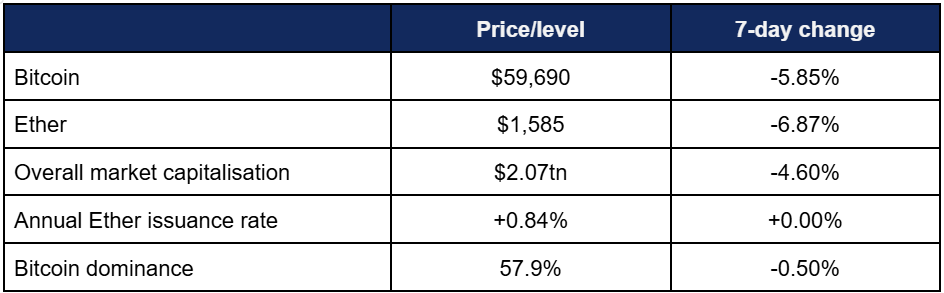
- Digital assets fell further following new strikes between the US and Iran
- Bitcoin dropped below $60,000 for the first time since October 2024, as continued global uncertainty drove investors further into risk-off mode.
- Bitcoin experienced a bearish trajectory throughout the week, dropping from highs of $64,100 on Tuesday to a weekly low of $58,560 on Friday, leading to mostly rangebound trading between $59,000 and $60,200 for the remainder of the week
- Ether performed similarly, as a Tuesday high of $1,727 gave way to a low of $1,523 on Friday
- Overall market capitalisation nearly dropped below $2tn in intraweek trading, falling as low as $2.02tn
- According to industry monitoring site DeFi Llama, total value locked in DeFi dropped to $71.25bn
Digital assets faced another challenging week, as continued geopolitical uncertainty weighed heavily upon investors across multiple markets. ETFs in particular bore the brunt of risk-off behaviour, as they logged their second-worst week since launch. Beyond the bearish markets, adoption nevertheless continued, as institutions like BNY, BlackRock, and Invesco all increased their involvement in the digital asset space, prediction markets continued their growth, another crypto firm neared a public launch, and much more.
ETF News
What Happened?
- Digital asset investment products experienced a challenging week, with outflows nearing record levels as global geopolitical uncertainty continued biasing investors towards risk-off behaviour
- Indeed, Bitcoin ETFs look set to conclude their worst month for outflows since launching, with investors pulling out $4.1bn (including $3bn from BlackRock’s market-leading IBIT)
- Spot Bitcoin ETFs reflected this momentum last week, as all five trading days resulted in outflows, including four in the nine-figure range (between $114m and $692m)
- Overall weekly outflows reached around $1.79bn; the second-worst week on record, leaving around 40% of IBIT holders underwater on their investments
- Outflows peaked on Thursday, as only one ETF registered any inflows whatsoever
- IBIT was marked by nine-figure outflows every day last week, ranging from $142m to $445m
- Fidelity’s FBTC also exhibited a shift towards risk-off performance this week, as it moved from two days of inflows to start the week ($57m and $23m) to consecutive nine-figure outflows ($121m and $275m)
- Despite the bearish overall market momentum, Morgan Stanley’s MSBT maintained its positive post-launch performance, logging three days of inflows (all in the $8m to $9m range), and zero outflow days
- Spot Ether ETFs mirrored the performance of Bitcoin funds, registering five days of outflows, dominated by BlackRock’s flagship ETHA fund
- ETHA outflows reached a peak of $86m on Tuesday, accounting for the day’s largest overall outflows at $82m
- Bitwise and 21Shares, two minor funds, actually reported overall weekly inflows amidst the market pullback, albeit both at very minor levels (around $1m)
Prediction market news
What happened?
- Blockchain-based prediction markets continue gaining steam globally, leading analysts to predict a potential swathe of M&A deals even as the broader digital asset market continues to endure a prolonged crypto winter
- In Japan, the leading platform, Miraima, was founded just seven months ago, as the sector displays caution due to stringent anti-gambling regulations in the country
- Instead of offering direct payouts on any successful wager, users on Japanese prediction market platforms receive rewards in the form of points that can be converted into vouchers, gift cards, or monetary rewards; effectively echoing the same gambling workaround as Japan’s notorious pachinko industry
- Since debuting in November, Miraima has already achieved one million monthly active users, making it one of the fastest-growing apps in the country
- Miraima founder Keita Adachi told Bloomberg “I saw prediction markets exploding in the US and immediately thought there was huge potential for this in Japan. Since real-money gambling isn’t possible, we built the platform around Japan’s strong gaming and point-collecting culture”
- Established foreign platforms like Polymarket are already seeking approval from Japanese regulators
- Leading international platform Kalshi is seeking new funding at a $40bn valuation ahead of a public launch next year, according to new Financial Times reports
- This could lead to yet another crypto windfall within the Trump family, as Donald Trump Jr holds a stake in the platform
- Analysts at Bernstein predict that the scale of growth and volume within the prediction market sector could lead to widespread deals as traditional platforms catch up on digital asset native firms by acquiring to build their own solutions
- In the US, leading sports betting company (and prediction market operator) DraftKings recently launched its own proprietary exchange (DKeX) to take advantage of the sector opportunity after already logging $3.4bn category volume
- DraftKings CEO Jason Robins previously said that prediction markets were “a massive, incremental opportunity… [we will] deploy growth capital to build the best customer experience … and acquire millions of customers”
- The analysts said this exchange launch represented a potential trend of established firms taking their predictions activity in-house rather than deferring or licencing to crypto-native firms like Polymarket or Kalshi
- They wrote “Kalshi and Polymarket own the stack but trail on distribution, which leaves each as plausibly a target as an acquirer… The revenue share that used to leave the building now stays inside it”
Crypto Treasury news
What happened?
- Leading Bitcoin treasury firm Strategy once again hit headlines (and potentially unsettled markets) by eschewing its traditional Bitcoin purchases in favour of overhauling its finance model
- Shares in Strategy have slumped to a two-year low alongside Bitcoin’s market performance over the last year, but recovered slightly after the company revealed its new buyback plans
- Strategy boosted its USD reserve to $2.55bn, and “authorised up to $1bn in digital credit securities repurchases, including STRC, STRF, STRD, and STRK, with STRC expected to be the biggest priority”
- As part of its new Digital Credit Capital Framework, the company’s board seeks to maintain at least one year’s worth of “current expected annual preferred stock dividend payments and interest obligations”
- It also declared it could sell up to $1.25bn of Bitcoin to further bolster cash reserves
- Leading Ether treasury firm BitMine was added to the Russell 1000, and bought 27,084 Ether over the last week, pushing its total holdings above 5.7 million Ether
- Chairman Thomas Lee noted that crypto winter is perhaps exceeding their initial projections, as he wrote in the company’s weekly press release that “This past week was a challenging one for crypto investors… even as Ethereum witnessed notable positive developments such as the creation of Ethlabs, and even the Bank of England softened its stance around stablecoins”
- Fellow Ether treasury firm Sharplink executed its first acquisition of the year (and first in eight months), purchasing 5,000 Ether for around $7.85m, according to analytics from blockchain forensics firm Arkham Intelligence
What happened: $2.5tn AUM asset manager Invesco files for tokenised fund
How is this significant?
- According to a new filing with the SEC, asset management giant Invesco is the latest TradFi powerhouse to recognise and embrace the benefits of tokenisation
- The filing in question indicates Invesco will launch a tokenised money market fund focused on stablecoin reserves
- Industry publication TheBlock noted that the (as-yet tickerless) fund “will invest primarily in high-quality, short-term assets such as US Treasuries, repo agreements, and cash equivalents to maintain a stable $1 net asset value. It will also tap blockchain infrastructure firm Superstate as its sub-transfer agent to tokenise its shares to be recorded on ‘designated’ unnamed public blockchains”
- It will list as a government money market vehicle under Rule 2a-7, similar to BlackRock’s BUIDL and Franklin Templeton’s BENJI
- The indication that the fund will be tokenised across public blockchains (with speculation pointing towards Ethereum, Avalanche, or Solana) helps demonstrate the benefits of accessibility over exclusivity that blockchains can provide
- GENIUS stablecoin legislation within the US has fostered growing interest in money market funds from asset managers and banks, particularly in an era of elevated interest rates, as Citigroup forecast a $4tn market capitalisation for the stablecoin sector by 2030
- Recently, other institutional giants launching tokenised funds included State Street, BNY, and JP Morgan, alongside sector veterans Franklin Templeton and BlackRock
What happened: BlackRock integrates synthetic dollar token into Aladdin platform
How is this significant?
- The world’s largest asset manager further deepened its DeFi involvement this week, as BlackRock officially added the yield-generating Ethena USDe “synthetic dollar” to its Aladdin investment management platform
- In a tweet announcing the collaboration, the Ethena protocol noted that other aspects of the partnership included utilising “BUIDL as the primary asset for our whitelabel product”, a “Liquidity facility on BlackRock tokenized products”, and “unique institutional access for the >$20 trillion of assets managed by financial institutions on Aladdin”
- The liquidity facility in question is worth $100m, and “intended to make it easier for eligible BUIDL clients to exchange BUIDL tokens for USDC, USDtb, and other supported stablecoins”
- Through the Aladdin platform, institutions will now have direct access to USDe, allowing an alternative to stablecoins such as USDT and USDC
- In a statement, the two firms said the move could “advance institutional adoption of digital dollar infrastructure and the interoperability of digital dollars with tokenised financial assets”
- Robert Mitchnick, BlackRock’s head of digital assets, commented “In the case of tokenised treasury funds in particular, this liquidity facility enables a level of frictionless interoperability that is core to the unique utility that tokenizing treasury funds makes possible”
- Ethena founder Guy Young stated “The next phase of digital asset adoption will be driven by infrastructure that allows traditional institutions to interact with onchain financial products through familiar systems and workflows”
- This is the latest of several institutional moves by Ethena, following a strategic investment by asset manager Janus Henderson with a pledge to use USDe for treasury management
What happened: BNY and Circle extend partnership
How is this significant?
- USDC stablecoin issuers Circle and banking custody leader BNY this week revealed a new aspect to their partnership, allowing institutions more flexibility in dealing with stablecoins
- Under the terms of the new collaboration, institutional clients will be able to “custody, transfer, mint and burn USDC directly through BNY”
- “Burning” any amount of the stablecoin will essentially redeem and convert it back into government-issued US Dollars within a customer’s account
- The two firms have a long history of collaboration already, with BNY serving as the primary custodian for the backing assets guaranteeing the US-dollar peg of the USDC stablecoin
- BNY’s chief innovation officer Carolyn Weinberg said in a press release that “as digital assets become increasingly integrated into financial markets, institutions need infrastructure that seamlessly works across traditional and blockchain-based systems. With the addition of our enhanced stablecoin enablement capabilities, we’re expanding the ways clients can move value with the operational scale, trust and resiliency they expect from BNY”
- Circle CCO Kash Razzaghi commented “BNY has always been where institutional finance moves first, and making USDC the first stablecoin included in their new offering reflects the regulatory rigour Circle has built into USDC from day one”
What happened: Securitize eyes public launch after $400m raise
How is this significant?
- Securitize, the tokenisation firm responsible for bringing BlackRock’s BUIDL fund onchain, advanced its plans to go public this week, announcing that “following lower-than-expected shareholder redemptions, the business combination with Cantor Equity Partners II (CEPT) is expected to generate roughly $400 million in gross proceeds, including private investment in private equity (PIPE) financing”
- According to a press release, the deal is expected to close on the 1st of July (pending shareholder approval), with the company expected to begin trading under the ticker SECZ on the NYSE one day later
- CEO Carlos Domingo commented “When we started more than eight years ago, the idea that major institutions would embrace tokenised securities was still largely theoretical. Today, tokenisation is moving into the mainstream”
- Meanwhile, a proposed public launch via SPAC between a digital asset treasury firm headed by Bitcoin researcher Adam Back and Cantor Fitzgerald-linked blank cheque firm has been delayed
- According to a statement, “previously disclosed private placements” are the cause of a delayed vote on the proposed merger
What happened: UK wealth advisors lag in control and guidance over client crypto assets
How is this significant?
- According to new research conducted by industry firm CoinShares, a majority of wealth advisors aren’t managing crypto assets on behalf of their clients, with firm policy cited as the number one reason for this trend
- CoinShares conducted a survey across 261 wealth advisors in EU countries, Switzerland, and the UK, and found that British practices differed strongly from those on the continent
- In total, 52% of UK advisors reported a “management gap” [i.e. “the portion of a client’s digital asset exposure that sits outside the advisor’s oversight”] above 50%, compared with just a quarter of European advisors
- 61% of advisors worked in firms with either restrictions on digital assets, or no specific internal guidance on the asset class, leading to just 1% recommendation rates, compared to 48% in managers with clear internal support
- This also led to far greater management gaps at firms without internal guidance; 34% in restricted firms vs 4% in supported companies
- CoinShares CEO Jean-Marie Mognetti commented “This is not a knowledge problem. It is not a demand problem. It is a firm-policy problem becoming a wrong-way risk”
- Mognetti added “Every month a firm remains silent [on digital asset guidance], more of its clients’ wealth migrates beyond its advice, its visibility and ultimately its economics”
- The study noted that in Italy “with a permissive retail distribution model built around frequent, direct advisor-client contact, the country records the lowest management gap at 12%. It’s an indicator of demand converting into managed exposure before it becomes self-directed activity”
What happened: SBI Holdings purchases Japanese digital asset exchange Bitbank
How is this significant?
- Following recent news that Japanese financial powerhouse SBI is offering a crypto asset rewards program for depositors at its SBI Shinsei banking chain, the TradFi giant deepened its involvement with digital assets once again this week
- In a press release, the conglomerate confirmed a deal to acquire Tokyo-based crypto exchange Bitbank, for approximately $289m
- Although Bitbank is a large exchange within the country, it isn’t currently profitable, but analysts posited that SBI’s acquisition was driven by the desire “to create new business opportunities in digital assets including stablecoins and on-chain finance”, as well as acquiring a licenced exchange in a regulated market
- In fellow Asian economic powerhouse South Korea, banks and institutions have also been on an acquisition spree in anticipation of potential stablecoin legislation and market frameworks
- The latest player to enter the field is local financial giant Kiwoom Securities, according to reports in the local press
- ChosunBiz wrote that Kiwoom is currently in discussions with the country’s second-largest exchange, Bithumb, on the issuance of new shares, which Kiwoom would purchase
- Kiwoom appears to be positioning itself with equity before an expected public float by Bithumb, reportedly set for 2028
This weekly financial roundup is for informational purposes only and is not financial, investment, or legal advice. Information is based on public sources as of publication and may change. Consult a professional before acting.