



Digital assets traded broadly sideways this week, while institutional adoption continued across payments, market infrastructure and regulation. U.S. Bank completed a live cross-border transaction using its proprietary stablecoin, Nasdaq agreed to invest $100m in Kraken parent Payward, and the House of Lords backed plans for a comprehensive UK digital-asset strategy.
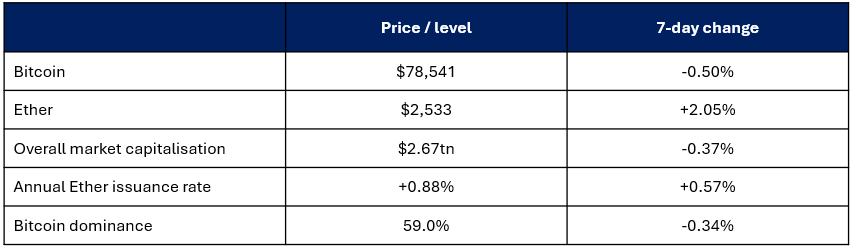
- Bitcoin traded at approximately $78,541, down -0.50% over the seven-day period, as the market remained relatively stable despite continued macroeconomic uncertainty.
- Ether outperformed Bitcoin, rising +2.05% over the week to approximately $2,533, while its annual issuance rate stood at +0.88%.
- Overall digital asset market capitalisation declined slightly by -0.37% to approximately $2.67tn, indicating relatively muted aggregate market movement.
- Bitcoin dominance fell -0.34% over the week to 59.0%, reflecting modest relative strength elsewhere in the digital-asset market.
U.S. Bank executes live cross-border payment using USBDC
- U.S. Bank completed a live cross-border payment between its North American and European entities using USBDC, the bank’s proprietary US dollar-backed stablecoin.
- The transaction was conducted on the public Stellar blockchain, while remaining integrated with U.S. Bank’s existing finance, risk, compliance and operational infrastructure.
Nasdaq invests $100m in Kraken parent Payward
- Nasdaq Ventures agreed to invest $100m in Payward, the parent company of Kraken, as the two firms expanded their collaboration around tokenised securities and always-on financial markets.
- The companies will continue to work on the Nasdaq Equity Token framework, which is intended to support tokenised representations of public equities while maintaining existing shareholder rights, governance and market-integrity standards.
- Nasdaq and Payward also announced a new market-surveillance agreement, with Kraken adopting Nasdaq technology across digital assets, equities, tokenised equities, futures and options.
House of Lords backs mandatory UK digital-asset strategy
- The House of Lords voted 194–138 in favour of an amendment requiring HM Treasury to prepare and consult on a comprehensive strategy for digital assets and related financial-market infrastructure.
- The proposed strategy would cover areas including crypto assets, qualifying stablecoins, central bank digital currencies, tokenised securities and other digital financial assets.
- If retained as the Financial Services and Markets Bill progresses through Parliament, the amendment would require the Treasury to publish the strategy within 12 months of the legislation being passed.
PayPal, M0 and MoonPay expand PYUSD into stablecoin infrastructure platform
- PayPal, M0 and MoonPay publicly launched PYUSDx, infrastructure allowing businesses to create customised stablecoins backed by PayPal’s PYUSD stablecoin.
- M0 provides the underlying stablecoin technology, while MoonPay supports issuance and reserve operations, allowing businesses to create individual products without building the underlying monetary infrastructure from scratch.
- Saturn, Concrete and Cap were live on the platform at launch, with more than $100m in processed volume already recorded across the platform.
- The development extends PYUSD beyond a standalone digital currency towards a broader infrastructure layer, allowing companies to build specialised payment and financial products using an established stablecoin as the underlying reserve asset.
MoneyGram launches stablecoin-backed Visa card in Colombia
- MoneyGram launched its first stablecoin-backed Visa card, initially making the product available to eligible customers in Colombia.
- Developed with stablecoin payments infrastructure provider Rain, the card enables users to maintain a stable-dollar balance in USDC and spend those funds wherever Visa is accepted.
- Customers can also transfer funds from their MoneyGram balance for local-currency cash collection through MoneyGram’s existing network, connecting stablecoin balances with established payment and cash infrastructure.
- MoneyGram plans to add support for its own MGUSD stablecoin and initially expand the product into additional Latin American markets, extending its stablecoin strategy from cross-border transfers into everyday payments.
This weekly financial roundup is for informational purposes only and is not financial, investment, or legal advice. Information is taken from public sources and Nickel takes no responsibility for its veracity. The information was sourced around the time of publication but may become out of date, even over short periods of time. Consult a professional before acting.