


Digital asset markets remained under pressure this week, but major financial institutions continued moving digital assets and blockchain services into commercial use. Developments at JPMorgan, Visa and CME showed how digital assets are becoming more closely integrated into payments, settlement and trading, even as broader investor risk appetite remained subdued.
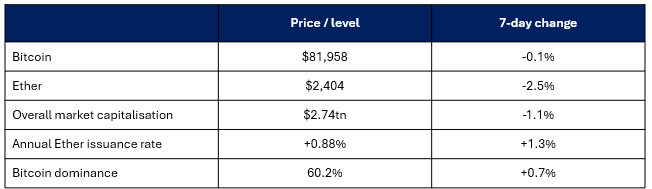
- Bitcoin recovered from a brief fall below $80,000 to end the week broadly unchanged, masking a sharper period of selling as stronger-than-expected US inflation data weighed on risk appetite and contributed to almost $1bn in leveraged liquidations.
- Ether underperformed Bitcoin, while overall market capitalisation declined, suggesting that the recovery from the week’s lows was not accompanied by a broader strengthening across digital assets.
- Bitcoin dominance increased to 60.2% as aggregate market value fell, indicating that its relative resilience reflected a larger share of a contracting market rather than a broad return of capital.
JPMorgan brings its deposit token to Ethereum
- JPMorgan made JPM Coin, its token representing US dollar deposits at the bank, available to institutional clients on Ethereum. The launch extends the product beyond Coinbase’s Base network, giving clients another public blockchain through which to transfer bank deposits.
- The bank cited Ethereum’s liquidity and existing institutional usage as reasons for the expansion. The token can support wholesale payments and the settlement of tokenised assets, extending the infrastructure connecting commercial bank money with blockchain-based financial markets.
Visa Direct moves USDC prefunding into commercial production
- Visa moved its stablecoin-enabled prefunding service into commercial production through payments infrastructure provider Inyo Global. Eligible businesses can now fund cross-border payouts through Visa Direct using USDC, moving the capability beyond the pilot programmes introduced last year.
- The integration allows businesses to fund payments in near real time through Inyo’s existing platform, reducing reliance on traditional banking windows. This provides money transmitters, fintechs and other payment businesses with greater flexibility to manage liquidity and fund international payouts outside normal banking hours.
BlackRock files for Bitcoin ETF offering downside protection
- BlackRock filed with the US Securities and Exchange Commission for the iShares Bitcoin Managed Protect ETF. The proposed fund would seek to provide a degree of downside protection while retaining exposure to gains in its flagship iShares Bitcoin Trust ETF, or similar Bitcoin exposure, up to an approximate limit.
- The filing extends BlackRock’s development of Bitcoin products beyond direct price exposure, following its Bitcoin premium-income ETF earlier this year. The proposed structure would offer investors another way to tailor Bitcoin exposure to their risk preferences, although protection levels and participation limits remain subject to the fund’s final terms.
CME adds Bitcoin Cash and Uniswap futures
- CME added Bitcoin Cash and Uniswap futures to its regulated cryptocurrency derivatives offering on 19 October, extending the range of assets institutions can access and hedge through its established trading and clearing infrastructure.
- Both assets are available in standard and micro contract sizes. Bitcoin Cash contracts represent 250 BCH and 25 BCH respectively, while Uniswap contracts represent 10,000 UNI and 1,000 UNI, allowing participants to manage exposures at different scales.
EBA designates USDC a significant e-money token
- The European Banking Authority classified Circle’s USDC as the first significant e-money token under the EU’s Markets in Crypto-Assets Regulation. The designation brings the stablecoin under enhanced supervision, with the EBA assuming direct responsibility for specified requirements from 12 November.
- The EBA will oversee reserve assets, own funds, liquidity requirements and recovery and redemption plans, while France’s ACPR retains responsibility for governance and other areas. The authority also signed an information-sharing agreement with New York’s financial regulator to support cross-border supervision of Circle’s operations.
This weekly financial roundup is for informational purposes only and is not financial, investment, or legal advice. Information is taken from public sources and Nickel takes no responsibility for its veracity. The information was sourced around the time of publication but may become out of date, even over short periods of time. Consult a professional before acting.