


Digital assets came under renewed pressure this week as Binance suffered the largest hack in digital asset history, with an estimated $6.3bn stolen, while weakness in technology stocks compounded the sell-off. Meanwhile, DTCC launched its tokenisation service, ICE announced plans for regulated US perpetual futures, and the Bank of England and Hong Kong Monetary Authority advanced their work on tokenised collateral and settlement.
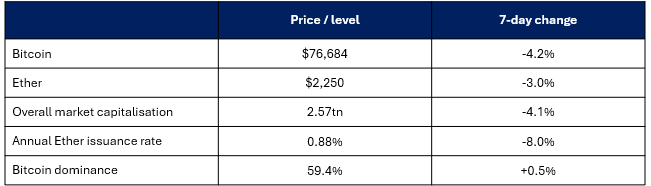
- Bitcoin briefly fell to approximately $76,400 following the Binance breach, while crypto futures liquidations reached $1.57bn and aggregate open interest declined. Monday’s recovery proved short-lived, with renewed selling in technology stocks pushing Bitcoin below $77,000 again on Tuesday.
- US spot Bitcoin ETFs recorded approximately $643m of net outflows on Friday, reversing four consecutive sessions of inflows. Ether nevertheless outperformed Bitcoin over the week, declining -3.04% against Bitcoin’s -4.15%, although the -4.10% fall in overall market capitalisation showed that weakness remained widespread.
Binance reports $6.3bn security breach
- Binance reported an estimated $6.3bn security breach, with approximately $3bn of affected assets frozen through coordination with industry partners. The exchange pledged to cover hacking losses as it investigated the incident.
- The breach prompted other exchanges to review their defences. Coinbase adjusted its offline key-storage systems as a precaution, while Kraken said it was monitoring the incident for lessons it could apply to its own security arrangements.
DTCC launches tokenisation service with major banks and asset managers
- DTCC launched its Tokenization Service, allowing eligible participants to create tokenised representations of securities held at DTC and convert them between traditional and tokenised forms. The instruments retain the ownership rights, investor protections and economic entitlements of their conventional counterparts.
- Twenty participants, including J.P. Morgan, Barclays, Fidelity, State Street and UBS, signed agreements to access the service. It initially connects to Canton and DTCC’s private Besu network, with additional networks planned for 2027.
ICE partners with TradeXYZ to bring perpetual futures to the US
- Intercontinental Exchange, the owner of the New York Stock Exchange, agreed to develop regulated US perpetual futures markets with TradeXYZ, using Hyperliquid infrastructure and subject to regulatory approval.
- ICE will make a strategic investment in TradeXYZ and operate the market and clearing structure. The proposed contracts would provide continuous exposure across cryptocurrencies, equities, indices, commodities and foreign exchange.
Hong Kong enables 24/7 settlement in tokenised central bank money
- The Hong Kong Monetary Authority upgraded EnsembleTX, enabling participating banks to settle tokenised deposit transactions with one another in tokenised central bank money around the clock.
- The pilot now includes 12 banks and 20 industry pioneers, with participants including HSBC, Standard Chartered, BlackRock and China Asset Management. The upgrade supports transactions beyond conventional settlement hours, including corporate treasury management and tokenised fund activity.
Bank of England proposes framework for tokenised clearing collateral
- The Bank of England opened a consultation on supervisory expectations for clearing houses seeking to accept tokenised versions of collateral already eligible under its proposed CCP rules. The proposals clarify how existing standards would apply to tokenised arrangements.
- The consultation also seeks views on broader collateral types, including regulated stablecoins, tokenised money market funds and tokenised gold, to inform future policy. These assets are being considered separately from the immediate proposals covering otherwise eligible collateral.
This weekly financial roundup is for informational purposes only and is not financial, investment, or legal advice. Information is taken from public sources and Nickel takes no responsibility for its veracity. The information was sourced around the time of publication but may become out of date, even over short periods of time. Consult a professional before acting.