


Digital assets suffered another sharp sell-off this week as ETF withdrawals and expectations of tighter US monetary policy weighed on demand, with leveraged liquidations accelerating the decline. Meanwhile, ICE advanced institutional custody and lending, JPMorgan and DBS connected tokenised deposit networks, the Bank of England completed a cross-border settlement trial, US regulators approved new derivatives infrastructure and major banks committed funding to a joint stablecoin venture.
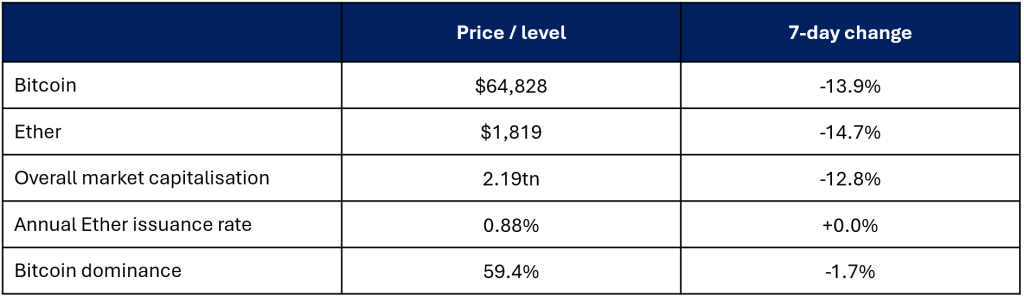
- Digital asset market capitalisation fell 12.8% to $2.19tn, reflecting another substantial contraction across the sector. Both Bitcoin and Ether underperformed the overall market.
- Bitcoin lost 13.9%, briefly approaching $62,000 on Sunday before recovering some ground. More than $2bn of positions were liquidated during the weekend sell-off, predominantly longs, accelerating the decline.
- Ether fell 14.7%, underperforming Bitcoin by 0.8%. Bitcoin dominance also declined to 59.4%, showing that the largest asset did not gain market share despite the sharp retreat.
- US spot Bitcoin ETFs recorded $1.07bn of weekly outflows, their second consecutive weekly withdrawal above $1bn, while Ether ETFs lost approximately $399m. Redemptions across almost every tracked crypto ETF category reinforced the weakness in investment demand.
JPMorgan and DBS launch continuous cross-border tokenised deposit transfers
- JPMorgan and DBS connected their blockchain-based deposit networks, enabling institutional clients to transfer dollars between US and Singapore blockchain accounts around the clock, including weekends. The service links DBS Token Services with Kinexys by J.P. Morgan.
- Ant International became the first client using the connection for global treasury management. The launch operationalises the banks’ previously announced framework, allowing institutions to move tokenised bank deposits across the two networks to meet liquidity needs outside conventional banking hours.
Goldman Sachs and Citi back $270m stablecoin venture
- Goldman Sachs, Citi and other financial institutions reportedly committed approximately $270m to their joint stablecoin venture, Project Faro. The funding is intended to cover five years of operating costs, according to Bloomberg.
- Participants include Santander, Deutsche Bank, Wells Fargo, Fidelity, MUFG and Standard Bank. The venture plans to issue a dollar-denominated stablecoin, with additional G7 currencies contemplated and a euro-denominated token taking priority
ICE and Abra introduce custody-backed institutional digital asset lending
- Intercontinental Exchange, owner of the New York Stock Exchange, partnered with Abra to provide institutional dollar loans backed initially by Bitcoin, Ether and Solana. ICE Digital Trust will custody collateral, while Abra Credit will manage lending and loan servicing.
- Collateral will remain in segregated accounts without rehypothecation, separating asset custody from lending activities. ICE Digital Trust will also hold assets for Abra Capital Management’s digital asset investment strategies.
Bank of England completes cross-border settlement trial with Singapore and Thailand
- The Bank of England, Monetary Authority of Singapore and Bank of Thailand demonstrated coordinated foreign-exchange settlement across conventional and blockchain-based systems through Project Meridian FX APAC, without requiring participants to use identical infrastructure.
- The trial tested payment-versus-payment settlement, making each currency transfer conditional on the other, alongside multilateral netting to reduce liquidity requirements. The Bank of England plans to introduce a live synchronisation interface in 2028
Backpack and tZERO secure US derivatives infrastructure approvals
- Backpack announced CFTC approvals for a regulated derivatives exchange and clearinghouse, while tZERO received exchange approval following its earlier clearing authorisation. The permissions support trading and settlement infrastructure built using blockchain technology.
- The approvals allow both firms to develop derivatives trading and clearing through their own regulated entities. For tZERO, the new permissions establish a derivatives infrastructure business serving financial institutions and other market participants.
This weekly financial roundup is for informational purposes only and is not financial, investment, or legal advice. Information is taken from public sources and Nickel takes no responsibility for its veracity. The information was sourced around the time of publication but may become out of date, even over short periods of time. Consult a professional before acting.