



Market Overview
Digital assets rebounded with the biggest inflows since the start of the year despite geopolitical tensions, as Morgan Stanley, Citi, and Barclays drive adoption amid regulatory shifts.
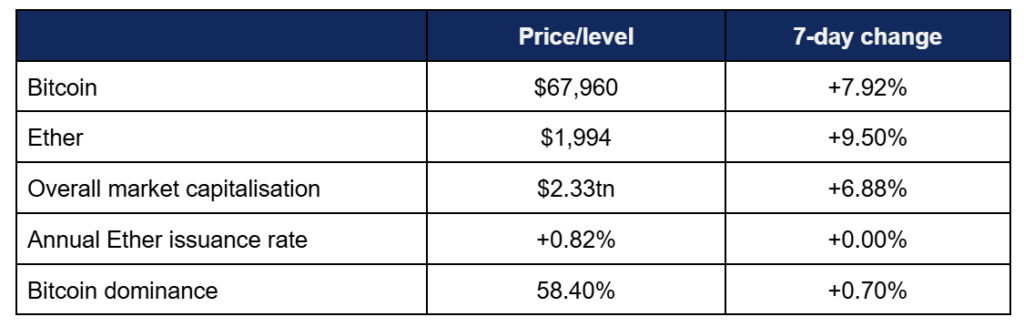
- Bitcoin bounced back, albeit after a sharp weekend decline following market concern around US and Israel escalating geopolitical tensions with a series of strikes on Iran
- Bitcoin increased from weekly lows of $62,920 last Tuesday to exceed $69,000 on Wednesday, before plunging back down as far as $63,390 in the aftermath of the Iran news
- However, this was followed by a recovery in recent trading, hitting weekly highs of $70,000 on Monday after markets settled
- In terms of direct news around the conflict, new concerns over possible insider trading on predictions markets were raised when large new Polymarket positions profited handsomely from the US actions, and digital asset outflows spiked 700% on Iran’s largest exchange in the day after the attack
- Ether grew from a Tuesday low of $1,823 and peaked at $2,111 on Wednesday, before following Bitcoin’s movements (including the swift upward surge on Monday)
- Overall market capitalisation recovered from an intraweek low of $2.2tn on Saturday
- According to industry monitoring site DeFi Llama, total value locked in DeFi increased in line with Ether’s recovery, to $94.8bn
Digital asset trading showed resilience amid geopolitical tensions, with the strongest inflows since early 2026. Institutional leaders like Morgan Stanley and Citi expanded crypto custody, Turkey formalised crypto taxes, and Barclays advanced blockchain payments, driving global adoption.
ETF News
What Happened?
- Digital asset investment products broke a five-week outflow streak, adding ten figures in overall inflows as investor sentiment seemed to recover
- According to Coinshares data published on Monday, the trading week ending Friday the 27th logged $1bn total inflows
- This featured a strong return to form from American funds, as well as a continuation of the recent inflow trend across Canada, Germany, and Switzerland
- Coinshares’ Head of Research James Butterfill refused to attribute a single catalyst for the shift in momentum, but wrote “prior price weakness, a break below key technical levels, and renewed accumulation by large Bitcoin holders appear to have contributed to the reversal. At a more anecdotal level, recent client discussions have been almost entirely focused on identifying entry points rather than reducing exposure to the asset class”
- Spot Bitcoin ETFs accounted for the vast majority of overall inflows, registering three consecutive midweek days of nine-figure inflows (between $254m and $507m) sandwiched by $204m outflows on Monday, and modest $28m outflows on Friday as the escalating US-Iran conflict led to some trader caution
- Wednesday was the most successful trading day of the week for funds, as the $507m inflows included $297m for BlackRock’s IBIT, and a near-unprecedented $103m for Grayscale’s 1.5% fee GBTC fund
- Usually, Grayscale’s mini-ETF, which features a tenth of the management fee outperforms the firm’s “heritage” fund in terms of inflows, but it still boasted a respectable $19m inflows that same day
- Other standout performances of the week included IBIT’s $276m inflows on Thursday, and Bitwise’s $69m the same day
- Bloomberg’s chief ETF analyst Eric Balchunas commented on the sudden shift in market momentum, tweeting “Half a bil[lion] into Bitcoin ETFs yesterday, biggest day in a while, +$750m over past two days, right as obituaries were being published”
- Early (but incomplete) reports on inflows yesterday indicated a return to inflows as markets digested the details of US strikes on Iran
- Spot Ether ETFs followed the same pattern of two outflow days bookending three days of inflows, but at much more modest levels and volumes, with daily outflows ranging between $43m and $50m, whilst inflows saw between $7m and $157m
- BlackRock’s market-leading ETHA fund actually experienced overall net outflows, as Fidelity’s FETH featured three days of eight-figure inflows between $26m and $62m
- Early reports on yesterday’s Ether ETF inflows also suggested a tentative return towards inflows
Stablecoin news
What Happened?
- Leading stablecoin issuer Tether confirmed Deloitte as auditors for its new USAT stablecoin designed for compliance with the US market’s GENIUS regulations
- Under the terms of the GENIUS Act, any stablecoins operating within the US market need to demonstrate full transparency and complete backing reserves for any tokens issued, to enable redemption for government money
- Partner bank Anchorage published a letter from Deloitte on its website, which noted that USAT holds $103,000 more in US Dollar backing assets than the total $17.5m value of USAT tokens in circulation
- This follows numerous previous claims by Tether that large accountancy firms avoided auditing crypto companies, creating greater uncertainty around the industry than deserved
- However, it should be noted that Tether themselves have born the brunt of scepticism around stablecoins, particularly as its dominant (and non-GENIUS-compliant) USDT has raised numerous concerns over its policy of publishing attestations, but not audits
- Tether also invested $200m in online marketplace Whop this week, in order to speed adoption of stablecoin payments
- Whop’s CEO said the deal represented a $1.6bn valuation for the company, and a press release indicated the funding would support expansion across Latin America, Europe, and the Asia-Pacific region
- Speaking of Asia-Pacific and stablecoin payments, Hong Kong stablecoin firm RedotPay is reportedly considering a $1bn US IPO, according to Bloomberg sources
- The sources say the company is collaborating with JP Morgan, Goldman Sachs, and Jefferies on the listing at a potential $4bn valuation, which follows nearly $200m of raises for the company in 2025
- In stablecoin-adjacent news, a recent US Senate Housing bill included a provision to bar the Federal Reserve from creating a CBDC, which the White House supported in a “Statement of Administration Policy”
- Generally-speaking, the Republican side of the aisle is opposed to any possibility of a CBDC, as such technology could potentially impinge on freedoms by monitoring or restricting spending
- Spanish news media reported that a coalition of 12 major European banks is pushing ahead with plans for a Euro-denominated stablecoin
- CincoDias wrote that the “Qivalis” consortium (comprising of Banca Sella, BBVA, BNP Paribas, CaixaBank, Danske Bank, DekaBank, DZ Bank, ING, KBC, Raiffeisen Bank International, SEB, and UniCredit) is targeting a commercial launch in the second half of the year
- Qivalis CEO Jan Sell calls the project “a regulated, domestic alternative to US dollar-denominated stablecoins”, backing up recent statements by ECB council member Joachim Nagel supporting the concept
- The Euro-pegged stablecoin will be backed by “a mix of bank deposits and high-quality short-term euro-area sovereign bonds”, and the banks are currently believed to be in discussions with crypto firms around ensuring liquidity
Crypto Treasury news
What Happened?
- Leading treasury firm Strategy added to its holdings made another major addition to its considerable holdings this week, purchasing 3,015 Bitcoin for approximately $204.1 million (or an average price of $67,700)
- Its total holdings are now 720,737 Bitcoin, acquired at an average price of just under $76,000
- The buys were funded by proceeds from at-the-market sales of its Class A common stock, MSTR, and perpetual Stretch preferred stock (STRC)
- Leading Ether treasury firm BitMine followed suit, spending $98m on new Ether purchases, pushing total holdings to 4.474 million Ether
- Chairman Thomas Lee wrote in the latest weekly press release that “In the midst of this ‘mini crypto winter,’ our focus continues to be on methodically executing our treasury strategy and steadily acquiring Ether and in turn, optimizing the yield on our Etherholdings”
- The company is currently staking around $6bn worth of Ether, allowing it to generate a return via validator rewards for helping to secure the network
What happened: Morgan Stanley applies for banking charter to custody crypto
How is this significant?
- After last week’s news about crypto firms applying for banking charters, there was a slight role reversal this week; an established banking giant applying for a crypto custody charter
- Banking giant Morgan Stanley is expanding its recent push into digital assets, following the filing of a de novo national trust bank charter application in order to enable it to hold digital assets
- In January, the company named Amy Oldenburg as its first head of digital asset strategy, alongside filings for various crypto ETFs, and providing access to the asset class for its ETrade customers
- According to its charter application, Morgan Stanley will “use the entity to conduct trading and facilitate staking for its investment clients”
- Another major bank to build on its crypto category involvement was Citibank, which has applied to custody Bitcoin
- Speaking at the World Strategy Forum, digital asset head Nisha Surendran stated that they “want to make Bitcoin bankable”
- “We will be offering our clients a single service model across crypto, securities and money… From a client perspective, all they should care about is that they instruct us. We handle all the clearing and settlement complexity, and then we report back”
- Surendran said the move was driven by client demand, and that the bank was building infrastructure allowing use of crypto assets for cross-margining
What happened: Turkey unveils 10% digital asset taxation plans
How is this significant?
- Turkey’s ruling AK Party recently introduced a bill to formalise digital asset taxation in the country, one of the biggest crypto markets in the region
- State news agency Anadolu Ajansı reported on the proposals, which would introduce a 10% tax on gains from trades on regulated exchanges, which could be adjusted anywhere from 0% to 20% within the regulation’s framework
- The bill also ties crypto concepts and terminology to the country’s existing Capital Markets Law
- Due to its history of hyperinflation, Turkey has been a fertile ground for digital asset adoption, with many citizens using crypto to hedge against fiat devaluation
- Last year, it led the MENA region, registering four times as much volume as the UAE, according to Chainalysis data
- In the Netherlands, legislators recently proposed a 36% tax on *unrealised* gains from crypto; this was met with a wide pushback amongst holders (particularly given the comparative volatility of many crypto assets), leading the country’s finance minister to state he would amend the rules
- Minister Eelco Heinen told RTL Nieuws “I don’t think the law can pass as it is… Something simply went wrong here, and the current law needs to be amended”
What happened: Barclays reportedly building blockchain payments and tokenisation platform
How is this significant?
- British banking behemoth Barclays is considering a bespoke blockchain solution for numerous financial functions, according to Bloomberg reports this week
- Sources told the publication that Barclays is sounding out technology providers to properly evaluate new offerings, with suppliers selected as soon as April
- Barclays’ services could potentially include stablecoin issuance and tokenised deposits, and builds on its existing presence within the UK’s multibank GBTD tokenised deposit solution
- This seems to indicate Barclays is adopting UBS’ “fast follower” strategy and echoing recent moves by the likes of JP Morgan and HSBC to introduce their own tokenised deposit services
- In other tokenisation news, real estate developer Grant Cardone announced plans to tokenise his $5bn property portfolio
- He stated this would provide investors “collateral and liquidity in the secondary markets”, making him the latest to declare plans to put buildings on blockchain; following fellow billionaire Barry Sternlicht and the Dubai Land Authority in separate initiatives last week
What happened: Jane Street sued by digital asset firm for alleged market manipulation
How is this significant?
- As part of the ongoing bankruptcy procedures around crypto developer Terraform Labs – which dramatically collapsed and catalysed 2022’s crypto winter following an algorithmic stablecoin depeg – administrators are suing trading giant Jane Street
- The market maker is where FTX founder Sam Bankman-Fried and several of the executives at his exchange cut their teeth in trading; and now administrators allege that Jane Street benefitted from inside trading
- According to the lawsuit, Jane Street shared secret chat groups with Terraform programmers and “used non-public information to front-run trading that hastened the collapse of Terraform… [unwinding] hundreds of millions of dollars in potential exposure at precisely the right time, mere hours before the Terraform ecosystem collapsed”
- Jane Street called the claims “baseless and opportunistic”, stating the downfall was entirely the result of behaviour from Terraform executives; lead developer Do Kwon was sentenced to 15 years in US jail in December 2025
- Meanwhile, a long-running class-action suit against decentralised exchange (DEX) Uniswap, brought in 2022, was fully dismissed this week
- Uniswap’s general counsel called it a “precedent-setting” decision for decentralised finance, as platforms cannot be sued for tokens listed by users
What happened: JP Morgan analysts predict crypto resurgence if market structure bill passes
How is this significant?
- In a new research note, JP Morgan analysts spoke positively on the potential of digital asset markets if the proposed CLARITY crypto market structure bill passes
- Analysis led by Managing Director Nikolaos Panigirtzoglou believe CLARITY could pass by mid-year, paving a bullish runway for the second half of 2026
- They wrote “If passed it will reshape market structure by providing regulatory clarity, ending ‘regulation by enforcement,’ promoting tokenisation, and facilitating greater institutional participation”
- Indeed, there have been some signs of institutional crypto interest rebounding, or even reaching new investor groups like endowments, according to discussions at the recent iConnections conference in Miami
- In total, JP Morgan listed eight positive catalysts if CLARITY passes, including; eased compliance burdens, grace periods, transition pathways from securities to commodities, promotion of tokenisation and more
- However, CLARITY passage remains an “if” at this stage, rather than a guarantee; rewards on stablecoins remained a major bone of contention between interests within the incumbent banking industry and upstart crypto newcomers, and the OCC recently moved to restrict US stablecoin rewards, potentially undermining “stablecoin as a service” platforms like Bridge and Anchorage
This weekly financial roundup is for informational purposes only and is not financial, investment, or legal advice. Information is based on public sources as of publication and may change. Consult a professional before acting.