Market Overview
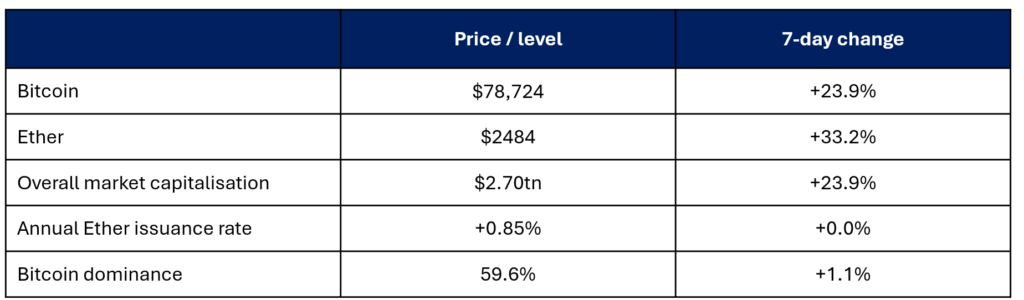
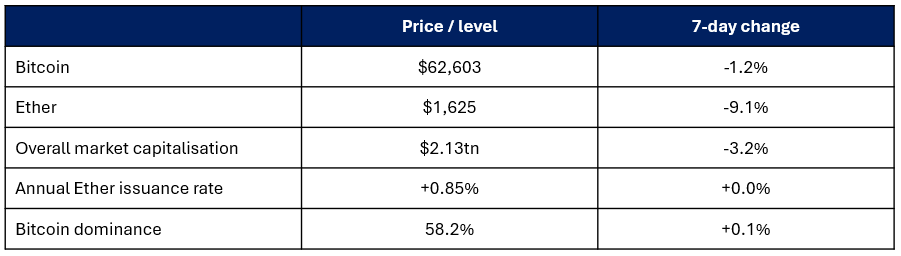
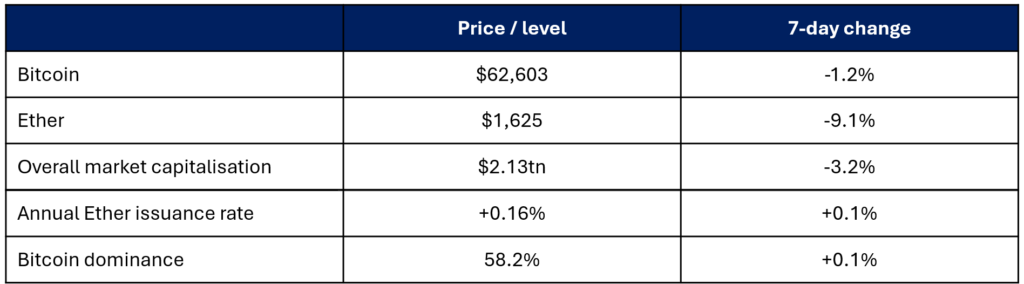
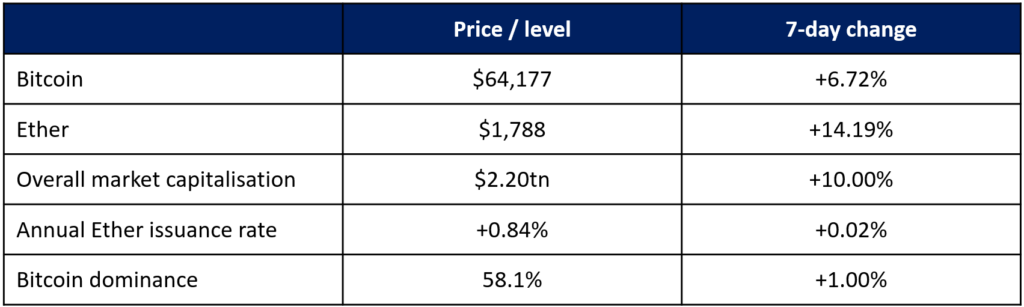
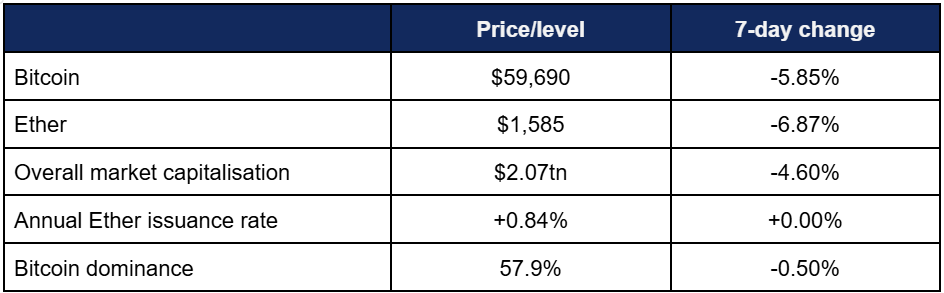
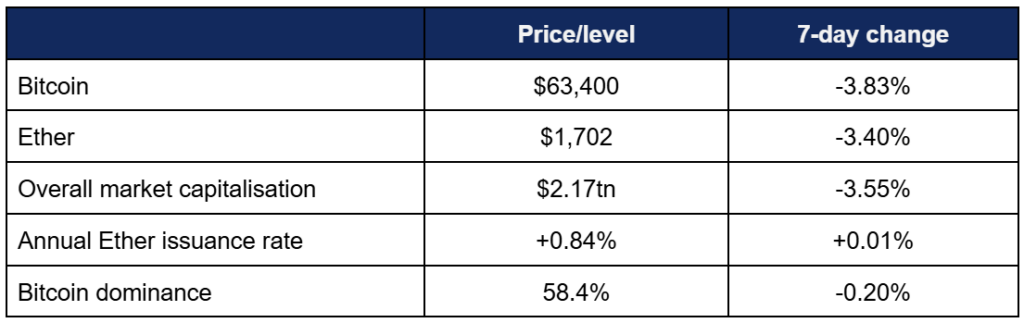
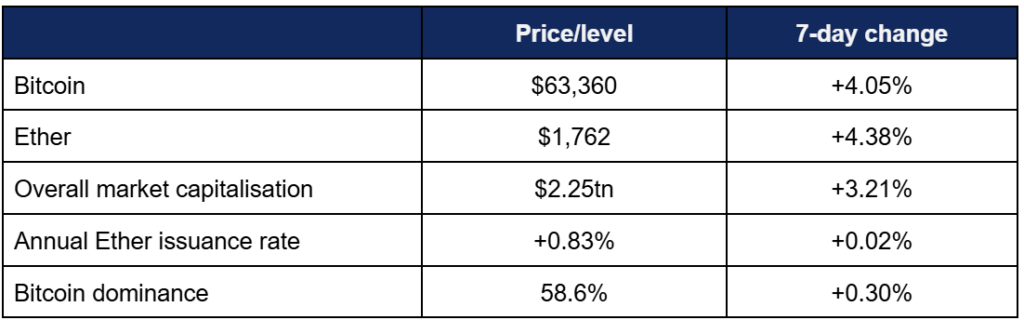
Digital assets experienced another week of growth, as Bitcoin hit a 12-week high amidst renewed optimism around the US-Iran war.

- Digital assets continued their recent bullish momentum, with Bitcoin nearing $80,000 as a fresh wave of optimism washed over investors regarding resolutions to the current Middle East conflict
- Bitcoin hit a 12-week high of $79,310 on Wednesday after a low of $74,870 on Tuesday, nearly matching the high again on Monday at $79,270
- It subsequently pulled back slightly amidst profit-taking as investors remain cautious
- Ether logged a slight decline on the weekly candle following a late pull-back, matching Bitcoin’s double-peak structure but falling further
- The second-largest digital asset also reached its weekly high ($2,420) on Wednesday, before falling to a low of $2,274 on Monday
- Despite two consecutive (minor) weekly losses, Ether remains well ahead over the last month, growing over 14% since late March
- Overall market capitalisation hit an intraweek high of $2.64tn, slightly ahead of last week’s highs
- Performance across the top 100 projects by market capitalisation was mixed, with a broadly-even split between weekly growth and losses
- According to industry monitoring site DeFi Llama, total value locked in DeFi pulled back further in the wake of recent exploits, dropping $3bn to $83.7bn
Digital assets continued their recent upward trajectory, with more strong performance across ETFs indicating continued investor enthusiasm, even after a major recent DeFi exploit potentially dampened institutional appetite for fully-decentralised protocols. Prediction markets and stablecoins continued their growth pattern, launching new products and services, whilst regulatory efforts progressed and a veteran VC kicked off its latest major raise across multiple funds.
Crypto Treasury news
What happened?
- Leading treasury firm Strategy executed another big Bitcoin buy, purchasing 3,273 Bitcoin for around $255.0 million at an average price of $77,906 per Bitcoin
- This brings the firm’s total holdings to 818,334 Bitcoin acquired at an average price of $75,537, which at current prices keeps the company back in profit on its holdings after several months underwater
- Meanwhile, leading Ether treasury firm BitMine announced plans to purchase 10,000 Ether directly from the Ethereum Foundation, in an effort to minimise price impact caused if the Foundation were to market sell
- The over-the-counter deal was confirmed by the Ethereum Foundation, with proceeds “supporting the organisation’s operations, including protocol research, ecosystem development and grants”
- In addition, the firm made its largest Ether purchase since December, adding 101,901 Ether to its holdings; an increase of about 300 Ether on the previous week’s substantial purchase
- BitMine CEO Thomas Lee wrote in the company’s weekly press release that the firm’s annualised staking revenues are now $264m, and that “Several recent research reports argue ETH is a ‘store of value’ and will be held as collateral as digital assets are increasingly used in financial transactions. This new role for ETH has arguably been demonstrated by its outperformance since the Iran War commenced. ETH has outperformed the S&P 500 by 1,696 basis points since the war started and remains the single best performing asset in the world (beside crude oil prices)”
ETF News
What happened?
- Digital asset investment products logged a fourth consecutive week of inflows, adding the most fresh capital since January
- According to CoinShares data published on Monday, crypto asset funds recorded an overall $1.2bn of inflows
- This included growth across eight different assets, compared with six the week prior
- Total AUM reached its highest levels since early February, and CoinShares head of research James Butterfill, believed that performance “reflects improving institutional demand against a backdrop of Bitcoin trading at its highest levels since early February. The market now turns to the FOMC decision on 28-29 April, which is likely contributing to caution at the margin”
- Spot Bitcoin ETFs showcased uninterrupted growth, with five consecutive positive trading days
- Inflows ranged between $12m and $336m, with three days in the nine-figure inflow range
- Overall inflows were largely driven by BlackRock’s IBIT; the only fund (apart from Morgan Stanley’s new ETF, at more modest levels) to return five consecutive growth days during the trading week
- Indeed, Fidelity’s second-placed FBTC experienced four negative days across the week – albeit at such low levels that its one day of inflows ($57m on Wednesday) more than cancelled them out
- IBIT accounted for the bulk of overall inflows, adding $257m, $247m, and $168m on Monday, Wednesday, and Thursday, against daily total inflows of $238m, $336m, and $223m respectively
- Bloomberg chief ETF analyst Eric Balchunas noted a return to form as “Bitcoin ETFs flows are (to quote Steve Winwood) back in the high life… every single rolling period we track is now positive, haven’t seen that in months (IBIT’s $3bn [year-to-date] is in Top 1% of all ETFs). Still though, need a couple bill more to get back to breaking new ground in cumulative lifetime flows ($62.8bn)”
- Spot Ether ETFs also had a strong week compared to historic average, returning four days of inflows versus one of outflows
- Inflows ranged between $23m and $96m, peaking on Wednesday
- BlackRock’s ETHA and ETHB [staking ETF], and Grayscale’s 0.15% fee mini-ETF were the week’s main winners, as most funds returned net zero overall flows
Stablecoin news
What happened?
- Stablecoins featured in reporting this week via both optimistic future projections, and actions anathema to some TradFi loyalists
- A new report by Juniper Research estimated that cross-border stablecoin transactions between businesses could reach $5tn by 2035
- That forecast represents more than 370-fold growth from current levels
- The firm estimates that by that timeframe, 85% of stablecoin transactions will be B2B rather than peer-to-peer, representing a drastic shift from current transaction patterns
- Analyst Jawad Jarhan noted “Stablecoins are not replacing payments infrastructure; they are being adopted where the advantages are most pronounced. Cross-border B2B is where those advantages are greatest, and where we expect the most sustained volume growth over the forecast period”
- Juniper added “Stablecoins are increasingly embedded in cross-border business-to-business transactions, treasury operations, and supply chain settlements, where their programmability and 24/7 settlement finality offers advantages over correspondent banking rails”
- Speaking on a recent earnings call, Western Union CEO Devin McGranahan confirmed that the 175-year old remittance giant plans to launch its Solana-based stablecoin next month
- However, it will be initially used as an internal improvement over legacy banking rails, rather than a customer-facing proposition
- McGranahan stated “We are not originally launching [USDPT] as consumer-facing. We are launching it as an alternative to the interbank SWIFT settlement network that we use today”
- He added the company is creating a Digital Asset Network allowing crypto wallet developers to offer Western Union as an off-ramp option
- He also said the company will release a Stable Card, allowing funds to be held in stablecoins and spent across card networks; “We expect to begin rolling this out across dozens of markets with an initial wave targeted for later this year”
- On the flip-side of the borderless transaction equation, leading stablecoin issuer Tether froze $344m of USDT linked to Iran’s central bank and IRGC
- In a blog post, Tether confirmed the action, noting a “zero-tolerance” policy towards criminal use of their “assets”, and stating “When wallets are identified as connected to sanctions evasion, criminal networks, or other illicit activity, Tether can move to restrict those assets. That work has become a routine part of the company’s response to lawful requests from authorities in the US and abroad”
What happened: DeFi protocol Aave recovers majority of losses from recent major exploit
How is this significant?
- Leading Defi protocol Aave recently suffered a major exploit – linked to the notorious North Korean Lazarus Group hackers – but has recovered the majority of the lost funds, following a concerted support effort across the DeFi spectrum
- The $292m attack was linked to Kelp DAO’s rsETH wrapped Ether token, via a cross-chain bridge, and severely undermined confidence in associated protocol Aave, leading to major withdrawals and a drop in total DeFi AUM during investor de-risking
- JP Morgan analysts warned that the history of exploits across DeFi protocols undermines institutional confidence in them, hamstringing future growth opportunities
- They wrote that DeFi’s ease of movement could render it uniquely vulnerable to contagion events; “The incident triggered outflows from pools with no direct exposure to the compromised asset, showing that DeFi’s interconnectedness can be a weakness during adverse events”
- JP Morgan claimed “This raises questions about the future of DeFi and whether DeFi can achieve the organic growth needed to support broader institutional adoption”
- However, the wider DeFi complex has rallied to support Aave, quickly raising amounts required to cover the bad debt of the protocol
- On Sunday, the newly-formed DeFi United group had raised $160m towards this goal, rising to $300m on Monday following support from stablecoin developer Circle Ventures, and Ethereum ecosystem firm Consensys
- Circle commented that “Strong DeFi infrastructure does not build itself. Aave is helping to shape the future of onchain finance, and we’re backing that ecosystem and the entire community built around it”
What happened: Prediction markets add perpetual crypto trading
How is this significant?
- Following recent news around fresh fundraising efforts, the burgeoning field of prediction markets continued to feature in reporting today as the two largest players rolled out new services and faced renewed scrutiny
- Kalshi and Polymarket, the two largest platforms, both announced a move towards perpetual crypto futures trading, representing Kalshi’s “first foray beyond the event contracts it offers on its prediction markets”
- The perpetual futures – i.e. derivatives with no expiration date – will allow users to speculate on the future value of a range of assets, ranging from crypto tokens to stocks and commodities
- According to Bloomberg sources, Kalshi will launch its offering with a focus on crypto assets, before expanding into other asset classes
- However, despite (or perhaps because of) their explosive growth, prediction markets are increasingly within regulatory crosshairs due to concerns over potential unregulated gambling and possibility to manipulate markets
- In Brazil, the government banned access to Polymarket and Kalshi, citing “illegal gambling” as the reason
- Finance minister Dario Durigan stated “We have advocated for stricter enforcement and very rigorous regulation, which will continue to advance, so that we can curb the negative externalities and social harm that unregulated gambling causes to the Brazilian population”
- Meanwhile, a US soldier who participated in the recent military action against Venezuelan president Maduro was arrested after earning $400,000 by betting on markets regarding that very event
What happened: White House crypto advisor teases significant Bitcoin reserve developments
How is this significant?
- A key member of the US administration’s digital asset advisory team dropped some hints last week indicating progress towards a planned national Bitcoin reserve
- Patrick Witt, executive director of the President’s Council of Advisors for Digital Assets, told the Bitcoin 2026 conference that they are working in earnest on converting the president’s Bitcoin Reserve executive order into reality
- He said “we’ve gone to work in figuring out exactly the machinations necessary and legal interpretations that we need to get that right and solidify that and protect the digital assets, specifically Bitcoin that we have on the government balance sheet”
- Witt indicated promising progress, sharing “So in the next few weeks, we’ll be making a big announcement. I think we have a bit of a breakthrough there, and obviously that needs to be followed up with legislation. In the meantime, we do believe we’re going to be able to take a big step forward from the executive branch side in the next few weeks”
- Speaking at the same conference, US rep. Nick Begich said he planned to resurrect his previous Bitcoin bill under a new name; the American Reserves Modernization Act (ARMA)
- He explained to attendees “Why the renaming – because it’s so important for people both in Congress and across the nation to understand what we’re actually trying to do. We’re trying to make sure that bitcoin is treated like the reserve asset that it is”
- In other regulatory news, Senator Cynthia Lummis indicated broad support for the CLARITY crypto market structure bill, tweeting “We have bipartisan support. We have the president’s support. This is our moment. Let’s get this done”
- However, Politico noted a roadblock – uncharacteristically from a Republican senator, Thom Tillis – over concerns around a lack of ethics language in the current bill, to prevent conflicts of interest
- As Tillis isn’t seeking re-election, this is viewed as a potential veiled criticism of president Trump, amidst reports of the Trump family enriching themselves via digital assets, and their involvement with the controversial World Liberty Financial DeFi project
- Elsewhere, market maker and trading firm Jane Street sought a dismissal of an insider trading suit regarding its involvement and alleged influence in a collapse of Terraform Labs, which catalysed 2022’s crypto winter
What happened: Blockchain Capital seeks $700m for two new funds
How is this significant?
- Major digital asset VC Blockchain Capital is gearing up for its latest funds, reportedly raising $700m for investments
- This includes the development of its seventh early-stage fund and second growth fund
- The industry veteran has a history including investments in category heavyweight like Coinbase, Kraken, and Tether
- According to Bloomberg sources, the VC “simultaneously raising for its seventh early-stage fund and its second growth fund, and has already begun to deploy some of the new capital”, with raises to wrap in five to six months
- Previous raises have totalled around $1bn for the firm, leading to an AUM including $2bn of fee-bearing assets and $6bn in portfolio value